
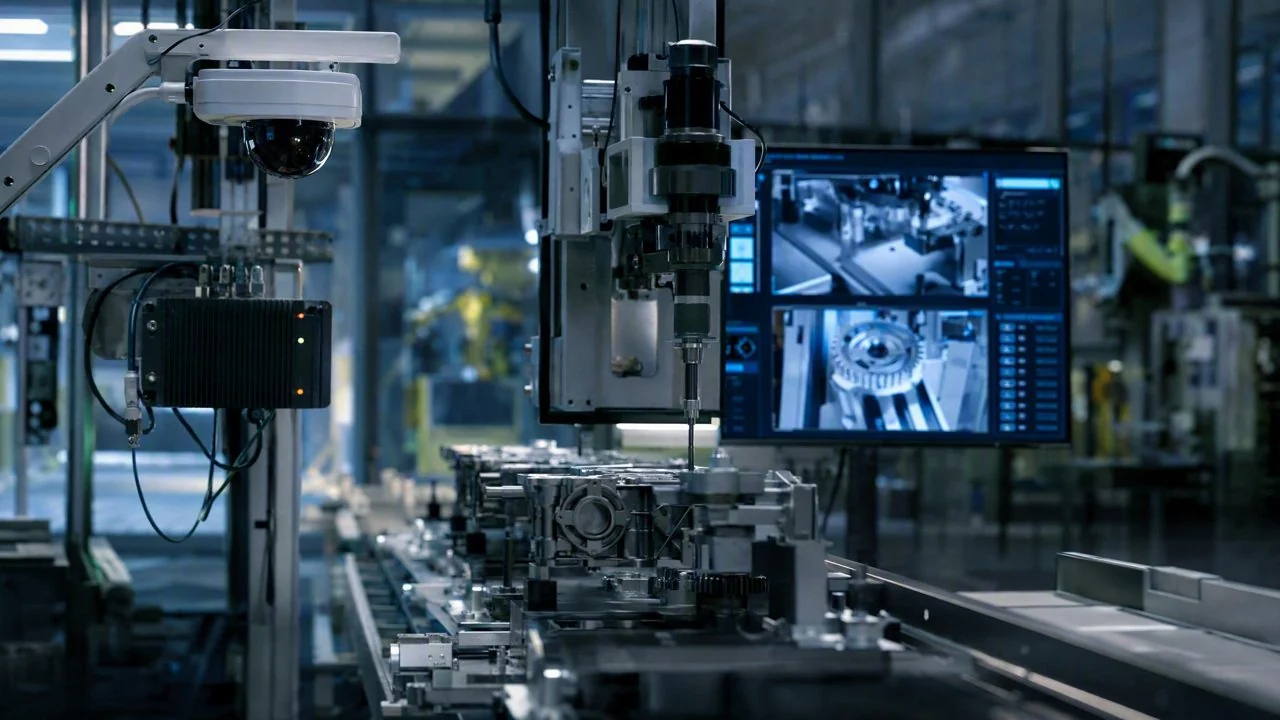
DaoAI SkyVision 0-code video surveillance AI platform, with its on-site hourly training of proprietary models, behavior/event recognition, edge box real-time alerting, 100% on-premise data security, and DaoAI World semantic understanding capabilities, successfully elevated the compliance detection rate of screw tightening actions from 85% with traditional solutions to over 99.5% for a leading automotive Tier-1 supplier's production line, reducing the missed detection rate by 78%.
In industrial production, screw tightening is a critical step in the assembly process, and its compliance directly impacts product structural stability, safety, and ultimate quality. Especially in high-value manufacturing sectors such as automotive components and precision instruments, any missed, stripped, under-torqued, or over-torqued screw can lead to severe product defects and even recall risks. Traditionally, compliance monitoring for screw tightening primarily relied on manual spot checks or rule-based vision systems. However, with accelerating production cycles and increasing product complexity, these solutions face significant challenges in terms of detection rate, missed detection reduction, adaptability, and cost-effectiveness. DaoAI SkyVision 0-code video surveillance AI platform, with its advanced AI vision analysis capabilities, provides an efficient and reliable solution for this pain point, significantly improving the compliance detection rate of screw tightening actions and substantially reducing the missed detection rate, thereby ensuring product quality and production efficiency.
Pain Points: Why This Hurdle Is So Difficult
The difficulty in monitoring screw tightening action compliance lies in its complexity and dynamism. Firstly, **high missed detection rates** are common: traditional manual inspections are limited by human fatigue, subjective judgment, and sampling methods, often resulting in missed detections of occasional, hidden non-compliant actions as high as 15% or more. Even with rule-based vision systems, it's challenging to cover all abnormal situations, leading to an average missed detection rate still hovering around 5-8%. Secondly, **false alarm rates are difficult to control**: due to factors such as lighting variations, personnel movement, hand occlusion, and tool model differences, rule-based vision systems are highly prone to false alarms, causing frequent production line stoppages and non-value-added re-inspection labor accounting for 30-40% of total time. This not only reduces production efficiency but also increases manual verification costs. Finally, **lack of flexibility and adaptability**: when product models are updated, workstation layouts are adjusted, or tools are replaced, traditional rule-based vision systems require days or even weeks for rule rewriting and debugging, leading to long changeover downtime, severely impacting production rhythm and flexible manufacturing capabilities.
From a process perspective, judging screw tightening action compliance involves multiple dimensions: whether the correct tool was used, whether it was tightened with the correct posture, whether the tightening action was completed, and whether the tightening sequence was correct. These behavioral features appear as continuous, subtle action sequences in video streams, which are difficult for traditional image processing methods to effectively capture and recognize. Furthermore, differences in operator habits, tool reflections, background interference, and other imaging challenges further exacerbate the recognition difficulty. In the current trend of AI video surveillance analysis improving operational efficiency and generating revenue, addressing these pain points is crucial for enterprises to enhance their core competitiveness.
Technical Principles
DaoAI SkyVision platform fundamentally transforms screw tightening compliance monitoring through its core deep learning and behavior recognition algorithms. The platform's key mechanism is its **0-code video surveillance AI platform** feature, allowing users to rapidly train proprietary models on-site within hours. Specifically, it utilizes continuous frame sequences from video streams, extracting spatial features via Convolutional Neural Networks (CNNs) and combining them with Recurrent Neural Networks (RNNs) or Transformer architectures to capture temporal action sequence characteristics. The DaoAI World model, serving as a unified foundation, endows the platform with powerful semantic understanding and cross-scenario generalization capabilities, enabling it to comprehend the deeper meaning of 'tightening action' beyond mere pixel changes. By learning from a large volume of video data of both normal and abnormal tightening actions, SkyVision can build highly robust behavior recognition models that accurately determine compliance even under complex and variable lighting and background conditions.
Compared to traditional methods, DaoAI SkyVision offers significant advantages. Traditional rule-based AOI relies on engineers manually writing complex rule sets, such as pixel change thresholds within specific regions or color recognition, which have poor adaptability to subtle action differences and environmental changes, leading to high false alarm and missed detection rates. Manual visual inspection, on the other hand, relies entirely on operator experience, is inefficient, and susceptible to subjective factors. SkyVision, however, uses data-driven machine learning to autonomously learn and extract the inherent patterns of screw tightening actions, eliminating the need for manual rule writing, thereby greatly enhancing the system's intelligence and accuracy. Its **edge box real-time alerting** feature triggers alarms within milliseconds of detecting non-compliant behavior, far exceeding human reaction speed, and its **100% on-premise data security** deployment ensures the security and privacy of industrial data, meeting strict compliance requirements.
Typical Application Scenarios
- **Missed and Under-Torqued Screw Detection**: At multi-screw assembly stations, DaoAI SkyVision can accurately identify whether each pre-set screw hole has completed the tightening action and judge if the tightening depth meets the standard, preventing product loosening due to missed or under-torqued screws. The challenge lies in precise recognition when multiple screws are operated simultaneously or obscured by hands.
- **Stripped and Over-Torqued Screw Behavior Recognition**: By analyzing abnormal shaking of the operator's hand or tool, combined with torque sensor data (if integrated) and the relative motion trajectory of the tool and screw in the video stream, the system identifies abnormal operating behaviors that could lead to stripped or over-torqued screws. The challenge is capturing microsecond-level abnormal action features.
- **Screw Tightening Sequence Compliance Monitoring**: For complex components with strict tightening sequence requirements, the platform can real-time monitor whether the operator follows the pre-set process and sequence for screw tightening, ensuring the rigor of the assembly process. The challenge is simultaneously tracking multiple screw points and their operation timestamps.
- **Tool Usage Compliance and Poka-Yoke**: Identify whether the operator uses the correct tightening tool (e.g., torque wrench, electric screwdriver) to prevent screw damage or improper assembly due to incorrect tool usage. The challenge lies in the high similarity of different tool appearances and potential angle occlusions.
Implementation Case Study
A leading automotive Tier-1 supplier, producing high-performance engine components, had extremely high requirements for screw tightening compliance. Previously, this production line primarily relied on manual spot checks and some rule-based vision systems for monitoring screw tightening actions. Manual spot checks had a missed detection rate of approximately 15%, while rule-based vision systems, although able to identify some obvious issues, still had a missed detection rate of 6-8% for subtle behaviors such as operating posture and tool usage norms, with a high false alarm rate requiring 10-15 manual re-inspections per hour, severely impacting production efficiency. To address this pain point, the supplier introduced the DaoAI SkyVision platform.
During implementation, DaoAI's engineering team deployed multiple high-definition industrial cameras on the production line and utilized SkyVision's 0-code training platform to complete custom model training for the specific screw tightening actions on that line in less than 4 hours. The model covered various compliant and non-compliant behavior patterns, including standard tightening, under-torquing, and incorrect tool usage. After system launch, real-time video stream analysis was performed via edge boxes, and upon detecting non-compliant actions, an alarm was immediately triggered through sound, light, and the SCADA system. After one month of trial operation, the DaoAI SkyVision platform elevated the **compliance detection rate of screw tightening actions to over 99.5%**, successfully **reducing the missed detection rate by 78% (from 6.5% to <1.4%)**, while also reducing the false alarm rate by 65%, bringing down manual re-inspections per hour to 3-5 times. This not only significantly improved product quality stability but also substantially reduced rework and after-sales costs due to quality issues, achieving considerable economic benefits.
"The DaoAI SkyVision platform allowed us to achieve 100% online monitoring of screw tightening actions for the first time. Its high detection rate and low missed detection rate completely resolved our long-standing quality pain points and significantly reduced operating costs."
DaoAI Solution and Products
The DaoAI SkyVision platform is at the core of this solution. Its powerful **0-code video surveillance AI platform** feature enables non-specialized production line engineers to quickly get started, training high-performance, exclusive AI models within hours on-site using simple drag-and-drop operations and a small number of video samples. This greatly shortens deployment cycles and costs, enabling rapid iteration and flexible production. The platform supports various industrial camera inputs, with local deployment via edge boxes, ensuring data remains within the factory, meeting strict data security and privacy requirements. The DaoAI World model, as the underlying technology, provides the SkyVision platform with exceptional generalization capabilities and robustness, allowing it to adapt to subtle differences across various workstations, shifts, and operators, ensuring high-precision recognition. Furthermore, the platform can be integrated into existing MES/SCADA systems, enabling data interoperability and automated management of production processes. For instance, upon detecting non-compliant behavior, the system can automatically record time, location, operator information, and trigger corresponding quality traceability processes, forming a data closed loop to further optimize production processes.
Through the DaoAI SkyVision platform, the client achieved an **increase in screw tightening action compliance detection rate to over 99.5%** and a **reduction in missed detection rate by 78%**. The direct business values include: significantly improved product quality stability, a 70% reduction in rework rate due to screw tightening issues, and a 50% reduction in after-sales repair costs. Concurrently, with a 65% reduction in false alarm rates, manual re-inspection labor hours were saved by 60%, greatly enhancing overall production line operational efficiency and automation. These quantified achievements not only boosted the client's market competitiveness but also brought tangible economic returns to the enterprise, fully demonstrating the immense potential of AI video surveillance analysis in improving operational efficiency and generating revenue.
FAQ
How does the SkyVision platform ensure the security and privacy of industrial production data?
DaoAI SkyVision platform supports 100% on-premise deployment. All video data and model training are conducted within the client's private environment, ensuring data never leaves the facility. Real-time analysis and alerts are performed via edge boxes, keeping data within the enterprise's closed loop, which complies with strict industrial data security and privacy protection standards, effectively mitigating data leakage risks.
What are the core advantages of SkyVision in screw tightening monitoring compared to traditional rule-based vision systems?
SkyVision's core advantages lie in its deep learning-based AI behavior recognition capabilities and its 0-code training platform. Traditional rule-based systems require engineers to manually write complex rules, struggling to adapt to complex and variable environments and subtle action differences, leading to high false and missed detection rates. SkyVision, by learning from extensive real-world data, autonomously identifies complex behavior patterns, significantly improving detection rates and reducing missed detections, while also greatly lowering the threshold and cost of model development and maintenance, enabling hourly rapid deployment and iteration.
What is the cost of deploying the DaoAI SkyVision platform, and what are the main influencing factors?
Deployment costs are primarily influenced by factors such as the number of cameras, edge computing hardware configuration, AI model training complexity, and the depth of integration with existing systems. DaoAI offers flexible licensing models, and the 0-code training feature significantly reduces long-term maintenance and iteration labor costs. We recommend scheduling an expert consultation to obtain a customized quote based on your specific production line conditions and requirements, to evaluate the total cost of ownership and return on investment.
Full solution for this scenario: the full inspection solution for Video Surveillance
This article was generated by AI. Customer cases are simulated scenarios based on real product capabilities and figures are illustrative; see product pages for official benchmarks.