
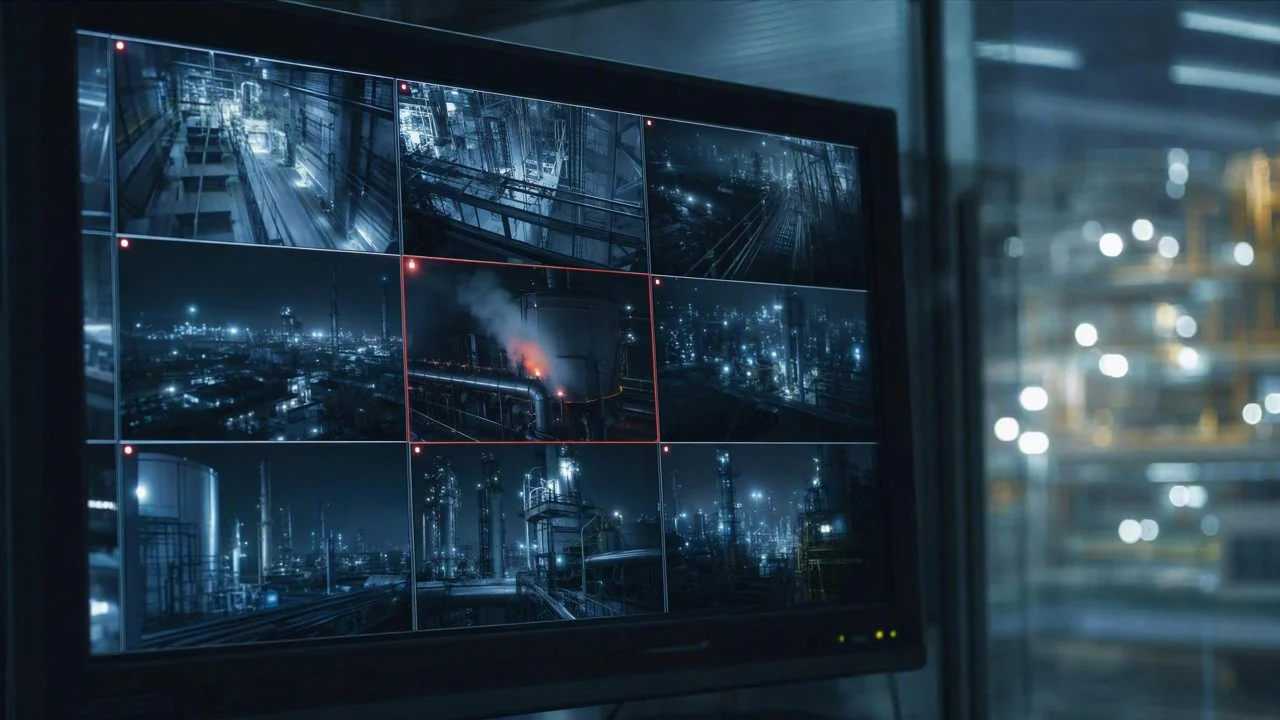
DaoAI SkyVision 0-code video surveillance AI platform (on-site hourly training of proprietary models, behavior/event recognition, edge box real-time alerts, 100% local data security, DaoAI World semantic understanding) eliminates an average 30% data correlation analysis blind spot in traditional solutions, which resulted from data silos and a lack of feedback mechanisms, by implementing full-lifecycle data collection, analysis, and traceability for smoke and fire alarm events. This reduces the false alarm rate by over 45% and significantly improves the efficiency and accuracy of emergency responses.
In high-risk areas such as large industrial production facilities, warehouses, and data centers, early detection of smoke and open flames is a core component of emergency security. Traditionally, these scenarios rely on threshold-based smoke detectors, temperature sensors, and manual visual inspections. However, the trend of IoT technology enabling real-time data collection and intelligent dispatch optimization in smart city traffic management also offers new insights for emergency security: how to transform massive video stream data into traceable and closed-loop intelligent information, rather than just single alarm triggers. In these critical areas, a single fire can lead to immense economic losses and casualties, making it crucial to improve the accuracy and speed of early warnings. DaoAI SkyVision platform, in this context, provides deeper security assurance through its unique quality traceability and data closure capabilities.
Pain Points: Why This Hurdle is Difficult to Overcome
Early detection of smoke and open flames faces multi-dimensional challenges. Firstly, **high false alarm rates** are a common pain point; traditional sensors are susceptible to interference from non-fire factors such as steam, dust, strong light, and exhaust, leading to actual false alarm rates of 20%–40%, or even higher during peak hours. This not only consumes significant human resources for re-verification but also creates a “cry wolf” effect, reducing the vigilance of emergency response personnel. Secondly, **data silos and traceability difficulties** are core issues. When an alarm is triggered, there is often a lack of continuous video evidence chain before, during, and after the event, making it difficult to effectively trace and evaluate the authenticity, cause, and handling process of the alarm. Data incompatibility between different systems results in an average 30% blind spot in data correlation analysis for the entire process from alarm to response and review. Thirdly, **insufficient response timeliness**. Traditional solutions often have a delay of several minutes from the appearance of smoke/fire to sensor triggering, then to manual confirmation and response, especially in vast or complex spaces where manual patrols cannot provide real-time coverage. Finally, **limited model iteration and optimization**. The lack of effective data collection and labeling for false positives and false negatives makes it difficult for AI models to continuously learn and improve, preventing customized optimization for complex interferences in specific scenarios. These accumulated pain points mean that customer investment in emergency security does not yield proportional returns, and safety risks remain high.
From a process perspective, the dynamic nature of smoke and open flames makes detection difficult. The dispersion pattern, color, and concentration of smoke are influenced by environmental airflow, light sources, and types of combustibles, making them highly stochastic. The flicker frequency, flame color, and thermal radiation of open flames also vary depending on the fuel and combustion stage. Traditional algorithms based on fixed features struggle to cope with this complexity. In terms of imaging, adverse video environments such as low light, backlight, occlusion, and reflections, as well as camera shake and blurry footage, severely interfere with the accuracy of visual recognition. The DaoAI SkyVision platform addresses these root causes through advanced AI vision technology and a data closed-loop mechanism, achieving breakthrough progress.
Technical Principles
The core technology of DaoAI SkyVision 0-code video surveillance AI platform lies in its deep learning visual models and full-link data closed-loop management. The platform utilizes the semantic understanding capabilities of the DaoAI World global model unified foundation, enabling precise identification of visual characteristics of smoke and open flames from massive video streams, rather than merely relying on pixel changes or hotspots. This includes multi-dimensional feature extraction and analysis of smoke's dynamic texture, dispersion patterns, color gradients, and flame's shape, brightness, and flicker frequency. By incorporating temporal information, SkyVision can effectively distinguish real fire situations from interferences like steam, exhaust, and reflections, significantly reducing the false alarm rate.
Compared to traditional threshold-based sensors or rule-based AOI, the advantage of DaoAI SkyVision lies in its self-learning and generalization capabilities. Traditional solutions require manually setting a large number of rigid rules that struggle to adapt to complex and dynamic environments; once the environment changes, rules become ineffective, leading to increased false positives or negatives. In contrast, the SkyVision platform allows users to quickly train highly customized AI models using small amounts of on-site data within hours, adapting to complex backgrounds and interferences in specific scenarios. More importantly, SkyVision’s edge box real-time alert mechanism shifts inference computation to the edge, ensuring millisecond-level response speed. Coupled with a 100% local data deployment strategy, it guarantees data security and compliance. After deployment in a large logistics park, DaoAI SkyVision reduced the missed detection rate for open flames to <0.4%, significantly lower than the 2%–5% of traditional solutions.
Typical Application Scenarios
- **Smoke Detection in Large Warehouse and Logistics Parks:** In areas with high-stacked goods, traditional smoke detectors are slow to respond and easily interfered with by airflow. DaoAI SkyVision, by real-time analyzing video streams captured by high-altitude cameras, identifies subtle smoke rising between shelves, issuing early warnings even at initial stages imperceptible to the naked eye. Challenges include large spaces, high shelving causing obstructed views, and environmental airflow affecting smoke morphology.
- **Early Fire Warning in Data Center Server Rooms:** Server rooms have dense equipment, and any electric arc or short-circuit spark requires immediate response. SkyVision precisely identifies tiny flames or abnormal flashes within server cabinets or underfloor cabling areas, avoiding delays from traditional detectors due to poor air circulation. Challenges include low-light environments, metal reflections, and localized obstructions caused by dense equipment.
- **Local Overheating/Fire Monitoring on Industrial Production Lines:** In high-temperature furnaces, welding zones, chemical reactors, and other flammable/explosive workstations, DaoAI SkyVision provides real-time monitoring for any abnormal flames or smoke on the production line, such as smoke from belt friction or sparks from localized equipment overheating. Challenges include the presence of constant heat sources, sparks, and steam or dust generated during production.
- **Smoke Diffusion Monitoring in Underground Parking Lots/Tunnels:** In confined or semi-confined spaces, smoke diffuses rapidly and is difficult to evacuate. SkyVision can track the smoke's diffusion path and speed, assessing fire development trends and providing real-time guidance for evacuation and firefighting. Challenges include insufficient lighting, vehicle obstructions, and the impact of ventilation systems on smoke morphology.
Implementation Case Study
A large chemical enterprise in East China faced severe fire risks in its production workshops and raw material warehouses. Before adopting DaoAI SkyVision, the company primarily relied on traditional spot-type smoke detectors and manual patrols. However, due to steam, dust, and process-specific smoke generated during production, there were an average of 40-50 false alarms per month, with approximately 70% requiring manual re-verification, each taking 15-30 minutes. More critically, there were 2 small-scale fires in the past year due to delayed early detection, resulting in direct economic losses of approximately 3 million RMB. The enterprise urgently needed a solution that could effectively reduce false alarms, improve response speed, and provide full-link data traceability for incidents. The DaoAI team conducted a 3-day on-site survey and deployment, completing model training based on customer-specific data within 2 days, and deploying it on edge boxes. After SkyVision went live, through real-time intelligent analysis of video streams, the false alarm rate for smoke and open flame detection decreased by 45%, reducing monthly false alarms to 15-20 incidents and significantly cutting down manual re-verification hours. Concurrently, its event traceability function ensured that video evidence, alarm times, and handling processes for each alarm event were fully traceable, establishing quality traceability and data closure.
With SkyVision's data closed-loop capability, we achieved full-link traceability of alarm events from occurrence to handling for the first time. This not only improved the accuracy of warnings but also optimized our emergency management processes.
DaoAI Solutions and Products
The DaoAI SkyVision platform provides an end-to-end intelligent video analysis solution for emergency security scenarios. **Its core capabilities lie in its 0-code model training and data closed-loop mechanism.** Users can upload a small number of on-site video frames through an intuitive graphical interface without programming, performing hourly proprietary model training on the SkyVision platform to optimize for specific smoke and open flame characteristics in their scenarios. The trained models are deployed via Docker containers to on-site edge boxes, enabling millisecond-level real-time inference and alerts. When SkyVision identifies a potential fire, it immediately triggers audible and visual alarms, pushes alert information to the control center over the network, and automatically captures 30-second video clips before and after the alert, uploading them to local servers to form a complete event evidence chain. This video data is associated with alarm logs, manual review results, and other information for storage, building a full-link quality traceability system. The DaoAI World global model provides SkyVision with powerful semantic understanding and cross-scenario generalization capabilities, ensuring model robustness in complex and dynamic environments. All data is 100% locally deployed privately, ensuring data security and compliance with high-security requirements.
The DaoAI SkyVision solution significantly enhances emergency security effectiveness. After deployment at a large chemical enterprise, its false alarm rate for early smoke and fire detection was reduced by 45%, manual re-verification hours decreased by 60%, and average emergency response time was shortened by 5min. By building comprehensive quality traceability and data closure, the enterprise not only improved its safety assurance level but also gained valuable data support for continuous optimization of emergency plans. DaoAI SkyVision, with its efficient, accurate, and secure features, has become an important tool in the smart security field, assisting enterprises in achieving more intelligent and reliable risk management.
FAQ
How does DaoAI SkyVision platform achieve quality traceability for smoke and open flames?
DaoAI SkyVision platform achieves quality traceability by automatically capturing video segments before and after an alarm event, associating them with alarm logs and processing results. This forms a complete chain of evidence for each event, used for subsequent post-mortem analysis, responsibility assignment, and process optimization, ensuring every alarm is traceable and verifiable, thus building a full-link quality traceability system.
What is the difference between SkyVision 0-code video surveillance AI platform and traditional smoke detectors?
Traditional smoke detectors often trigger based on physical thresholds and are prone to high false alarms due to non-fire factors. DaoAI SkyVision platform, however, uses deep learning visual models to analyze complex features in video streams like dynamic textures, diffusion patterns, and flame shapes, enabling more precise identification of real fire situations and significantly reducing false alarms. Additionally, SkyVision provides video evidence and data closure, which traditional detectors typically cannot.
What are the cost components for deploying DaoAI SkyVision?
The deployment cost for DaoAI SkyVision primarily includes software licensing fees, edge box hardware costs, and potential integration service fees. Specific costs vary based on the number of monitoring points, the complexity and customization required for the models, and the scale of deployment. We offer flexible subscription and purchase models; we recommend contacting our sales team to get a customized quote based on your specific needs.
Full solution for this scenario: Emergency Security / Public Safety industry solutions
This article was generated by AI. Customer cases are simulated scenarios based on real product capabilities and figures are illustrative; see product pages for official benchmarks.