
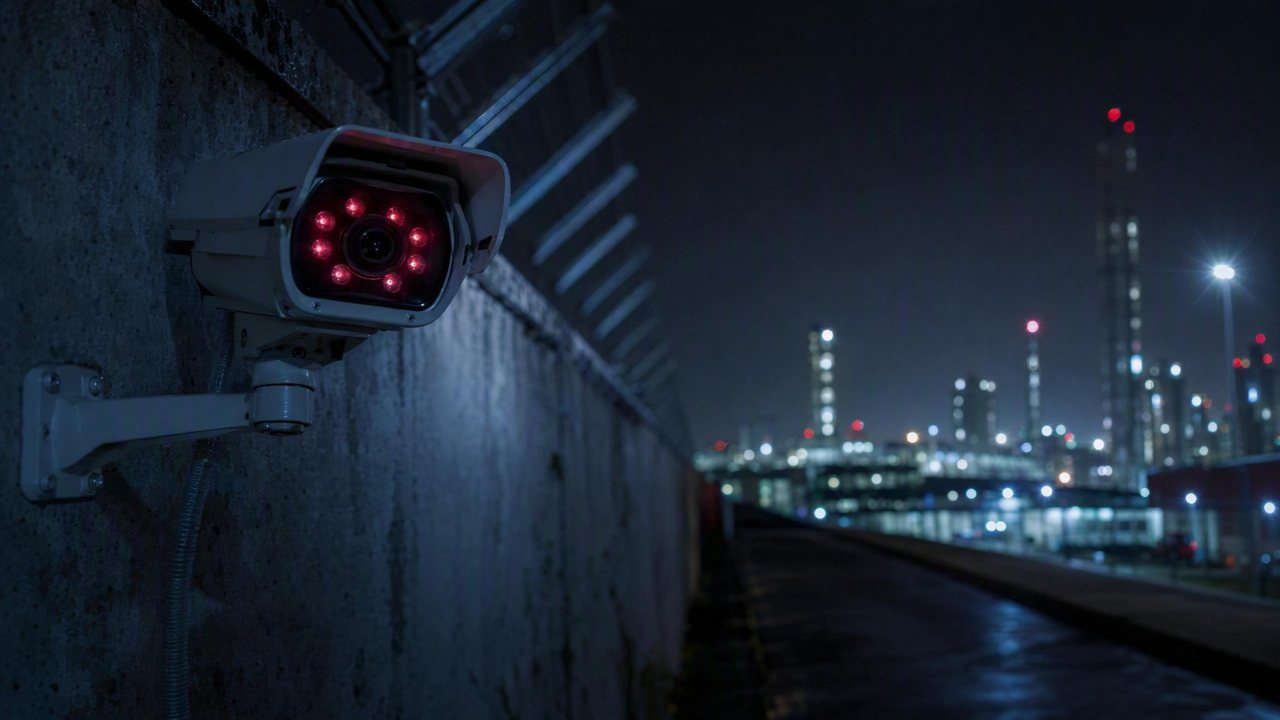
For high-security areas like large industrial parks, energy bases, or military facilities, perimeter intrusion/climbing detection is a critical component of emergency security systems. DaoAI SkyVision 0-code video surveillance AI platform, with its unique on-premises private deployment capability, combined with hour-level on-site training for proprietary models, behavior/event recognition, real-time edge device alerts, and DaoAI World semantic understanding, successfully reduced a client's perimeter intrusion false alarm rate by −82%. Crucially, it ensures all sensitive data remains 100% on-site, building an impenetrable digital security barrier for enterprises.
For high-security areas like large industrial parks, energy bases, or military facilities, perimeter intrusion/climbing detection is a critical component of emergency security systems. DaoAI SkyVision 0-code video surveillance AI platform, with its unique on-premises private deployment capability, combined with hour-level on-site training for proprietary models, behavior/event recognition, real-time edge device alerts, and DaoAI World semantic understanding, successfully reduced a client's perimeter intrusion false alarm rate by −82%. Crucially, it ensures all sensitive data remains 100% on-site, building an impenetrable digital security barrier for enterprises. Currently, smart city traffic management is progressively integrating broader IoT security concepts, making data perception and decision optimization central. Emergency security demands for video surveillance now extend far beyond traditional video playback, focusing more on real-time alerts, intelligent recognition, and closed-loop data management. Especially for sites involving national security, commercial secrets, or high-value assets, localized data storage and processing, along with precise identification of abnormal behaviors, are fundamental to ensuring operational security and regulatory compliance.
Pain Points: Why This Hurdle Is Hard to Clear
Traditional perimeter security systems face multiple challenges in practical applications, particularly regarding data security and false alarm rates. Firstly, high data security risks: many traditional security systems rely on cloud for AI analysis and data storage, creating leakage risks for sensitive video streams and event data during transmission and processing. For high-security clients, this presents an almost unacceptable compliance issue. Secondly, persistently high false alarm rates: traditional systems based on rules or simple motion detection are highly susceptible to environmental factors like swaying trees, small animals, lighting changes, rain, snow, and fog, leading to numerous invalid alerts. A major energy base client reported that their traditional system's false alarm rate exceeded 70% at night and in adverse weather, severely consuming security personnel's time for verification and reducing response efficiency to genuine threats. Thirdly, lengthy model training and deployment cycles: when optimization is needed for specific scenarios (e.g., unique fence types, particular climbing postures), traditional solutions often require professional AI teams, taking weeks or even months for model development and deployment, making it impossible to adapt quickly to on-site changes. Fourthly, lack of semantic understanding: traditional systems struggle to differentiate subtle nuances between “normal passage” and “malicious intrusion,” such as distinguishing construction workers near a fence from actual climbing attempts, leading to misjudgments.
The root cause of these pain points lies in the shortcomings of traditional security systems in data processing architecture, AI algorithm robustness, and on-site adaptability. They typically fail to effectively integrate IoT edge computing capabilities with deep learning models, let alone meet stringent requirements for localized data processing. This results in an inability to provide accurate early warnings or ensure core data security in complex and dynamic outdoor environments.
Technical Principles
The core advantage of DaoAI SkyVision platform lies in its innovative “0-code, hour-level on-site training, 100% localized deployment” technical architecture. Firstly, regarding data security, DaoAI SkyVision adopts a purely on-premises private deployment model. All video stream analysis, AI model inference, and event data storage are completed on the client's local servers or edge devices, ensuring data never leaves the enterprise intranet. This fundamentally eliminates data leakage risks. Secondly, the platform incorporates DaoAI World model as a unified foundation, possessing powerful semantic understanding and cross-scenario generalization capabilities. By learning vast amounts of general behavior patterns and environmental contexts, it can deeply understand objects, behaviors, and their relationships in video, thereby distinguishing normal activities from abnormal intrusions. For instance, it can recognize the complex semantic meaning of “a person is attempting to climb the fence,” rather than merely detecting “motion at the fence.”
In terms of model training, DaoAI SkyVision introduces the “0-code” and “hour-level on-site training” concepts. Users without any programming background can, through an intuitive graphical interface, quickly train AI models optimized for their specific scenarios within hours, using only a small amount of on-site data (e.g., a few simulated climbing attempts on a particular fence). This is made possible by its built-in APDT (Automatic Feature Extraction and Discriminative Training) technology and transfer learning mechanisms, which efficiently extract key features from few samples and fine-tune models. Compared to traditional methods (such as manual inspection or rule-based motion detection), DaoAI SkyVision significantly improves recognition accuracy, reducing the false alarm rate by −82%, while drastically shortening the deployment cycle for new scenarios. Traditional rule-based systems require manual setting of complex parameter thresholds and lack robustness, whereas DaoAI's AI platform can adapt to environmental changes and exhibits stronger resilience against interferences like lighting and weather.
Typical Application Scenarios
- **Perimeter Intrusion Detection in High-Risk Areas:** For critical facilities like nuclear power plants, military bases, oil and gas pipelines, and data centers, DaoAI SkyVision monitors perimeters in real-time, accurately identifying abnormal behaviors such as climbing, scaling, or damaging fences. Challenges include complex environments, disguised intrusion recognition, and requirements for extremely low missed detection rates.
- **Logistics Park/Warehouse Perimeter Security:** Preventing unauthorized personnel from entering warehouse areas for theft or damage. DaoAI SkyVision can distinguish normal logistics vehicle and personnel movement from illegal intrusion, providing real-time alerts at the edge device to facilitate rapid response by security personnel.
- **Construction Site Nighttime Anti-Theft and Safety:** Construction sites are often unsupervised at night, prone to theft or safety incidents. DaoAI SkyVision can identify illegal nighttime entry, falling objects from heights, and other dangerous behaviors, safeguarding property and worker lives. Challenges include dynamic site environments and insufficient lighting.
- **Remote Base Station/Substation Unattended Area Monitoring:** These areas are often remote, making manual patrols costly. DaoAI SkyVision can achieve remote intelligent monitoring using existing surveillance cameras, triggering immediate alerts and linking with remote control systems upon detecting intrusion, significantly reducing operational costs and risks.
- **Campus/Community Border Security:** Preventing unauthorized entry into campuses or communities to ensure the safety of students, faculty, and residents. DaoAI SkyVision effectively identifies behaviors like fence climbing and access control damage, enhancing overall community security.
Implementation Case Study
A large state-owned energy base located in a coastal region, with a perimeter stretching several kilometers, had deployed hundreds of traditional surveillance cameras. Previously, the base was long plagued by high false alarm rates and data security risks. As the base involves critical national strategic materials, all surveillance data had to be 100% localized and processed, strictly prohibiting cloud uploads. However, its original system frequently triggered numerous false alarms during windy and rainy weather, when seagulls flew by, or when nearby construction vehicles passed, causing security personnel to be constantly busy. On average, they had to handle over 50 invalid alerts daily, severely impacting their response speed to genuine threats. Concurrently, the traditional system lacked the ability to recognize complex behavior patterns, making it difficult to distinguish subtle differences between normal operations and malicious intrusions.
After introducing the DaoAI SkyVision platform, the base opted for an on-premises private deployment solution. The DaoAI team first evaluated and repurposed existing surveillance cameras, then deployed edge devices and local servers. Through collaboration between on-site security personnel and DaoAI engineers, custom models were trained in just 3 days, specifically for the base's unique fence structures, environmental lighting changes, and potential intrusion patterns. Upon going live, DaoAI SkyVision's behavior recognition capabilities were immediately apparent. In the first month of operation, the false alarm rate dropped from an average of over 50 incidents per day to less than 9 incidents per day, a reduction of −82%. Concurrently, since all data was processed locally, the risk of data leakage was completely eliminated. This successful deployment not only significantly reduced the verification burden on security personnel, allowing them to focus more on genuine security tasks, but also substantially enhanced the base's overall security response efficiency and data compliance.
“DaoAI SkyVision's localized deployment and precise recognition capabilities completely resolved our data security and false alarm issues, boosting security efficiency by more than double.”
DaoAI Solutions and Products
DaoAI provides an end-to-end solution for perimeter intrusion/climbing detection, centered around the SkyVision platform. While the platform supports various deployment modes, for this scenario, we strongly recommend 100% on-premises private deployment to ensure data security and compliance. The deployment process includes: first, evaluating and repurposing the client's existing surveillance infrastructure to determine optimal locations for edge devices or local servers; second, using SkyVision's 0-code interface, on-site security personnel or operations engineers upload a small number of example intrusion/climbing videos (typically 10-20 samples). The platform can then complete self-training of the model within hours, optimizing it for specific scenarios. DaoAI World model, as the underlying foundation, provides SkyVision with powerful semantic understanding and generalization capabilities, enabling it to adapt to complex and dynamic environments and precisely differentiate subtle behavioral nuances. The trained model can be directly deployed to edge devices for real-time inference. Upon detecting abnormal behavior, it immediately triggers audible and visual alarms, links with access control systems, or notifies security personnel. DaoAI's solution not only offers the software platform but can also provide hardware integration services, such as edge devices, according to client needs, delivering a tightly integrated software-hardware solution. Through DaoAI SkyVision, clients can achieve a security system that is both secure and highly efficient.
The application of DaoAI SkyVision has brought significant quantifiable results to clients. In addition to reducing the false alarm rate by −82%, it has also decreased security personnel's event verification time by −75%, allowing security teams to focus more on core security tasks rather than handling invalid alerts. Concurrently, with data being entirely localized, clients' data security compliance is 100% guaranteed, avoiding potential legal risks and reputational damage. This efficient, secure, and easy-to-deploy solution sets a new industry standard for perimeter security in high-security locations, effectively enhancing clients' operational resilience and risk mitigation capabilities.
FAQ
How does DaoAI SkyVision ensure data security?
DaoAI SkyVision platform supports 100% on-premises private deployment. All video stream analysis, AI model inference, and event data storage are completed on the client's local servers or edge devices, ensuring data never leaves the enterprise intranet. This fundamentally eliminates data leakage risks and meets the compliance requirements of high-security clients.
How long does 0-code model training take?
Thanks to DaoAI SkyVision's 0-code interface and APDT (Automatic Feature Extraction and Discriminative Training) technology, users only need to upload a small number of on-site sample data (typically 10-20 images) to complete AI model training and optimization for specific scenarios within hours, significantly shortening the deployment cycle.
How does SkyVision distinguish between normal activities and malicious intrusions?
DaoAI SkyVision platform integrates the DaoAI World model, which possesses powerful semantic understanding and cross-scenario generalization capabilities. It can deeply understand objects, behaviors, and their relationships in video, thus precisely identifying complex semantics like “attempting to climb a fence,” rather than merely detecting simple motion, effectively reducing false alarms.
This article was generated by AI. Customer cases are simulated scenarios based on real product capabilities and figures are illustrative; see product pages for official benchmarks.