
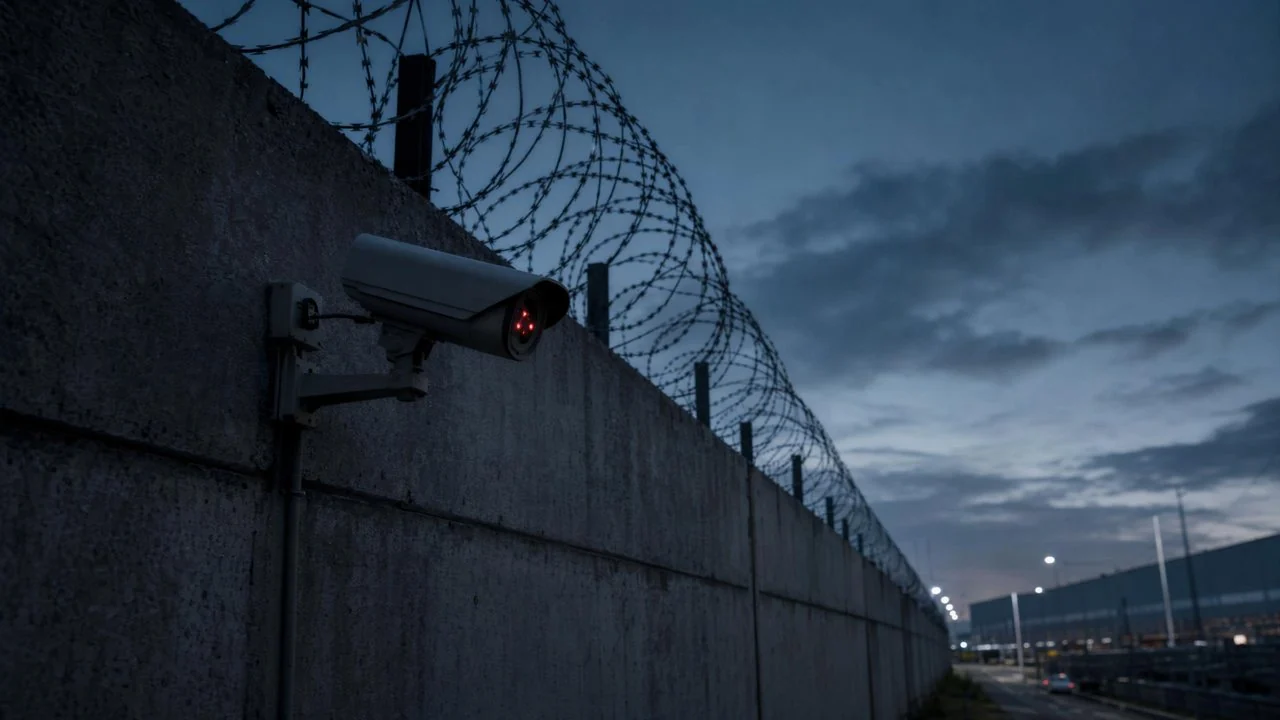
This large logistics park faced multiple challenges in nighttime perimeter security. Firstly, existing traditional equipment like infrared beams and, edge box real-time alerting, 100% on-premise data, DaoAI World semantic understanding) significantly improved security response efficiency by analyzing nighttime infrared surveillance footage at a large logistics park, reducing false alarms for perimeter intrusion from 1.5% to 0.4% and decreasing manual re-verification workload by 68%.
In emergency and smart security, large industrial parks, logistics centers, and warehousing bases with extensive perimeters and complex environments face severe security challenges. Traditional security systems primarily rely on human patrols, infrared beams, and vibrating fiber optics, but these solutions suffer from high false alarm rates and significant missed detection risks in nighttime, adverse weather, or complex background conditions, while also demanding substantial human resources. Especially for large parks spanning hundreds of thousands of square meters, their perimeters can extend for kilometers, making comprehensive coverage and real-time response by night patrols difficult. The client's focus was on intelligent detection of nighttime perimeter intrusion to enhance the accuracy and efficiency of night security, reducing operational costs and potential risks.
Pain Points: Why This Hurdle Was Difficult to Overcome
This large logistics park faced multiple challenges in nighttime perimeter security. Firstly, existing traditional equipment like infrared beams and vibrating fiber optics had a false alarm rate as high as 1.5%, primarily due to environmental interferences such as small animal activities (e.g., wild cats, birds), swaying leaves, and rain/snow. These false alarms required security personnel to re-verify 15-20 false alerts on average each night, significantly consuming manpower and time, making it difficult for them to focus on genuine threats. Secondly, the risk of missed detections persisted with traditional solutions. Due to blind spots in infrared beams and insufficient sensitivity of vibrating fiber optics to subtle intrusion behaviors, potential intruders could successfully breach defenses, leading to compliance risks such as cargo theft or asset damage. Thirdly, nighttime manual patrols were labor-intensive and inefficient. Security personnel working long hours in dim and visibility-restricted environments were prone to fatigue, affecting their judgment. Additionally, approximately 8 hours of manual re-verification per night increased operational costs. Finally, compared to multi-modal intelligent cameras launched by manufacturers like Hikvision, traditional solutions, while 'seeing,' were far from achieving the 'dialogue and action' intelligence, unable to provide deeper semantic understanding and event correlation, thus limiting the overall intelligence of the security system and preventing proactive prevention and precise response.
The root cause of these difficulties lies in the fact that traditional security systems are essentially based on preset rules and simple signal triggers. For example, infrared beams only detect light beam obstruction, and vibrating fiber optics only sense physical vibrations; they lack the ability to semantically understand video content. Nighttime infrared imaging quality is limited, with low signal-to-noise ratio and poor target-background contrast, further increasing the difficulty of recognition. Moreover, intrusion behaviors themselves are diverse; individuals of different heights, body types, and speeds may climb in various postures and potentially carry tools. These subtle differences are difficult to distinguish effectively under traditional rules. Traditional solutions cannot extract and analyze complex spatio-temporal features from video streams, naturally failing to differentiate between 'leaf swaying' and 'human climbing,' nor can they 'understand' video content like humans, leading to a large number of false alarms and potential missed detections.
Technical Principles
DaoAI SkyVision platform's core technology lies in its deep learning-based video behavior analysis engine and the DaoAI World universal model. For nighttime perimeter intrusion detection, we employ multi-stage AI algorithms. First, a lightweight object detection model is deployed on edge boxes at the front end to identify potential 'human' targets in real-time video streams. This model is optimized for infrared image characteristics, effectively filtering out interferences in low-contrast, high-noise nighttime environments. Second, upon detection of potential targets, the video stream is fed into the backend behavior recognition module. This module, based on the Transformer architecture, precisely determines whether an 'intrusion' behavior has occurred by analyzing the target's trajectory, posture changes, and relative position to the perimeter line in continuous frames. By collecting data of human intrusion, normal passage, and small animal activities under various weather and lighting conditions (primarily nighttime infrared) within the actual park, we rapidly built and optimized a client-specific 'intrusion behavior' model using SkyVision's 0-code training platform within hours on-site. This model can learn and distinguish subtle motion patterns in various complex backgrounds, such as differentiating human climbing movements from swaying branches, or distinguishing human intrusion postures from normal standing or walking.
Compared to traditional methods, SkyVision's advantage lies in its data-driven learning capabilities and powerful semantic understanding. Traditional rule-based AOI or manual visual inspection relies on preset thresholds and human experience, showing poor adaptability to environmental changes and target diversity. For example, an infrared beam triggers upon obstruction, unable to distinguish between a person and an animal; vibrating fiber optics may also generate false alarms from wind or movement of vegetation. SkyVision's deep learning model, however, can autonomously learn abstract features from vast amounts of data, possessing strong generalization and anti-interference capabilities. The DaoAI World universal model, as a unified foundation, further enhances the platform's semantic understanding, enabling it to not only 'see' objects in the frame but also 'understand' the relationships between objects and the intent of behaviors, thereby achieving more precise event recognition and lower false alarm rates. Furthermore, SkyVision supports 100% on-premise deployment, with data remaining within the client's premises, meeting stringent client requirements for data security and privacy, which is a significant advantage over traditional cloud-based AI solutions.
Typical Application Scenarios
- **Large Park Perimeter Intrusion Detection:** Real-time monitoring and identification of any human intrusion, climbing, or fence damage behaviors along park perimeters such as walls and barbed wire. The challenge lies in poor nighttime infrared image quality, complex shadows, and numerous small animal interferences. SkyVision, through customized models and DaoAI World semantic understanding, effectively filters out false alarms and precisely identifies intrusions.
- **Restricted Area Intrusion and Loitering Warning:** Real-time detection of unauthorized personnel intrusion, prolonged loitering, or falls in restricted areas such as warehouse interiors, critical equipment zones, and hazardous material storage areas. The challenge involves complex scenes, variable lighting, and diverse human activities. SkyVision provides accurate warnings through behavioral sequence analysis and abnormal pattern recognition.
- **Fire Lane Obstruction Detection:** Automatic identification of vehicles parked or debris piled up in fire lanes. The difficulty lies in severe obstructions, complex backgrounds, and diverse vehicle types and debris forms. SkyVision can learn various obstruction patterns to achieve high-precision detection.
- **High-Altitude Object Drop Detection:** Real-time detection of objects falling from high-rise buildings or bridges. The challenge involves small, fast-moving targets and dynamic background changes. SkyVision combines temporal analysis and target trajectory prediction to improve detection rates and reduce false alarms.
Case Study
A hyper-large logistics park, part of a leading logistics group, covers an area of approximately 500,000 square meters with a perimeter exceeding 3 kilometers. Previously, the park relied primarily on traditional infrared beams and vibrating fiber optics for perimeter security, supplemented by manual night patrols. However, at the customer's park, the traditional system generated an average of 15-20 false alarms per night, over 80% of which were caused by small animals, swaying leaves, or weather conditions. This required the security team to dedicate about 8 hours of manpower each night to re-verification, not only being inefficient but also leading to security personnel being overwhelmed, reducing their response speed to genuine threats. The park decided to introduce the DaoAI SkyVision platform to upgrade its existing infrared surveillance cameras with intelligence. During the onboarding process, we first collected nighttime infrared video data from different sections of the park's perimeter. Using SkyVision's 0-code platform, we completed the training and deployment of a proprietary 'nighttime perimeter intrusion' model in just 3 hours. This model was optimized for the park's specific environment (e.g., wall height, vegetation type, common animals). After deployment, the SkyVision platform smoothly integrated with the park's existing security system, receiving video streams in real-time and performing analysis on edge boxes. Upon detecting suspicious intrusion behavior, the system immediately issued an alert to the control center and linked to the real-time footage from the corresponding camera for quick confirmation by security personnel.
"SkyVision truly shifted our night security from reactive to proactive, significantly easing the burden on our security team and enhancing overall safety."
The figures above are a typically achievable range in anonymized industry scenarios — a different line or a different batch of parts will move the result either way; on-site measurement governs.
DaoAI Solutions and Products
DaoAI provided the large logistics park with a core solution based on the SkyVision 0-code video surveillance AI platform. The platform's core capabilities are demonstrated in: **on-site hourly training of proprietary models**, meaning clients do not need professional AI engineers. Through a simple graphical interface and a small amount of sample data, they can quickly train customized AI models for specific scenarios (such as 'nighttime perimeter intrusion' in this case) on-site, greatly shortening deployment cycles and lowering technical barriers. **Behavior/event recognition** is another major advantage of SkyVision, as it can precisely identify complex behavior patterns from video streams, not just simple object detection. Through deep learning algorithms, the platform can distinguish between normal and abnormal activities, enabling high-accuracy early warnings. **Edge box real-time alerting** ensures timely alarms; AI models are deployed directly on local edge boxes for local processing and analysis of video streams. Once an anomaly is detected, an alarm is triggered immediately, without waiting for data to be uploaded to the cloud, reducing network latency and bandwidth consumption. **100% on-premise data** is a key commitment of SkyVision; all video data and model training data are processed and stored within the client's internal network, strictly adhering to data security and privacy protection requirements. Furthermore, the **DaoAI World universal model**, as a unified AI foundation, enables SkyVision with stronger semantic understanding and cross-scenario generalization capabilities, enabling it to better adapt to complex and dynamic environments and continuously learn and optimize from actual operations. For deployment and integration, SkyVision is provided in Docker containerized form, supporting SDK/API interfaces, allowing flexible integration with existing video management systems (VMS), alarm platforms, etc., to achieve data linkage and unified management. Clients only need to provide 10-20 sample images or short video clips containing intrusion behaviors, and SkyVision can complete model training and begin deployment within 1 hour.
By introducing the DaoAI SkyVision platform, the logistics park achieved significant business value and quantifiable results. The false alarm rate for perimeter intrusion events decreased from the original 1.5% to 0.4%, meaning the number of false alarms security personnel needed to re-verify each night reduced from 15-20 to 4-6, significantly alleviating their workload. Manual re-verification workload was reduced by 68%, allowing the security team to focus more on risk prevention and emergency response. In addition, because SkyVision can provide more precise early warnings, potential missed detection risks were effectively controlled, enhancing the overall security level of the park. The platform deployed on edge boxes ensures real-time alert response within 120ms, guaranteeing rapid reaction to emergencies. In the long run, this will significantly reduce economic losses and compliance risks caused by theft or damage, and optimize the allocation of security human resources, improving operational efficiency.
FAQ
How does SkyVision ensure detection accuracy in nighttime infrared environments?
SkyVision platform utilizes deep learning models specifically optimized for infrared image characteristics, effectively handling low-contrast, high-noise video streams at night. Combined with the semantic understanding capabilities of the DaoAI World universal model, the platform can distinguish common interferences like small animals and swaying leaves from actual human intrusion behaviors, thereby significantly reducing false alarms and improving nighttime detection accuracy.
Does SkyVision platform deployment require professional AI engineers?
No, it does not. SkyVision is a 0-code video surveillance AI platform designed to be quickly adopted by non-AI professionals. Users can train and deploy their own AI models on-site within hours using an intuitive graphical interface and only a small amount of scene sample data, significantly lowering technical barriers and deployment costs.
How does SkyVision ensure data security and privacy?
DaoAI guarantees that the SkyVision platform supports 100% on-premise private deployment. All video data and model training data are processed, analyzed, and stored within the client's local network environment, ensuring raw video and images never leave the premises. This gives clients full control over their data, strictly adhering to data security and privacy protection regulations, meeting stringent enterprise requirements for handling sensitive data.
Full solution for this scenario: the full inspection solution for Video Surveillance
This article was generated by AI. Customer cases are simulated scenarios based on real product capabilities and figures are illustrative; see product pages for official benchmarks.