
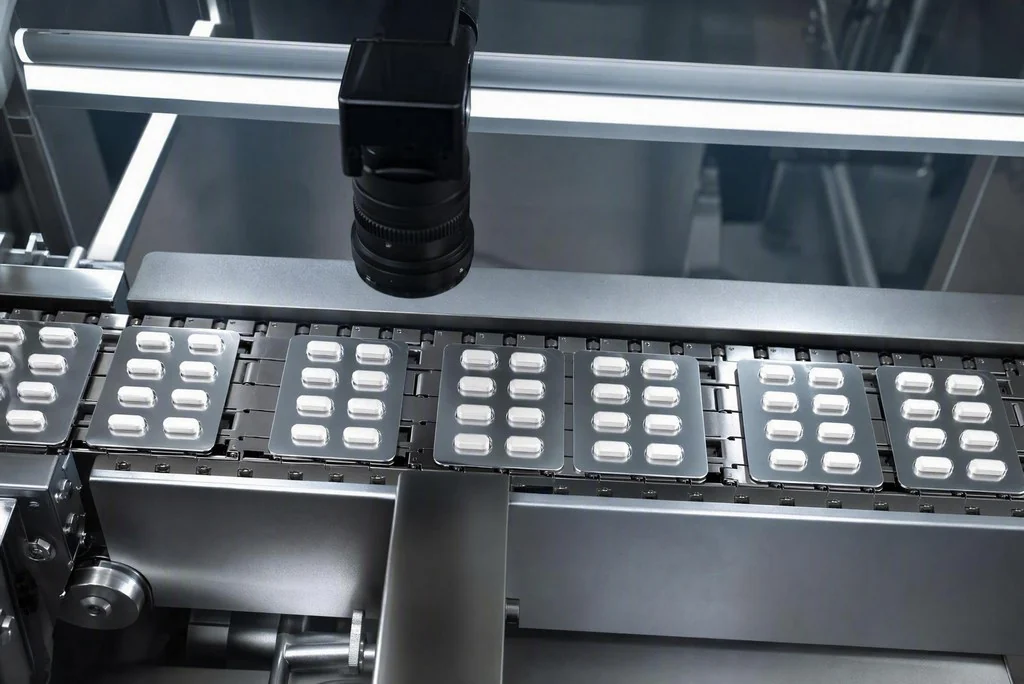
In the pharmaceutical production field, the quality detection of blister packaging is directly related to patient medication safety. As the production line speed continues to increase, traditional detection methods have struggled to meet the requirements. WeLinkirt, with its advanced technology and solutions, has brought new breakthroughs to high-speed real-time blister detection.
Industry Background and User Scenario: In the pharmaceutical industry, the blister packaging of oral solid preparations is a very common packaging form. It is the last physical barrier for patient medication safety. Blister production lines usually operate at a high-speed rhythm of tens of thousands of pieces per hour. In such a high-speed production environment, problems such as whether there are missing tablets in each blister cavity, whether the tablets are damaged or broken, and whether the aluminum foil seal is intact need to be accurately judged within a millisecond-level time window. For pharmaceutical companies, ensuring the quality of blister packaging is not only a responsibility to patients but also a key to compliant production and establishing a good brand image.
Pain Points: Why is it Difficult?
From a quantitative perspective, high-speed real-time blister detection faces many difficulties. First of all, in terms of detection accuracy, when traditional threshold-based vision detection methods face the strong reflection of PVC blisters and aluminum foil, the false alarm rate can be as high as over 30%. This is because strong reflection can interfere with the image judgment of traditional vision detection systems, making it difficult for the system to accurately distinguish between normal areas and defective areas, thus frequently issuing false alarms and seriously affecting the detection efficiency and accuracy.
Secondly, in terms of imaging quality, the high-speed operation of the production line will lead to blurred imaging. According to statistics, at a production line speed of 50,000 pieces per hour, the imaging blur rate can reach about 20%. The high-speed movement makes it difficult for the camera to capture clear images, and the defect forms also become changeable, increasing the difficulty of detection. Moreover, defects such as damage and poor sealing are rare on production lines with high pass rates, accounting for less than 1%. This makes it difficult for traditional machine-learning algorithms to obtain enough samples for training, further reducing the reliability of detection.
Furthermore, in terms of production line rhythm, traditional detection methods often slow down the production line rhythm due to slow processing speed. For example, some traditional detection equipment requires a long time for image analysis and judgment during the detection process, resulting in a decrease in the production line speed and affecting production efficiency. Taking a pharmaceutical company as an example, when using traditional detection methods, the production line speed could only be maintained at about 30,000 pieces per hour, which was far from the ideal production capacity of 50,000 pieces per hour.
Technical Principle
DaoAI ACI (AI-AOI) uses a deep-learning model for blister defect detection. Through learning and analyzing a large amount of blister image data, the model can accurately identify problems such as missing tablets, damages, and sealing defects. In terms of imaging, it uses advanced high-speed cameras and a special light source system. The high-speed camera can capture clear images in a high-speed moving production line environment, and the special light source system can effectively reduce the reflection effect of PVC blisters and aluminum foil, improving the quality and contrast of the image.
Compared with the traditional threshold-based vision method, the deep-learning model is not troubled by reflection and threshold drift. The traditional method judges defects in the image based on a preset fixed threshold. When encountering interference factors such as reflection, the threshold is prone to drift, resulting in an increase in false alarms. The deep-learning model has a strong adaptive ability. It can make intelligent judgments based on different image features and can accurately identify defects even under complex lighting conditions, greatly improving the accuracy and reliability of detection.
In addition, DaoAI ACI also uses APDT few-shot learning technology. When there are insufficient samples of rare defects such as poor sealing, this technology can quickly establish an effective detection model through learning and analysis of a small number of samples. Traditional machine-learning methods often have difficulty training accurate models when the samples are scarce, while APDT few-shot learning technology breaks this limitation, enabling rapid model establishment and online operation even when the samples of rare defects are limited, meeting the detection requirements of high-speed production lines.
Typical Application Scenarios
- Missing Tablet Detection: In the blister production process, missing tablets are one of the more common defects. DaoAI ACI analyzes the image of each blister cavity through a deep-learning model to determine whether there is a tablet in the cavity. The difficulty lies in that the imaging may be blurred at high speed, making it difficult to accurately judge whether there is a tablet in the blister cavity. Moreover, blister cavities of different shapes and sizes also increase the difficulty of detection.
- Damage Detection: Tablet damage may affect the efficacy and patient safety. The system analyzes the contour and texture of the tablet to identify whether there is damage. However, the shape of damaged tablets is changeable under high-speed movement, and reflection may cover the details of the damage, making detection difficult.
- Poor Sealing Detection: The sealing quality between the aluminum foil and the PVC blister is directly related to the shelf life and stability of the drug. DaoAI ACI uses image analysis technology to detect whether the sealing edge is intact and whether the sealing strength meets the requirements. However, the forms of poor-sealing defects are diverse, and the samples are scarce, which poses challenges to the training of the detection model.
- Blister Deformation Detection: During the production process, blisters may be deformed, affecting the packaging quality of the drug. The system detects the shape and size of the blister to determine whether there is deformation. The high-speed production line and strong reflection can cause the image of the blister edge to be unclear, increasing the difficulty of accurately detecting deformation.
Implementation Case
The blister production line of a medium-sized oral preparation factory has always faced detection difficulties. The designed production capacity of the factory's blister production line is 50,000 pieces per hour, but when using traditional detection methods, the production line speed could only reach about 30,000 pieces per hour. The missing-tablet miss-detection rate was as high as 5%, the poor-sealing detection rate was only 60%, and the false alarm rate reached 25%. After introducing WeLinkirt's DaoAI ACI system, the implementation process was relatively smooth. The technical staff first conducted a detailed understanding and analysis of the production line environment and product characteristics, and then customized and trained the detection model according to the actual situation. After a period of debugging and optimization, the system was successfully put into operation.
High speed is not the enemy of detection; reflection and rare defects are. Deep learning solves both problems.
WeLinkirt's Solution and Product
WeLinkirt's DaoAI ACI system is deployed at the post-sealing station of the blister line. It can simultaneously judge three types of defects: missing tablets, damages, and poor sealing with a single imaging. The system uses a deep-learning model resistant to strong reflection, fundamentally getting rid of the problems of reflection and threshold drift in traditional threshold-based vision detection methods. At the same time, with the help of APDT few-shot learning technology, even when there are insufficient samples of rare defects, it can quickly establish a model and go online. The whole solution is designed for high-speed production lines, and real-time detection does not slow down the production line rhythm, ensuring a balance between production efficiency and detection quality.
Quantitative Results
After the system was launched, the DaoAI ACI system achieved remarkable results. The comprehensive detection accuracy reached mAP 99%, and it ran stably at a full-speed of 50,000 pieces per hour. The miss-detection rate of missing tablets and damages approached zero, dropping from the original 5% to a negligible level. The detection rate of poor sealing increased significantly, from the original 60% to over 95%. The false alarm rate decreased significantly, from the original 25% to below 5%. Quality inspection was upgraded from manual sampling to full-online inspection, greatly improving the quality and safety of blister packaging.
FAQ
What difficulties does high-speed real-time blister detection face?
There are mainly two difficulties in high-speed real-time blister detection. Firstly, the strong reflection of PVC blisters and aluminum foil can interfere with traditional threshold-based vision detection systems, causing frequent false alarms. The false alarm rate can reach over 30%. Secondly, the imaging is blurred at high speed, with a blur rate of about 20%. The defect forms are changeable, and the samples of rare defects are scarce, accounting for less than 1%, making it difficult for traditional algorithms to train.
How does DaoAI ACI solve the blister detection problem?
DaoAI ACI is deployed at the post-sealing station of the blister line. It uses a deep-learning model to detect defects, getting rid of the problems of reflection and threshold drift. With the help of APDT few-shot learning technology, it can quickly establish a model when there are insufficient samples of rare defects. Moreover, real-time detection does not slow down the production line rhythm, meeting the requirements of high-speed production.
What is the effect after the launch of DaoAI ACI?
After the launch, the comprehensive detection accuracy reaches mAP 99%, and it can run stably at a full-speed of 50,000 pieces per hour. The miss-detection rate of missing tablets and damages approaches zero. The detection rate of poor sealing increases from 60% to over 95%. The false alarm rate drops from 25% to below 5%, upgrading the quality inspection from manual sampling to full-online inspection.
This article was generated by AI. Customer cases are simulated scenarios based on real product capabilities and figures are illustrative; see product pages for official benchmarks.