
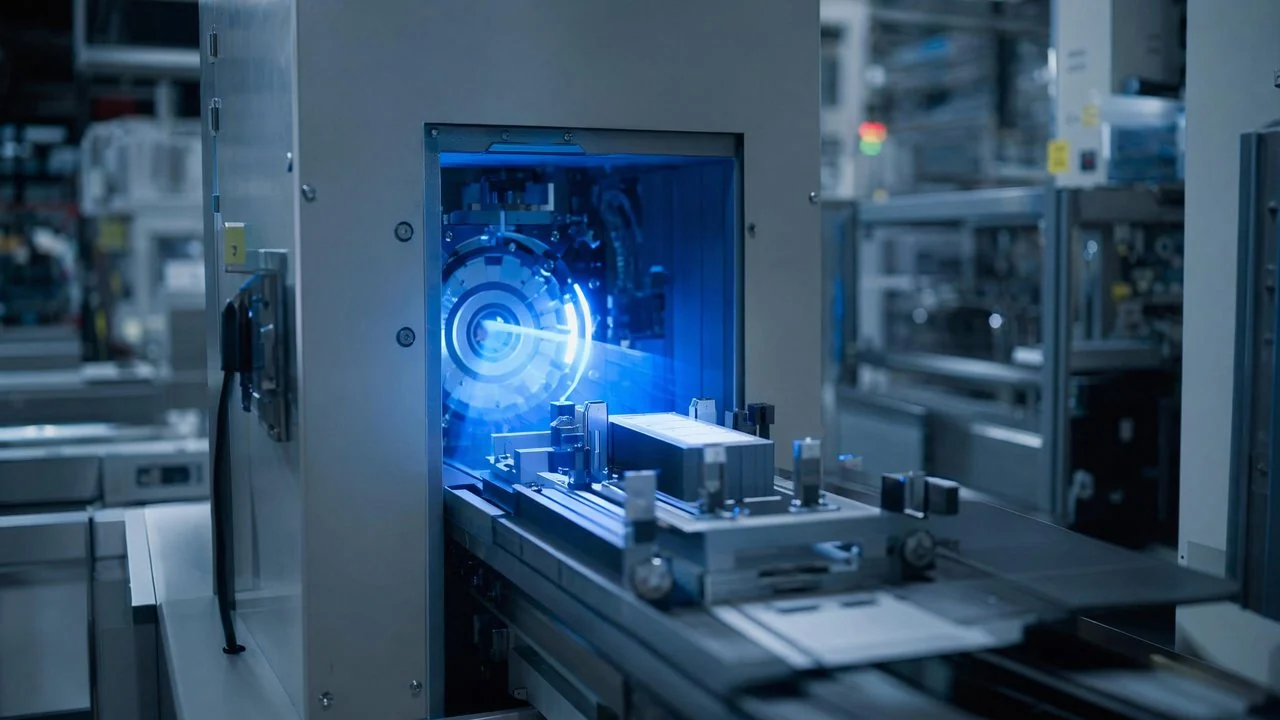
In the production of new energy batteries, accurate detection of anode-cathode alignment in winding/laminating is crucial. DaoAI provides an efficient and reliable detection solution for the industry with advanced AI technology.
User Scenario: A leading new energy battery manufacturer needs to detect the alignment of the anode and cathode of the battery during the winding/laminating process in battery production. Its products are various new energy batteries, and the detection object is the alignment state of the anode and cathode during the winding or laminating process. Ensuring the precise alignment of the anode and cathode is crucial for the performance and safety of the battery.
Pain Points: The manufacturer faces many dilemmas. On the one hand, the traditional detection method has a relatively high missed detection rate of about 3%. This may allow batteries with anode-cathode alignment problems to flow into subsequent processes, affecting the final quality and safety of the battery. At the same time, the false alarm rate is also relatively high, about 18%, resulting in a large number of products needing to be re-inspected, which increases labor costs and production time. In addition, the efficiency of change-over detection for different battery models is low, with the change-over time as long as 20 minutes, which affects the production flexibility. Moreover, the battery production process involves a large amount of confidential data, and the traditional detection method is difficult to effectively ensure that the data does not leave the factory, posing a risk of data leakage.
Technical Principle
DaoAI uses advanced X-ray CT imaging technology combined with AI algorithms to solve the problem of anode-cathode alignment detection. X-ray CT technology can penetrate the inside of the battery, obtain three-dimensional structural information of the anode and cathode, and generate high-precision tomographic images. Then, the visual basic model in the DaoAI ACI (AI-AOI) software system is used to recognize the features of these images. This model uses APDT positive-sample/few-sample learning technology. Only 1-20 good product samples are needed as sample data to quickly learn the normal features of anode-cathode alignment. Through the semantic false alarm filtering algorithm, it can accurately distinguish real defects from false alarms. This is because the algorithm is based on the understanding of image semantics, and it can identify the key features related to anode-cathode alignment in the image, eliminating the interference of non-defect factors, thus effectively improving the accuracy of detection.
- X-ray CT imaging provides detailed internal structure information, laying the foundation for accurate detection.
- The AI visual basic model can quickly adapt to the characteristics of different products through few-sample learning.
- The semantic false alarm filtering algorithm is based on image semantic understanding to reduce false alarms.
- The deep feature extraction ability of the model can capture tiny alignment deviations.
DaoAI Solution and Product Introduction
DaoAI provides the DaoAI ACI OS and the DaoAI World model to solve the problems of the manufacturer. The DaoAI ACI OS has powerful feature recognition capabilities. It can realize automatic programming of a good product in 5 minutes with 0 code, greatly shortening the programming time and improving the detection efficiency. Through APDT positive-sample/few-sample learning, only a small number of good product samples are needed to complete model training, meeting the detection needs of different battery models. The semantic false alarm filtering function can effectively reduce the false alarm rate. The DaoAI World model, as a unified base, has the abilities of semantic understanding, cross-scenario generalization, and continuous learning from production line feedback. It supports SDK / API / Docker deployment methods and can achieve 100% local private deployment, ensuring that the data does not leave the factory and meeting the manufacturer's needs for data compliance and protection of process secrets.
The combination of advanced AI technology and local private deployment provides a safe and reliable solution for new energy battery detection.
Quantitative Results: By adopting the DaoAI solution, the detection results of the manufacturer have been significantly improved. The missed detection rate has been reduced from about 3% to <0.6%, greatly improving the product quality. The false alarm rate has been reduced by 63%, reducing a large amount of re-inspection work and improving production efficiency. The change-over time has been shortened from 20 minutes to 5 minutes, enhancing the production flexibility and adaptability and enabling a faster response to market demands.
FAQ
What pain points can the anode-cathode alignment detection solution for new energy batteries of DaoAI solve?
DaoAI's solution can solve the problems of high missed detection rate, high false alarm rate, long model change time and easy data leakage in traditional detection. For example, it can reduce the missed detection rate to <0.6%, the false alarm rate by -63%, shorten the model change time to 5 minutes, and ensure data does not leave the factory.
What is the technical principle of DaoAI's detection solution?
It combines X-ray CT imaging technology with AI algorithms. X-ray CT obtains the 3D information inside the battery. The visual basic model of DaoAI ACI OS uses APDT few-shot learning, and the semantic false alarm filtering algorithm improves detection accuracy.
What products does DaoAI provide to solve the problems of manufacturers?
DaoAI provides the DaoAI ACI OS and the DaoAI World model. The former can achieve 0-code automatic programming in 5 minutes with few-shot training and reduce false alarms. The latter can be privately deployed locally to protect data and process secrets.
Full solution for this scenario: the full inspection solution for New-energy batteries
This article was generated by AI. Customer cases are simulated scenarios based on real product capabilities and figures are illustrative; see product pages for official benchmarks.