
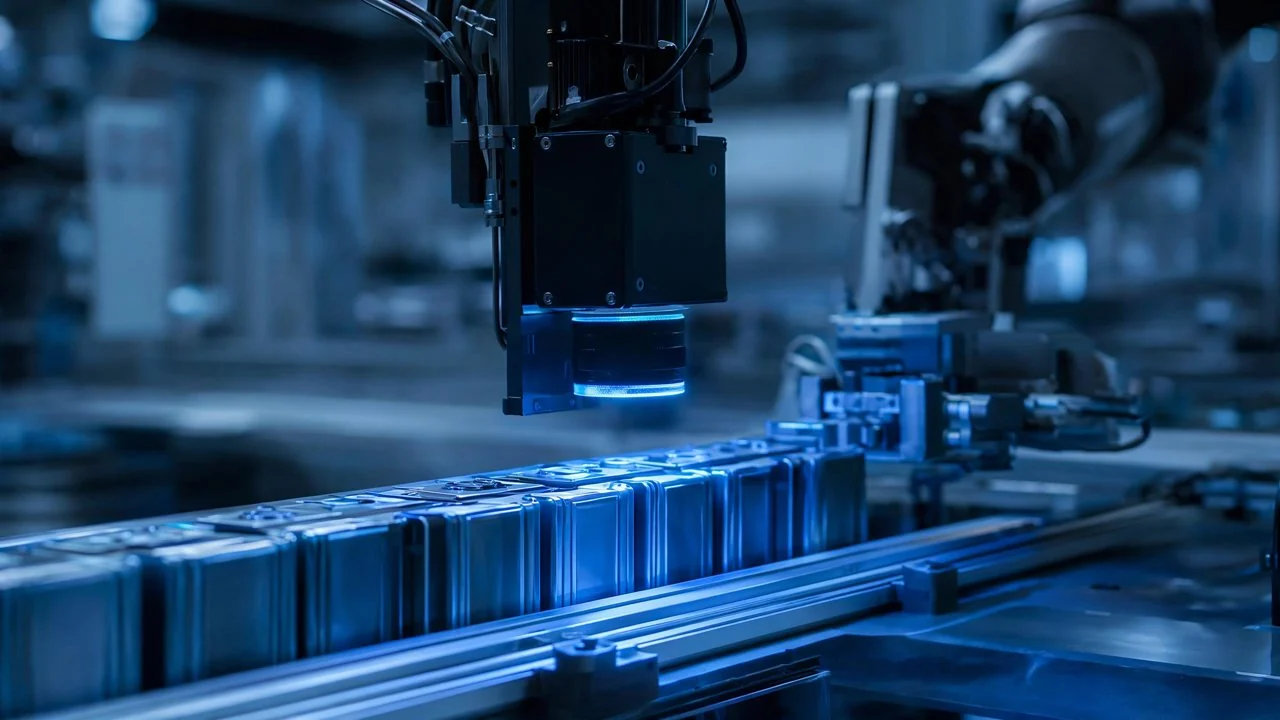
In the production of new energy batteries, the quality inspection of cell sealing/filling ports is crucial. WeLinkirt provides an efficient solution for the industry with its advanced AI vision technology.
User Scenario: A leading new energy battery manufacturer needs to conduct high-precision inspections on the sealing and filling ports of battery cells during the cell sealing/filling port process in cell production. Its products are various types of new energy battery cells, and the inspection objects include the sealing condition at the cell sealing port, as well as the size, shape, and surface defects of the filling port.
Pain Points: Under traditional inspection methods, the manufacturer faces many difficulties. The missed detection rate is relatively high, reaching about 3%, which may lead to defective products flowing into the market, affecting product quality and brand reputation. At the same time, the false alarm rate remains high, about 20%. A large number of false alarms disperse the limited re-inspection resources, and products with real problems cannot be processed in time. Moreover, manual inspection is inefficient, with high labor costs and long changeover times. Each changeover takes about 30 minutes, seriously affecting the production rhythm.
Technical Principle
WeLinkirt uses advanced AI algorithms and imaging technologies to solve these problems. In terms of algorithms, it utilizes the feature recognition ability of the visual basic model to conduct in-depth analysis of the images of cell sealing and filling ports. Through APDT positive sample/few-shot learning, only 1-20 good product images are needed to quickly learn the characteristics of normal products. This few-shot learning method greatly reduces the workload of sample collection and annotation, and at the same time improves the generalization ability of the model. In terms of imaging, the self-developed 3D camera can obtain the three-dimensional morphology information of the battery cells and realize three-dimensional morphology reconstruction. This enables the system to not only detect surface defects but also detect hidden soldering points, coplanarity, and micron-level morphological changes. By analyzing the three-dimensional information, real defects can be identified more accurately, reducing false alarms.
- The feature recognition of the visual basic model can extract key features from a large number of images, making it more sensitive to different types of defects.
- APDT positive sample/few-shot learning can train an accurate model with a small number of good product samples, avoiding the cumbersome process of large-scale sample collection and annotation.
- The three-dimensional morphology reconstruction technology of the self-developed 3D camera can provide more comprehensive product information, which helps to detect some defects that are difficult to find in two-dimensional images.
- The semantic false alarm filtering function can effectively filter false alarms based on the semantic information of defects, focusing the limited re-inspection resources on real problems.
WeLinkirt Solution and Product Introduction
WeLinkirt provides the DaoAI ACI (AI-AOI) software system and the DaoAI 2D / 3D ACI equipment. The DaoAI ACI OS has the feature recognition ability of the visual basic model, and a good product can be automatically programmed without code in only 5 minutes. Through APDT positive sample/few-shot learning, it can quickly adapt to different types of battery cell products. At the same time, its semantic false alarm filtering function can effectively reduce false alarms and concentrate re-inspection resources on products with real problems. The DaoAI 2D / 3D ACI equipment uses a self-developed 3D camera to realize three-dimensional morphology reconstruction, detecting hidden soldering points, coplanarity, and micron-level morphology. During the implementation process, the equipment is installed at the inspection position of the cell sealing/filling port process, and the software system is integrated with the equipment to perform real-time analysis and processing on the collected images and three-dimensional data.
WeLinkirt's AI vision solution has brought new breakthroughs to the quality inspection of new energy battery production.
Quantitative Results: By adopting WeLinkirt's solution, the manufacturer has achieved remarkable results. The detection rate has increased from about 97% to 99.2%, and the missed detection rate has been reduced to <0.8%, effectively reducing the risk of defective products flowing into the market. The false alarm rate has been reduced by 65%, from 20% to about 7%, enabling re-inspection resources to focus more precisely on real problems. The changeover time has been shortened from about 30 minutes to 5 minutes, greatly improving production efficiency and reducing production costs.
FAQ
What pain points in the detection of the sealing/liquid injection port of new-energy battery cells can Microchain DaoAI's AI visual inspection solve?
Microchain DaoAI can solve problems such as high missed-detection rate, high false-alarm rate, low efficiency of manual inspection, and long model-changing time. Its solution can reduce the missed-detection rate, cut the false-alarm rate by 65%, and shorten the model-changing time to 5 minutes.
What technologies does Microchain DaoAI use for the detection of the sealing/liquid injection port of battery cells?
Microchain DaoAI uses advanced AI algorithms and imaging technologies. In terms of algorithms, it utilizes the feature recognition ability of the visual foundation model and APDT positive-sample/few-sample learning. In imaging, it uses self-developed 3D cameras for 3D shape reconstruction and has a semantic false-alarm filtering function.
What products does Microchain DaoAI provide for new-energy battery detection?
Microchain DaoAI provides the DaoAI ACI OS and the DaoAI 2D / 3D ACI equipment. The software can perform zero-code automatic programming and reduce false alarms. The equipment uses self-developed 3D cameras and can detect various defects.
Full solution for this scenario: New-energy batteries industry solutions
This article was generated by AI. Customer cases are simulated scenarios based on real product capabilities and figures are illustrative; see product pages for official benchmarks.