
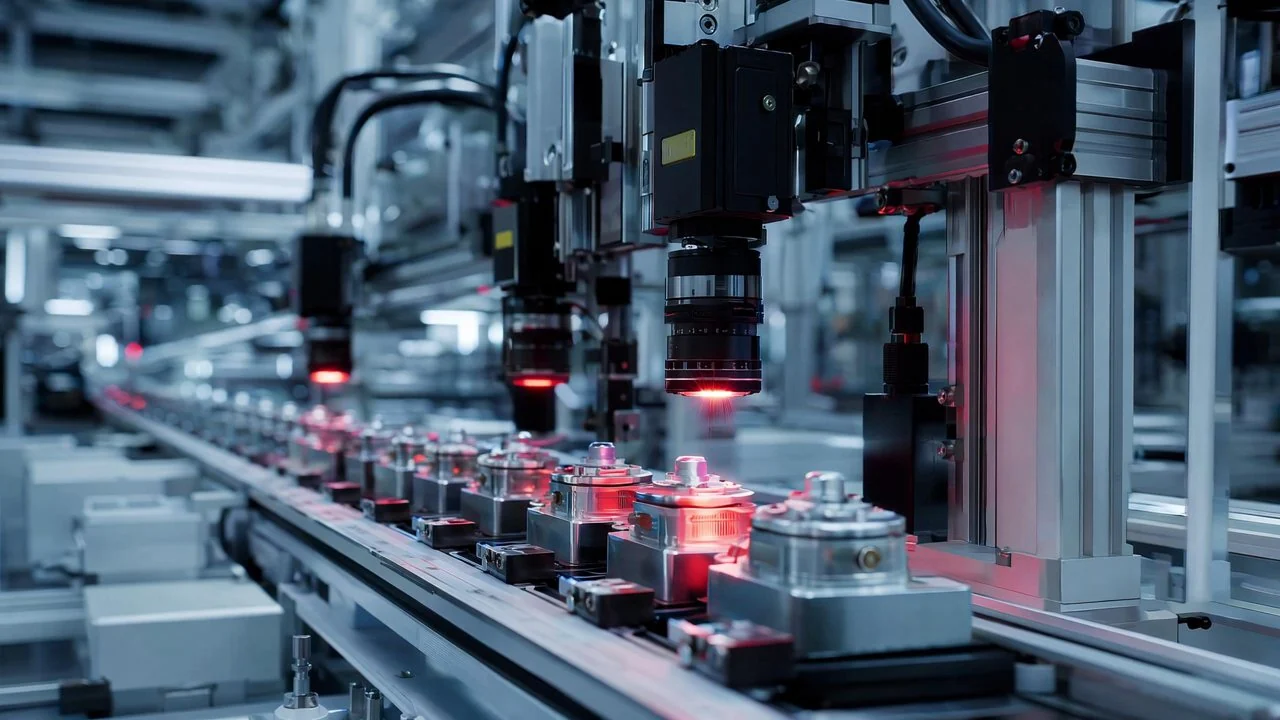
In the production of new energy batteries, the appearance inspection of posts and caps is crucial. WeLinkirt provides an efficient and accurate inspection solution for the industry with its advanced AI vision technology.
User Scenario: A leading new energy battery manufacturer needs to conduct strict appearance inspections on the posts and caps during the assembly process of battery posts and caps. As key components of the battery, the appearance quality of the posts and caps directly affects the safety and performance of the battery. The inspection objects include surface scratches, cracks, and deformations of the posts, as well as the flatness and sealing of the caps.
Pain Points: Traditional inspection methods mainly rely on manual visual inspection and traditional CNN algorithms. Manual visual inspection has the problems of low efficiency and high miss-detection rate. On average, only about 100 posts/caps can be inspected per hour, and the miss-detection rate is as high as 3%. Although the traditional CNN algorithm improves the inspection efficiency to a certain extent, when facing posts/caps of different models and batches, it is necessary to rewrite the code and adjust the parameters. The model change time is up to 30 minutes, and the false-alarm rate is relatively high, reaching 8%. In addition, the traditional CNN algorithm is difficult to generalize across scenarios. For newly emerging defect types, a large number of samples are required to retrain the model, which cannot meet the rapidly changing production needs.
Technical Principle
WeLinkirt uses an algorithm based on the visual foundation model, combined with self-developed 3D camera imaging technology and high-precision hardware equipment to solve the above problems. The visual foundation model has strong semantic understanding and cross-scene generalization ability. By learning and analyzing a large amount of image data, it can extract general feature patterns, not limited to specific defect types. For example, in the appearance inspection of posts and caps, the model can learn general features such as surface texture, shape, and edges, so as to quickly identify different types of defects. The self-developed 3D camera can obtain the three-dimensional morphology information of the posts and caps. Through the three-dimensional morphology reconstruction technology, hidden solder joints, coplanarity, and micron-level morphology defects can be detected more accurately. The high-precision hardware equipment ensures the stability and accuracy of image acquisition, providing a reliable data basis for subsequent algorithm analysis.
- The feature recognition ability of the visual foundation model enables it to learn and train with a small number of positive samples. Only 1-20 good samples are needed, and an accurate detection model can be quickly established through the APDT positive-sample/few-sample learning method.
- The semantic false-alarm filtering function can filter false alarms according to the semantic information of defects, greatly reducing the false-alarm rate.
- The three-dimensional morphology reconstruction technology of the 3D camera can provide more comprehensive detection information, making up for the deficiencies of traditional 2D detection.
- The high precision and stability of the hardware equipment ensure the reliability and consistency of the detection.
WeLinkirt Solutions and Product Introduction
WeLinkirt provides the DaoAI ACI (AI-AOI) software system, DaoAI 2D / 3D ACI equipment, and the DaoAI World model. The DaoAI ACI OS has a strong feature recognition ability. Only 5 minutes are needed for a good sample to complete zero-code automatic programming, greatly shortening the model change time. At the same time, its APDT positive-sample/few-sample learning method only needs 1-20 good samples for model training, and can reduce the false-alarm rate through the semantic false-alarm filtering function. The DaoAI 2D / 3D ACI equipment integrates a self-developed 3D camera, which can perform three-dimensional morphology reconstruction to accurately detect hidden solder joints, coplanarity, and micron-level morphology defects. The DaoAI World model, as a unified base, has semantic understanding and cross-scene generalization abilities, and can continuously learn from production line feedback to optimize the detection model. The model supports SDK / API / Docker deployment methods and can achieve 100% local private deployment to ensure that the data does not leave the factory.
WeLinkirt's solutions provide reliable guarantee for the appearance inspection of new energy battery posts and caps with their high-efficiency, accuracy, and flexibility.
Quantitative Results: After adopting WeLinkirt's solutions, the detection rate of the appearance inspection of posts and caps has reached 98%, and the miss-detection rate has been reduced to <2%. The false-alarm rate has been reduced by 65%, greatly reducing the subsequent re-inspection workload. The model change time has been shortened from the original 30 minutes to 5 minutes, improving the production efficiency and being able to quickly respond to the production needs of different models of products.
FAQ
What are the advantages of Weilian DaoAI in the appearance inspection of new-energy battery poles/covers?
Weilian DaoAI provides efficient and accurate solutions with advanced AI vision technology. It has a 98% detection rate, a 65% reduction in false-alarm rate, and a 5-minute model-changing time. It uses technologies like the visual foundation model to solve the pain points of traditional methods.
What problems do traditional inspection methods have in the appearance inspection of new-energy battery poles/covers?
Traditional manual visual inspection is inefficient with a high missed-detection rate, about 100 pieces per hour and a 3% missed-detection rate. Traditional CNN algorithms have long model-changing times, high false-alarm rates, and are difficult to generalize across scenarios, failing to meet production needs.
What products does Weilian DaoAI offer for the appearance inspection of new-energy battery poles/covers?
Weilian DaoAI offers the DaoAI ACI OS, DaoAI 2D / 3D ACI equipment, and the DaoAI World model. The software has fast model-changing and low false-alarm rates, and the equipment can perform 3D reconstruction.
Full solution for this scenario: the full inspection solution for New-energy batteries · Battery Post / Top-Cap Appearance Inspection
This article was generated by AI. Customer cases are simulated scenarios based on real product capabilities and figures are illustrative; see product pages for official benchmarks.