
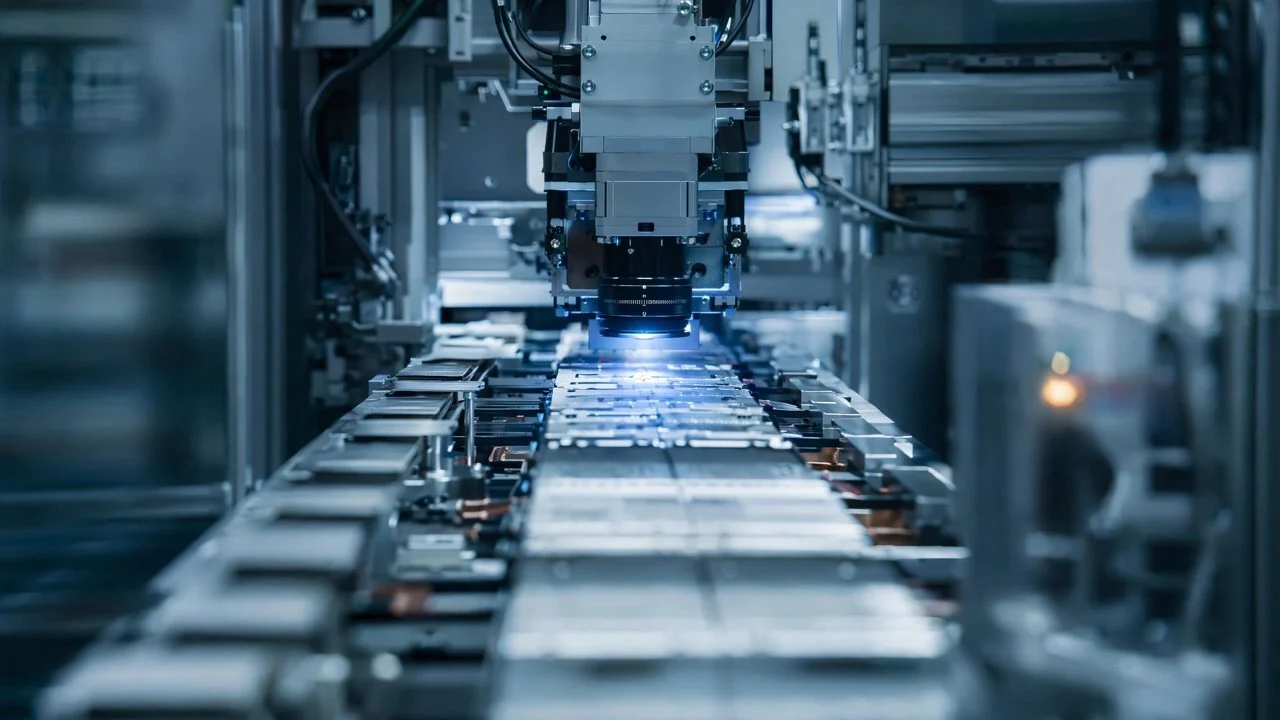
In the production process of new energy batteries, the quality of module weld spots directly affects the performance and safety of the batteries. WeLinkirt (DaoAI) provides an efficient and accurate solution for the inspection of new energy battery module weld spots with advanced AI vision technology.
User scenario: In the module production line of a leading new energy battery manufacturer, during the battery module assembly process, the weld spots of the modules need to be inspected. The inspection objects are various weld spots on the battery modules, and the quality of these weld spots is crucial for the electrical connection performance and overall safety of the battery modules.
Pain points: Traditional methods for weld spot inspection have many problems. In terms of quantitative dilemmas, the missed detection rate is relatively high, reaching about 3%. This means that some defective weld spots may flow into subsequent processes, affecting the quality and safety of the batteries. The false alarm rate is also not to be underestimated, about 10%. Frequent false alarms not only increase the workload of manual reinspection but also reduce the production efficiency of the production line. In addition, the labor cost of manual inspection is high, and the model change time is long, taking about 30 minutes each time, which seriously affects the flexibility of the production line. Moreover, for some hidden defects in weld spots, such as air holes and electrode alignment problems, traditional methods are difficult to perform effective non-destructive testing.
Technical Principles
WeLinkirt (DaoAI) uses advanced AI algorithms and imaging technologies to solve these problems. In terms of algorithms, deep learning algorithms are used to learn and train a large number of weld spot images, enabling the model to accurately identify the features of various weld spot defects. Through the convolutional neural network (CNN), key features in the weld spot images can be automatically extracted, such as the shape, size, and gray value of the weld spots, so as to judge whether there are defects in the weld spots. In terms of imaging, a self-developed 3D camera is used for three-dimensional topography reconstruction, which can obtain the three-dimensional information of the weld spots. This imaging method can clearly show the internal structure of the weld spots, which is very effective for detecting hidden defects such as air holes and electrode alignment. Because 3D imaging can observe the weld spots from multiple angles, it avoids the blind spots of 2D imaging and can find defects more comprehensively. Moreover, through three-dimensional topography reconstruction, micron-level parameters such as the height and coplanarity of the weld spots can be accurately measured, further improving the accuracy of the inspection.
- The deep learning algorithm automatically extracts the features of weld spots to improve the ability of defect recognition.
- The self-developed 3D camera is used for three-dimensional topography reconstruction to obtain the three-dimensional information of weld spots.
- 3D imaging observes the weld spots from multiple angles to avoid the blind spots of 2D imaging.
- Accurately measure the micron-level parameters of weld spots to improve the inspection accuracy.
WeLinkirt (DaoAI) Solutions and Product Introduction
WeLinkirt (DaoAI) provides a series of targeted products and solutions. First is the DaoAI ACI (AI-AOI) software system, which has the feature recognition ability of the visual basic model. With just one good product, it can achieve 0-code automatic programming in 5 minutes, greatly shortening the programming time. Its APDT positive sample/few-sample learning function only needs 1-20 good products to quickly train an accurate detection model, reducing the workload of sample collection. In addition, the semantic false alarm filtering function can effectively reduce the false alarm rate. Second is the DaoAI 2D / 3D ACI equipment, which is equipped with a self-developed 3D camera and can perform three-dimensional topography reconstruction, detecting hidden weld spots, coplanarity, and micron-level topography, providing comprehensive and accurate information for weld spot inspection. In terms of implementation, these products are deployed on the production line through SDK / API / Docker, supporting 100% local privatization to ensure that the data does not leave the factory and guarantee the security of the customer's data.
WeLinkirt (DaoAI)'s products and solutions provide efficient, accurate, and safe guarantees for the inspection of new energy battery module weld spots.
Quantitative results: By applying WeLinkirt (DaoAI)'s solutions, the new energy battery manufacturer has achieved remarkable results. The detection rate has increased from about 97% to 99.2%, effectively reducing the missed detection rate, which is now controlled at <0.8%. The false alarm rate has been reduced by 60%, greatly reducing the workload of manual reinspection. The model change time has been shortened from about 30 minutes to 5 minutes, improving the flexibility and production efficiency of the production line.
FAQ
What pain points of traditional detection methods can the new energy battery module solder joint detection solution of Weilian DaoAI solve?
Weilian DaoAI's solution can address the pain points of traditional methods, such as reducing the missed detection rate by about 3% and the false alarm rate by about 10%, cutting labor costs, shortening the model change time from 30 minutes to 5 minutes, and effectively detecting hidden solder joint defects.
What is the technical principle of Weilian DaoAI's detection solution?
Weilian DaoAI uses advanced AI algorithms and imaging technologies. It employs deep-learning algorithms to learn solder joint images, and CNN to automatically extract features. The self-developed 3D camera performs 3D morphology reconstruction to obtain stereo information, improving detection accuracy.
What products and solutions does Weilian DaoAI offer?
Weilian DaoAI offers the DaoAI ACI OS with feature recognition, few-shot learning, and false alarm filtering functions. There is also the DaoAI 2D / 3D ACI device that can detect hidden solder joints, etc., and supports local private deployment.
Full solution for this scenario: New-energy batteries industry solutions
This article was generated by AI. Customer cases are simulated scenarios based on real product capabilities and figures are illustrative; see product pages for official benchmarks.