
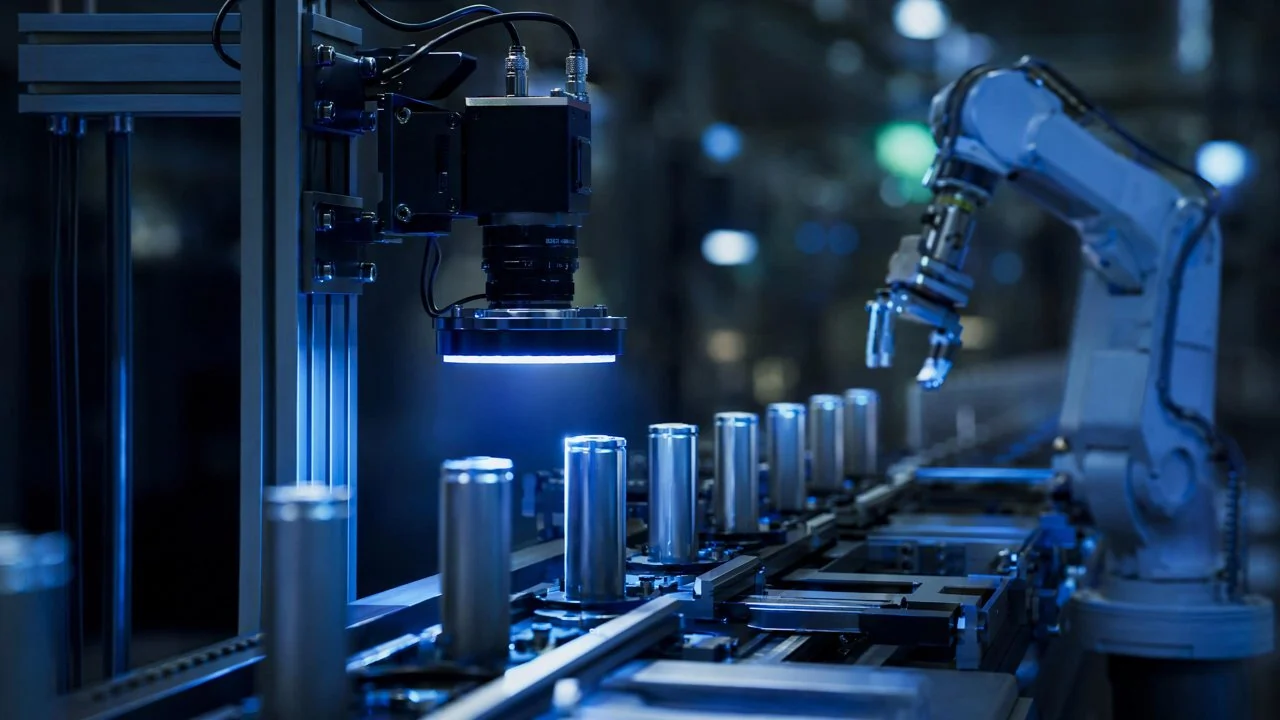
In the production of new-energy batteries, the defect inspection of the reflective metal shells of cylindrical battery cells is of great importance. WeLinkirt provides an efficient solution for the industry with its advanced AI vision technology.
User Scenario: A leading new-energy battery manufacturer needs to conduct strict inspections on the reflective metal shells of cylindrical battery cells during the production process. The cylindrical battery cells produced are widely used in various new-energy vehicles and energy storage devices. The inspection objects are surface defects such as scratches, dents, and cracks on the metal shells, which may affect the safety and service life of the batteries.
Pain Points: Traditional inspection methods face many quantitative dilemmas. On the one hand, the missed-detection rate is relatively high, about 3%, which means that some defective products may enter the market, posing potential safety hazards. On the other hand, the false-alarm rate is as high as 20%. A large number of false alarms not only increase the workload of manual re-inspection but also reduce production efficiency. At the same time, due to the reflective characteristics of the metal shell surface, traditional algorithms have difficulty accurately identifying defects, resulting in insufficient inspection accuracy. In addition, the model-change time is relatively long, taking about 30 minutes each time, which affects the flexibility of the production line. Moreover, in the face of different types of false defects, traditional methods lack an effective filtering mechanism, further exacerbating the false-alarm problem.
Technical Principle
WeLinkirt uses an advanced visual foundation model combined with deep-learning algorithms to solve these problems. The visual foundation model has a powerful feature-recognition ability and can learn the normal features and various defect features of the metal shell surface from a large amount of sample data. Through semantic understanding technology, the model can distinguish between real defects and false defects. For example, for visual interference caused by reflection, the model can recognize its non-defective nature, thereby filtering out these false defects and reducing the false-alarm rate. In terms of imaging, a special lighting technology combined with a self-developed 3D camera can clearly capture the three-dimensional topography information of the metal shell surface, and can also accurately image tiny scratches, dents and other defects. In terms of hardware, high-performance computing equipment ensures the speed and accuracy of data processing, enabling the model to analyze and judge images in real-time.
- The feature-recognition ability of the visual foundation model can accurately identify defects and normal features through learning from a large number of samples.
- Semantic understanding technology filters false defects and reduces false alarms caused by interference such as reflection.
- The combination of special lighting technology and self-developed 3D camera clearly presents the three-dimensional topography and improves the defect-detection ability.
- High-performance computing hardware ensures real-time data processing and accurate judgment.
WeLinkirt Solution and Product Introduction
WeLinkirt provides the DaoAI ACI (AI-AOI) software system and the DaoAI 2D / 3D ACI equipment. The DaoAI ACI OS uses the feature-recognition ability of its visual foundation model to complete 0-code automatic programming within 5 minutes for a good product. Through APDT positive-sample/few-sample learning (only 1-20 good samples are needed), it can quickly establish an accurate inspection model. At the same time, its semantic false-alarm filtering function can effectively identify and filter false defects, reducing the false-alarm rate. The DaoAI 2D / 3D ACI equipment uses a self-developed 3D camera for three-dimensional topography reconstruction, which can detect hidden solder joints, coplanarity, and micron-level topography, and can also accurately detect tiny defects on the metal shells of cylindrical battery cells. In terms of implementation, the equipment is installed at a suitable position on the production line to collect image data of the metal shell surface, and the software system analyzes and processes the data in real-time to achieve efficient defect detection.
WeLinkirt's AI vision solution provides a reliable guarantee for the quality inspection of new-energy battery production with advanced technology and products.
Quantitative Results: By adopting WeLinkirt's solution, the defect-detection rate of the manufacturer has increased from the original 97% to 99.2%, and the missed-detection rate has been reduced to < 0.8%, greatly improving product quality. The false-alarm rate has been reduced by 65%, reducing the workload of manual re-inspection and improving production efficiency. The model-change time has been shortened from the original 30 minutes to 5 minutes, enhancing the flexibility of the production line and enabling it to adapt more quickly to the production needs of different products.
FAQ
What are the advantages of Weilian DaoAI in the defect detection of the metal shell surface of new-energy cylindrical battery cells?
Weilian DaoAI uses advanced AI vision technology, increasing the defect detection rate to 99.2%, reducing the false-alarm rate by 65%, and shortening the model-change time to 5 minutes. It combines advanced models and algorithms with special lighting and self-developed 3D cameras for efficient detection.
What pain points does the traditional detection method have in the defect detection of the metal shell surface of new-energy cylindrical battery cells?
The traditional method has a miss-detection rate of about 3% and a false-alarm rate as high as 20%, increasing the workload of manual re-inspection and reducing efficiency. Due to the reflective properties of the metal, the traditional algorithm has insufficient recognition accuracy, long model-change time, and lacks a false-defect filtering mechanism.
What solutions and products does Weilian DaoAI provide for defect detection?
Weilian DaoAI provides the DaoAI ACI OS and the DaoAI 2D / 3D ACI equipment. The software can perform zero-code automatic programming and filter false defects; the equipment can accurately detect tiny defects, and can be installed on the production line for efficient detection.
Full solution for this scenario: the full inspection solution for New-energy batteries · Cylindrical Cell Reflective-Shell Inspection
This article was generated by AI. Customer cases are simulated scenarios based on real product capabilities and figures are illustrative; see product pages for official benchmarks.