
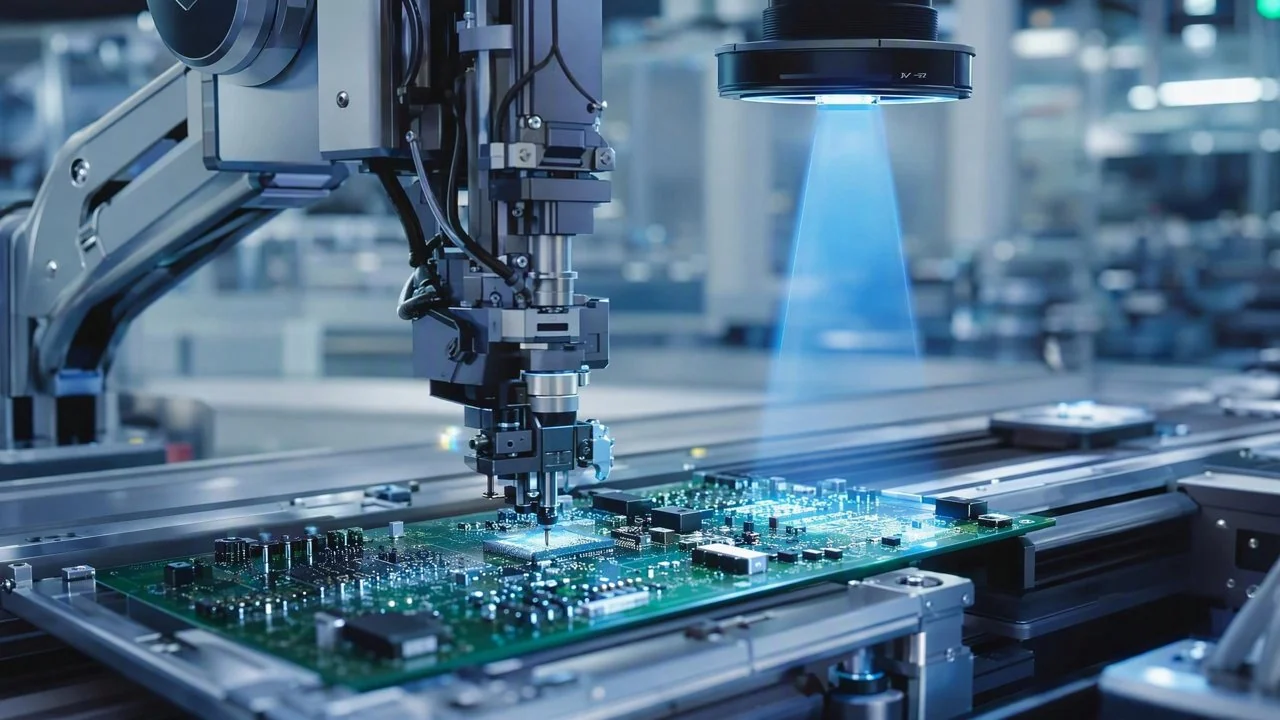
DaoAI ACI OS (featuring vision foundation models for feature recognition, 5-minute 0-code programming with one good sample, APDT positive/few-shot learning from 1–20 good samples, semantic false positive filtering, and SDK/API/Docker for 100% on-premise deployment) achieves over 95% replacement of manual inspection for PCBA connector misplacement and missing components through high-precision, high-efficiency automated visual inspection, significantly reducing labor costs and operational risks for electronics manufacturing service (EMS) providers.
In the electronics manufacturing industry, the assembly quality of PCBAs (Printed Circuit Board Assemblies) directly determines the performance and reliability of final products. With increasing integration of electronic products, the number of components on PCBAs has surged, especially various connectors, which come in a wide variety, demanding extremely high precision in installation direction and position. Traditionally, detecting defects such as connector misplacement, missing components, or incorrect assembly after PCBA assembly heavily relies on manual visual inspection. However, manual inspection is not only inefficient but also prone to missed detections or false positives due to factors like eye fatigue and subjective judgment, leading to increased rework costs and product quality risks. Especially in the context of continuously rising labor costs, seeking efficient, reliable, and automated inspection solutions that can replace human labor has become an urgent priority for electronics manufacturers.
Pain Points: Why This Hurdle Is Difficult to Overcome
In the specific domain of PCBA connector misplacement and missing component detection, traditional inspection methods face multiple challenges. First, there are **high labor costs**. Production line data from a major electronics EMS provider shows that for connector inspection alone, peak periods require dozens of experienced inspectors working 8-hour shifts, resulting in monthly labor costs reaching hundreds of thousands of RMB. Second, **persistently high rates of missed detections and false positives**. Due to the wide variety of connectors, their diverse package types, colors, and reflective properties, manual visual inspection, especially during long working hours, can lead to a missed detection rate of 1-3%, while the false positive rate often hovers around 5%. This results in a large number of good products being incorrectly identified as defective, increasing the workload for re-inspection and rework. Furthermore, **inefficient changeover** is a significant problem. When the production line switches product models, inspectors need to be retrained to recognize new connector types and installation standards, typically causing several hours or even half a day of downtime, severely impacting production line rhythm. Finally, **difficulty in standardizing inspection criteria**. Subjective differences in defect judgment among various inspectors make quality control challenging to standardize and trace, leading to potential compliance risks.
The root cause of these dilemmas lies in the complexity of connector inspection. Connectors are often small, with dense pins, and may exhibit subtle misalignments, tilts, deformations, or insufficient solder, which are often not visually obvious. At the same time, the dense components on the PCBA surface, shadows, reflections, silkscreen characters, and other background noise severely interfere with imaging quality and defect recognition algorithms, posing extremely high demands. Traditional rule-based AOI (Automated Optical Inspection) systems, when faced with the diversity and complexity of connectors, require extensive and complex rule programming. They also exhibit poor robustness to lighting and background variations, leading to high false positive rates. Each product changeover necessitates hours or even days of rule adjustments and parameter optimization, making it difficult to meet the demands of flexible production. The current industry hot topic focusing on real-time scheduling optimization and engineering deployment challenges of multi-model collaboration in apparel AI quality inspection shares similarities with the electronics industry's challenge of efficiently deploying and managing multi-dimensional visual inspection models in complex scenarios to achieve real-time scheduling and optimization. Both highlight the lack of generalization ability and deployment flexibility of traditional solutions in complex environments.
Technical Principles
DaoAI ACI OS fundamentally resolves these challenges, leveraging the feature recognition capabilities of **vision foundation models**. Unlike traditional AOI, which relies on engineers manually setting rules, DaoAI ACI OS can automatically learn and extract complex visual features of connectors from images through deep learning, including their shape, color, texture, pin arrangement, and relative relationship with the surrounding environment. This “feature recognition” capability allows the system to understand “what constitutes a normal connector” and “what is a misplacement or missing component” much like an experienced inspector. Specifically, it employs APDT (Automated Positive Data Training) technology, requiring only 1-20 good sample images to complete model training, significantly lowering the barrier for sample collection and annotation. Its **5-minute 0-code automatic programming** capability means that even non-specialized personnel can configure new product inspection programs in an extremely short time, reducing changeover time from hours to minutes.
Compared to traditional methods, the advantages of DaoAI ACI OS are evident on multiple levels. Firstly, its vision foundation model-based recognition capability offers strong robustness to lighting variations, minute component deformations, and background noise, significantly reducing the false positive rate. Secondly, the system's built-in **semantic false positive filtering** mechanism can understand contextual information in images, identifying visually apparent defects that are not actual quality issues (false positives), such as those caused by light reflections or silkscreen characters, further enhancing detection accuracy and reliability. This is fundamentally different from traditional AOI, which relies solely on pixel-level or geometric rules and often struggles to distinguish between real and false defects. Moreover, DaoAI ACI OS supports SDK/API/Docker for 100% on-premise private deployment, ensuring data security and low-latency operation, meeting the stringent requirements of the electronics manufacturing industry for data never leaving the factory. In a practical application at a leading electronics EMS provider, the DaoAI ACI OS successfully **kept the missed detection rate below 0.3%**, far superior to average manual inspection levels, and **reduced the false positive rate by over 80%**, substantially decreasing the workload for manual re-inspection.
Typical Application Scenarios
- **USB/HDMI/FPC Connector Orientation and Position Detection**: These connectors often suffer from reversed orientation, tilting, or incomplete insertion due to improper manual handling. DaoAI ACI OS can precisely identify the keying, pin orientation, and body position of connectors, determining if they conform to design standards. The challenge lies in the complex internal structures of connectors, significant variations between models, and potential interference from reflective glare.
- **Pin Header/Female Header Missing Solder and Cold Solder Joint Detection**: Pin headers and female headers are common board-to-board connectors, and their solder joint quality is critical. DaoAI ACI OS can analyze image features of the pin pad areas to detect defects such as missing solder, cold solder joints, or insufficient solder volume. The difficulty stems from the small size of solder joints, potential obscuration by the connector body, requiring high-resolution imaging and sensitive detection of minute defects.
- **SIM Card Slot/SD Card Slot and Other Irregular Connector Assembly Integrity**: These connectors have irregular shapes and often contain movable parts, prone to issues like unlatched buckles, deformed internal contacts, or missing components. DaoAI ACI OS can perform comprehensive inspection of the overall appearance and critical parts of irregular connectors to ensure assembly integrity. Challenges include complex backgrounds due to irregular structures and indirect judgment of hidden internal defects.
- **Cable Harness and Connector Insertion Depth and Latch Status**: In some PCBA applications, the insertion depth of cable harnesses into connectors and whether the latches are fully engaged are critical quality points. DaoAI ACI OS can identify cable harness color, position, and the physical status of connector latches to determine if they are fully connected. Difficulties arise from the flexible nature of cable harnesses, leading to variable forms, and small, potentially obscured latches.
Case Study
A leading Tier-1 electronics EMS provider, whose production lines are primarily responsible for assembling core PCBAs for smart wearable devices, faced severe challenges in detecting connector misplacement and missing components before adopting DaoAI ACI OS. The factory produced tens of thousands of PCBAs daily, with each board integrating 5-8 different types of connectors, leading to immense pressure on manual visual inspection. During peak periods, 30 workers were required to work in shifts for inspection. Before deployment, **the average missed detection rate for manual inspection was approximately 1.8%**, resulting in about 30-50 PCBAs per batch being found with connector defects during final system testing, incurring high rework costs. Concurrently, **the average false positive rate for manual re-inspection reached 6%**, meaning hundreds of good PCBAs were misidentified as defective each day, adding an extra 40-50 hours of manual re-inspection labor.
To address these issues, the factory deployed the DaoAI ACI OS solution. After an initial two-week integration and model training phase, the system officially went live. Post-deployment, DaoAI ACI OS achieved high-precision detection for all connector types. **Production line data indicated that its missed detection rate was consistently controlled below 0.4%, representing a 77% reduction compared to manual inspection**. More critically, **the false positive rate significantly dropped to 1.2%**, leading to a **reduction in manual re-inspection hours by over 75%**, from 40-50 hours per day to 10-12 hours. Furthermore, thanks to the 0-code automatic programming capability of DaoAI ACI OS, new product changeover time was reduced from an average of 4 hours to **less than 10 minutes**, greatly enhancing production line flexibility and utilization. In this case, the successful deployment of DaoAI ACI OS directly led to the optimization of personnel allocation in the factory's inspection department, **saving millions of RMB in labor costs annually**.
DaoAI ACI OS didn't just replace manual inspection; it transformed our understanding of PCBA quality control, moving from reliance on experience to data-driven, and from high-cost, low-efficiency to intelligent, lean production.
DaoAI Solutions and Products
DaoAI provides a comprehensive solution for PCBA connector misplacement/missing component detection, centered around the ACI OS operating system. In the modeling phase, engineers or production line technicians only need to provide a small number (1-20) of good sample images, and DaoAI ACI OS automatically completes model training through its APDT technology, eliminating the need for complex defect samples. For production line changeovers, its 5-minute 0-code automatic programming feature allows users to quickly switch inspection tasks through simple parameter configuration and a one-time good sample learning process, greatly improving production efficiency. For deployment, DaoAI ACI OS offers various integration methods such as SDK/API/Docker, supporting 100% on-premise private deployment, ensuring customer data security and independent operation of production systems. This means all inspection data and model inference are performed locally at the customer's site, with data never leaving the factory, meeting stringent industry compliance requirements.
Beyond the core ACI OS, DaoAI can also provide complementary 2D / 3D ACI equipment based on customer needs, such as those equipped with self-developed high-precision 3D cameras for detecting defects like connector pin coplanarity and micron-level morphological deviations that are difficult to capture in 2D. For more complex assembly guidance or disorganized bin picking scenarios, DaoAI Robot Vision solutions (e.g., 6D pose recognition, bin picking) can also work synergistically with ACI OS to build an intelligent manufacturing system with a closed-loop of 'brain-eye-body.' These collaborative products collectively provide customers with end-to-end support, from defect detection to intelligent manufacturing. In the aforementioned case, the solution, primarily driven by DaoAI ACI OS, **increased the replacement rate of manual inspection for PCBA connector detection to over 95%**, achieving significant business value including substantial reductions in labor costs, improved product quality, shortened changeover times, enhanced production line flexibility, and enabled quality data traceability.
FAQ
How does DaoAI ACI OS achieve '5-minute 0-code automatic programming with one good sample' for PCBA connector inspection?
DaoAI ACI OS utilizes APDT (Automated Positive Data Training) technology. Users only need to provide 1-20 good sample images, and the system automatically learns the normal features of the connector through vision foundation models. Coupled with an intuitive graphical interface, users can complete detection zone setup and parameter configuration within 5 minutes, without writing any code, significantly simplifying the new product introduction process.
How can the deployment cost and ROI period for the DaoAI ACI OS solution be estimated?
The deployment cost of DaoAI ACI OS is influenced by various factors, including the number of inspection stations, required hardware configuration (cameras, lighting, industrial PCs, etc.), and whether robot vision integration is needed. Typically, by significantly reducing manual inspection costs, minimizing rework, and increasing production line utilization, customers can recover their initial investment within 6-18 months. We recommend contacting the DaoAI expert team for a customized cost analysis and detailed quotation.
How does DaoAI ACI OS ensure data security and on-premise private deployment?
DaoAI ACI OS fully supports 100% on-premise private deployment, meaning all image data, inspection results, and model inference processes are completed on the customer's local servers or devices. The system provides SDK/API/Docker interfaces for integration into existing production management systems, ensuring data never leaves the factory. This meets stringent customer requirements for data sovereignty and security, while also guaranteeing extremely low detection latency.
Full solution for this scenario: ACI OS industry solutions
This article was generated by AI. Customer cases are simulated scenarios based on real product capabilities and figures are illustrative; see product pages for official benchmarks.