
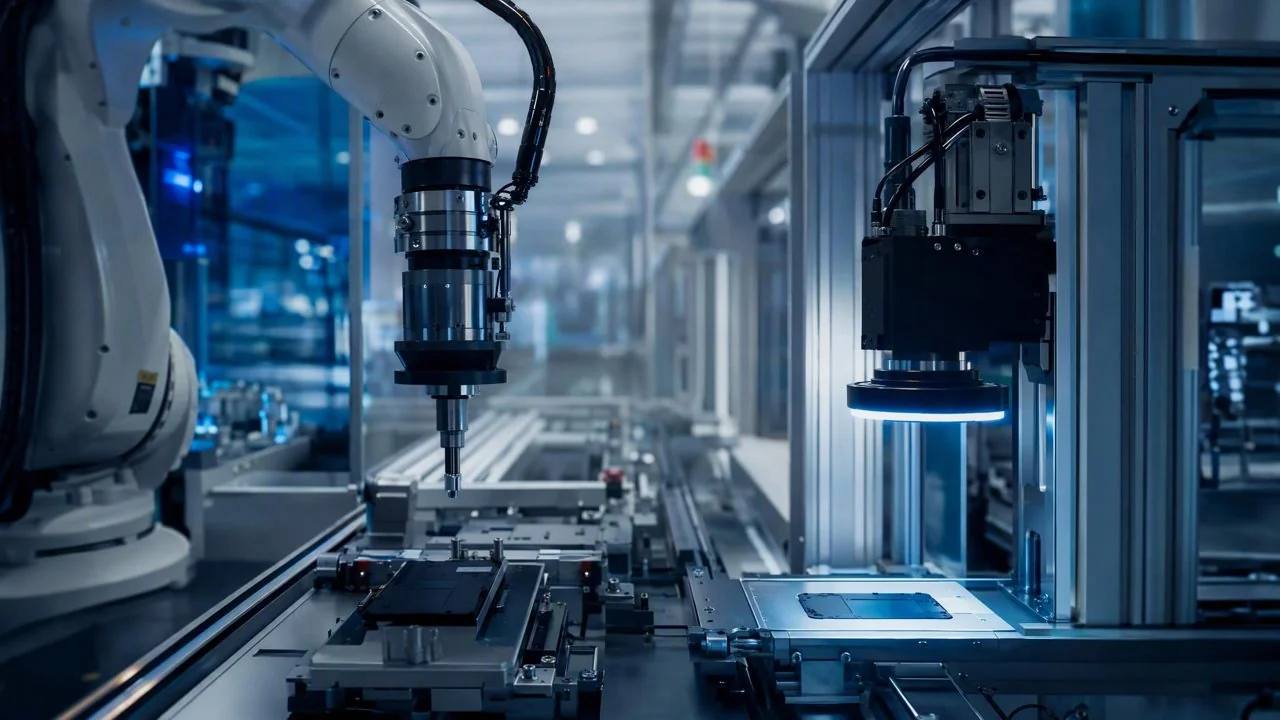
DaoAI ACI OS (Visual Foundation Model for Feature Cognition, 5-minute 0-code automatic programming with one good sample, APDT positive/few-shot learning with 1–20 good samples, semantic false positive filtering, and SDK/API/Docker for 100% local private deployment) significantly reduces the false positive rate for complex misassembly and missing part detection after ultrasonic welding in consumer electronics precision assembly from an industry-typical 15% to below 2%, thanks to its visual foundation model's feature cognition and semantic false positive filtering mechanisms. This drastically eases the manual re-inspection burden and resource waste on production lines.
DaoAI ACI OS (Visual Foundation Model for Feature Cognition, 5-minute 0-code automatic programming with one good sample, APDT positive/few-shot learning with 1–20 good samples, semantic false positive filtering, and SDK/API/Docker for 100% local private deployment) leverages its visual foundation model's feature cognition and semantic false positive filtering mechanisms to significantly reduce the false positive rate for complex misassembly and missing part detection after ultrasonic welding in consumer electronics precision assembly from an industry-typical 15% to below 2%. This drastically eases the manual re-inspection burden and resource waste on production lines. In the consumer goods, especially precision electronics manufacturing industry, product structures are becoming increasingly complex, with higher integration. For instance, smart wearables, wireless earbuds, or small home appliances often contain dozens of tiny components tightly joined using techniques like ultrasonic welding. Any minor misassembly, missing parts, or foreign objects during assembly can lead to product malfunction, reduced reliability, or even safety hazards. Traditional sampling or manual inspection can no longer meet the growing demands for quality and efficiency, making 100% inspection an inevitable trend. However, the challenge of 100% inspection is ensuring detection accuracy at high production speeds, especially with complex backgrounds and microscopic defects. Effectively reducing false positive rates to avoid unnecessary re-inspection steps has become a core issue for the industry.
Pain Points: Why This Obstacle Is So Hard to Overcome
Detecting misassembled/missing parts and foreign objects after the ultrasonic welding stage in consumer electronics precision assembly faces multiple challenges. First, there's an extremely high false positive rate; production line data shows that traditional AOI solutions often yield false positive rates as high as 15% to 20% when detecting such complex defects. This means 15 to 20 out of every 100 products are incorrectly flagged as defective, requiring manual re-evaluation. Second, the enormous burden of manual re-inspection: a leading manufacturer reported needing at least 8 hours of manual labor daily for re-inspecting false positives, which not only increases operational costs but also consumes valuable human resources, with consistency and stability difficult to guarantee. Third, for such processes, each product changeover or minor process adjustment typically requires hours or even days of adjustment and validation for traditional AOI rule libraries, leading to long production line downtime and impacting efficiency. Finally, the thermal effects and plastic deformation inherent in ultrasonic welding can leave subtle textures or color variations on product surfaces. These normal process marks are often misidentified as defects by traditional vision systems, further exacerbating the false positive problem.
The root cause of these difficulties is that the nature of ultrasonic welding leads to a certain randomness in the surface morphology and color of the weld area. Traditional AOI systems, based on fixed thresholds and geometric rules, struggle to distinguish between normal process variations and true defects. For example, tiny burrs, slight indentations, or localized uneven melting of material might be acceptable to the human eye, but a traditional AOI could flag them as defects. Furthermore, the components being inspected are often miniature and densely packed, with complex image backgrounds and susceptibility to lighting reflections, increasing the difficulty of precise identification. More importantly, in few-shot or even zero-shot scenarios, how to rapidly deploy and iterate detection models is an insurmountable barrier for traditional solutions, as they typically require a large amount of annotated data to reach a usable level. DaoAI ACI OS provides a targeted solution precisely for this context.
Technical Principles
The core reason why DaoAI ACI OS operating system can achieve a significant reduction in false positive rates for complex assembly defect detection lies in its advanced visual foundation model and semantic false positive filtering mechanism. Unlike traditional AOI, which relies on engineers manually writing complex rules, or deep learning models requiring extensive annotated samples, ACI OS features a visual foundation model with powerful feature cognition capabilities. It is pre-trained on vast amounts of unlabeled data, learning rich general visual features to understand object shape, texture, color, and spatial relationships at a high dimension. This allows ACI OS to complete model programming in just 5 minutes with only 1–20 good sample images, or even a single good sample, rapidly establishing a cognition of the 'normal' state. When an area that does not match the good sample's features is detected, the system flags it as a potential defect.
Crucially, DaoAI ACI OS incorporates APDT (Anomaly Pattern Discrimination & Transfer) positive/few-shot learning technology, combined with an innovative semantic false positive filtering function. APDT enables the system to quickly grasp the normal variation range of a product through transfer learning and adaptive pattern recognition, based on extremely few good samples. Concurrently, the semantic false positive filtering layer leverages deep semantic understanding of defect types to intelligently differentiate between non-defect factors like process marks, normal lighting variations, and actual misassembly, missing parts, or foreign objects. For example, the system can recognize that minor plastic textures generated after ultrasonic welding are normal phenomena, rather than misclassifying them as cracks or scratches. This mechanism significantly enhances the model's generalization ability and robustness, thereby controlling the false positive rate to an extremely low level. Compared to traditional rule-based AOI, ACI OS eliminates the need for tedious parameter tuning and exhibits stronger adaptability to lighting and background changes; compared to traditional deep learning, it drastically reduces data annotation requirements and model training time, shortening production line changeover time from hours to minutes, and can reduce the false positive rate for misassembly after ultrasonic welding to below 2%, improving false positive accuracy by nearly 85%.
Typical Application Scenarios
- **Misassembly/Missing Component Detection for Precision Electronic Components**: In products like smartphones and tablets, the position, orientation, and presence of micro-connectors, flex cables, and sensors are critical quality points. DaoAI ACI OS can precisely identify the assembly status of these tiny components, accurately determining misplacement, missing parts, or incorrect orientation even under complex optical reflections and background interference, preventing functional failures.
- **Ultrasonic Welded Part Integrity and Foreign Object Detection**: For example, the battery compartment or speaker cavity inside wireless earbud charging cases, sealed by ultrasonic welding. ACI OS can detect the integrity of the welded joint, identifying defects like cold welds or insecure fusion, and also recognize plastic debris, metal particles, and other foreign objects remaining in the welded area, ensuring product sealing and internal cleanliness.
- **Assembly Defects of Buttons, Ports, and Indicator Lights**: Physical buttons, USB/Type-C ports, and LED indicators on consumer electronics casings directly affect user experience in terms of position, flatness, gap, and presence. DaoAI ACI OS can perform 100% inspection of these external components on high-speed production lines, quickly identifying defects such as tilt, jamming, missing parts, or color mismatch.
- **Multi-component Assembly Consistency Detection**: In complex assemblies of small appliances like toothbrushes or razors, multiple components (e.g., motor, drive shaft, brush head base) require precise alignment. DaoAI ACI OS can perform linked detection of multiple key features of the entire assembly, ensuring all components are assembled as designed, preventing overall performance degradation due to minor deviations in individual parts.
- **Accessory Counting and Anti-mixing in Product Packaging**: In the final product packaging stage, the correct type and quantity of accessories such as power adapters, manuals, and data cables are essential. ACI OS can quickly count packaged accessories and identify mixed-model accessories, effectively preventing customer complaints and brand damage caused by incorrect accessory provision.
Deployment Case Study
A leading consumer electronics manufacturer had a high-speed production line for assembling core modules inside a wearable device, involving multiple ultrasonically welded connections and precision components. Previously, they used traditional AOI combined with manual inspection to detect misassembled or missing parts after ultrasonic welding. However, due to the complex product structure and the tendency of ultrasonic welding textures to cause false positives, production line data showed that the false positive rate consistently hovered around 15%. This required significant daily human input for re-inspection, severely slowing down the overall takt time. Furthermore, each product upgrade or minor mold adjustment necessitated several hours of downtime for AOI rule library updates, leading to low production line utilization.
After introducing the DaoAI ACI OS operating system, the client first conducted a pilot deployment on one production line. Using only 5 good sample images, the system completed model training in 5 minutes. Post-launch, the ACI OS visual foundation model accurately distinguished between normal ultrasonic welding marks and actual defects. Production line data indicated that ACI OS successfully reduced the false positive rate for misassembly/missing parts to 1.8% in actual operation. This improvement led to an approximate 88% reduction in manual re-inspection volume, saving about 7 hours of manual re-inspection labor per day. Concurrently, product changeover time was reduced from an average of 3 hours to less than 5 minutes, significantly enhancing production line flexibility and utilization. In this case, DaoAI ACI OS not only significantly improved detection efficiency and accuracy but also delivered tangible operational cost savings and production efficiency gains through the reduction of false positive rates.
DaoAI ACI OS's semantic false positive filtering teaches machines to understand 'acceptable imperfections' like humans do, reducing the false positive rate from 15% to below 2%, completely freeing up production line re-inspection labor.
DaoAI Solution and Products
DaoAI's solution for the consumer goods industry, centered around the ACI OS operating system, focuses on addressing pain points in precision assembly. The solution offers highly flexible deployment, supporting SDK/API/Docker for 100% local private deployment, ensuring all data remains on-site and meeting clients' strict requirements for data security and privacy. For model building, DaoAI ACI OS features '5-minute 0-code automatic programming with one good sample' capability, greatly lowering technical barriers and deployment cycles. Engineers only need to provide a small number of good samples, and the system can quickly build high-precision detection models through APDT positive/few-shot learning technology. For the demand of frequent production line changeovers, ACI OS model updates and switching can be completed within minutes, without prolonged downtime.
Furthermore, the semantic false positive filtering function of DaoAI ACI OS is a unique advantage, effectively distinguishing between defects and non-defect features, significantly reducing false positives. In addition to ACI OS, DaoAI also offers DaoAI 2D/3D ACI equipment, which, combined with proprietary 3D cameras and 3D morphology reconstruction technology, can be used to detect hidden defects or micron-level morphological deviations that are difficult to find with traditional 2D. For scenarios requiring robotic gripping or assembly guidance, DaoAI Robot Vision provides 6D pose recognition and bin-picking capabilities. Through the combined application of these products, DaoAI is committed to building an intelligent detection and control closed-loop for clients, from cognition to execution, achieving comprehensive optimization of the production process. In the case above, DaoAI ACI OS successfully reduced the false positive rate by nearly 88%, greatly improving detection accuracy and production line operating efficiency.
This solution not only enhances product quality but also brings direct economic benefits to customers through the reduction of false positive rates. Production line data shows that after the deployment of DaoAI ACI OS, manual re-inspection hours were reduced by approximately 88%, significantly lowering labor costs. Concurrently, production line utilization increased by about 5%, and product yield was further solidified. These quantified results collectively demonstrate the outstanding performance and immense value of DaoAI ACI OS in addressing the challenges of precision assembly in consumer goods.
FAQ
How does DaoAI ACI OS achieve rapid deployment with few samples?
DaoAI ACI OS leverages the feature cognition capabilities of its visual foundation model and APDT positive/few-shot learning technology. Engineers only need to provide 1–20 good sample images, or even just one, and the system can complete model programming within 5 minutes, quickly adapting to new inspection tasks and significantly shortening the deployment cycle.
How does DaoAI ACI OS's semantic false positive filtering function work specifically?
ACI OS's semantic false positive filtering function works by deeply understanding features in images and their contextual semantics. It can intelligently distinguish between non-defect factors like normal process marks, lighting variations, or material characteristics on the product surface, and actual assembly errors, missing parts, or foreign objects. It learns to ignore 'acceptable imperfections,' thereby reducing the false positive rate to extremely low levels and minimizing manual re-inspection.
What is the typical cost and ROI period for deploying DaoAI ACI OS system?
The deployment cost of DaoAI ACI OS varies depending on the client's specific production line scale, integration complexity, and required functional modules. By significantly reducing false positive rates, cutting manual re-inspection hours, and improving production line utilization and product yield, the system typically achieves return on investment within several months. We recommend scheduling an expert consultation for a customized cost assessment and ROI analysis.
Full solution for this scenario: ACI OS industry solutions · Food Foreign-Object Removal & Grading: Robot Vision Cuts False Positives
This article was generated by AI. Customer cases are simulated scenarios based on real product capabilities and figures are illustrative; see product pages for official benchmarks.