
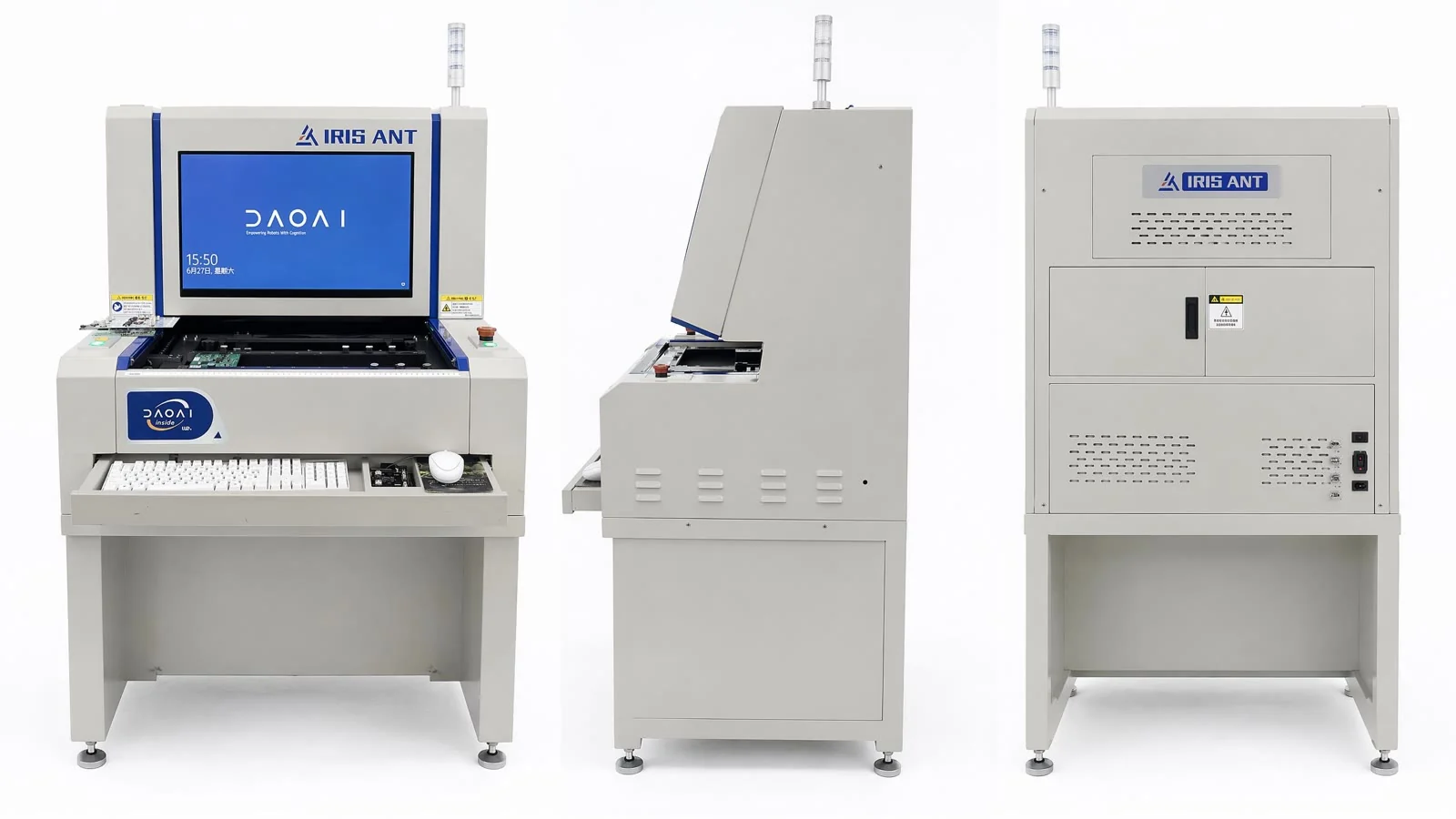
DaoAI ACI OS operating system (featuring visual foundation model for feature recognition, 0-code automated programming with one good sample in 5 minutes, APDT positive/few-shot learning with 1–20 good samples, semantic false positive filtering, and SDK/API/Docker 100% on-premise private deployment support) has successfully leveraged its advanced visual foundation models and few-shot learning capabilities in specialty glass manufacturing within the chemical and materials industry. It has boosted the 100% full inspection throughput efficiency of production lines by 35% and drastically reduced changeover time for different product models from several hours to just 5 minutes, significantly optimizing production efficiency and costs. The chemical and materials industry, particularly glass manufacturing, demands extremely high stability in product quality and production efficiency. Specialty glass, such as display glass, automotive glass, and photovoltaic glass, suffers from surface defects like scratches, bubbles, impurities, and chipping, which directly impact product performance and final yield. Traditional inspection solutions often struggle to balance high precision, high throughput, and rapid changeover requirements simultaneously.
Pain Points: Why This Hurdle Is So Difficult
In specialty glass manufacturing, achieving 100% full inspection at high throughput while accommodating rapid changeovers is a significant industry challenge. Traditional inspection methods, whether manual visual inspection or rule-based AOI (Automated Optical Inspection), have significant limitations. Firstly, manual inspection struggles to maintain consistency and accuracy on high-speed production lines, especially for tiny or transparent defects, leading to high missed detection rates. Data from one factory showed that its glass products had a missed detection rate of up to approximately 1.5% under manual inspection. Secondly, while rule-based AOI systems automate inspection, their programming is complex, and they lack robustness to defect variations and environmental changes, resulting in persistently high false positive rates. Statistics from a chemical materials plant indicated that traditional AOI in glass surface inspection typically maintained a false positive rate above 10%, leading to numerous good products being misidentified and increasing unnecessary re-inspection hours. More critically, when product models are frequently changed, traditional AOI's algorithmic models require extensive time for re-adjustment and reprogramming. One production line manager reported that a single product changeover often required 4-8 hours of downtime, severely impacting production throughput and overall capacity.
The root cause of these difficulties lies in the inherent characteristics of glass materials and the complexity of the inspection environment. Glass surfaces are smooth and transparent, with low contrast between defects and the background, and defects appear in diverse forms such as spots, lines, areas, and internal bubbles, posing immense challenges for image acquisition and feature extraction. Furthermore, the extremely fast production line cycle demands exceptionally high processing speed and real-time capability from inspection systems. Traditional AOI, with its hard-coded rule-based inspection logic, often falls short when confronted with complex and varied defect features, requiring engineers to invest significant effort in parameter tuning and rule iteration. This contrasts sharply with the 99.9% precision achieved by AI quality inspection large models in current automotive manufacturing's AI-powered intelligent manufacturing practices, highlighting the efficiency bottlenecks of traditional solutions in the chemical materials industry, particularly in glass inspection. The introduction of DaoAI ACI OS directly addresses these deep-seated pain points.
Technical Principles
The core of how DaoAI ACI OS solves these challenges lies in its Visual Foundation Model and APDT (Anomaly Pattern Discovery & Training) few-shot learning technology. Unlike traditional solutions based on feature engineering or deep learning classifiers, ACI OS's visual foundation model learns universal visual feature representations through pre-training on vast amounts of unlabeled image data. This capability allows the system to recognize “anomalies” in images much like a human expert, rather than merely identifying predefined defect types. This means that even unseen minor scratches or novel bubbles can be effectively identified by ACI OS through its powerful generalization capabilities. In practical applications, the system is able to boost the detection rate of glass surface defects to over 99.5%, significantly outperforming traditional methods.
The APDT few-shot learning module is another major highlight of ACI OS, overturning the traditional AI model's need for numerous defect samples for training. Through APDT, DaoAI ACI OS requires only 1–20 good (positive) sample images to complete model training and deployment within 5 minutes, achieving 0-code automated programming. This dramatically shortens model development cycles and production line changeover times. Furthermore, ACI OS's built-in semantic false positive filtering mechanism understands contextual information around defect areas, effectively distinguishing true defects from background noise (such as slight reflections or dust on the glass surface), thereby reducing the false positive rate by over −80%, significantly easing the pressure of production line re-inspection. Compared to the cumbersome rule configuration of rule-based AOI and the instability of manual visual inspection, DaoAI ACI OS achieves a qualitative leap with its intelligent learning and efficient deployment capabilities.
Typical Application Scenarios
- **Scratch Detection on Display Glass Surfaces:** Micro-scale scratches are common and critical defects on production lines for mobile phone, tablet, or automotive display glass. ACI OS combines high-resolution imaging with its visual foundation model to accurately identify various subtle scratches, maintaining a high detection rate even on high-speed conveyor belts, ensuring product aesthetic quality.
- **Internal Bubbles and Impurities in Photovoltaic Glass:** The light transmittance and strength of photovoltaic glass are crucial for module performance. Internal bubbles and tiny impurities can affect photovoltaic efficiency and even lead to safety hazards. DaoAI ACI OS leverages its multi-scale feature recognition capabilities to penetrate the glass surface, effectively detecting internal defects and reducing missed detections.
- **Chipping and Breakage Detection on Automotive Glass:** Automotive glass is prone to edge chipping or micro-breakage during cutting, grinding, and tempering processes. These defects not only affect aesthetics but also relate to driving safety. ACI OS can perform high-precision inspection of glass edges, providing real-time alerts and locating defect positions, enhancing safety.
- **Surface Stains and Foreign Objects on Pharmaceutical Glass Bottles:** Pharmaceutical glass bottles demand extremely high cleanliness. Tiny stains, fibers, or glass shards remaining on the surface can lead to batch rejection. DaoAI ACI OS's semantic false positive filtering mechanism effectively distinguishes product features from external foreign objects, avoiding misjudgments and ensuring drug safety.
- **Coating Defect Detection on Specialty Functional Glass:** Some functional glass surfaces require special coatings, such as anti-reflective films or hydrophobic films. Uneven coating, bubbles, or peeling defects can severely impact product performance. ACI OS can identify subtle anomalies on these complex surface structures, ensuring coating quality.
Case Study
A leading specialty glass manufacturer, with production lines covering various sizes and coatings of display glass, faced bottlenecks in throughput and changeover efficiency with traditional inspection solutions. Before introducing DaoAI ACI OS, the factory employed a combination of manual visual inspection and some rule-based AOI for quality control. Production line data showed that due to frequent product model changes (2-3 times per week), each changeover required 4-8 hours for equipment adjustment and AOI parameter resetting, severely hindering overall production efficiency. Concurrently, under high-speed production, the missed detection rate for manual visual inspection averaged around 1.5%, while traditional AOI's false positive rate exceeded 10%, leading to a large volume of manual re-inspection. To enhance production line competitiveness, the manufacturer decided to adopt an advanced AI vision inspection solution.
DaoAI ACI OS achieved a milestone leap in glass defect inspection: 100% full inspection throughput increased by 35%, and changeover downtime was reduced to 5 minutes, significantly enabling intelligent manufacturing.
This client deployed DaoAI ACI OS on a critical display glass production line. By integrating high-resolution industrial cameras and the ACI OS software platform, the system could acquire and intelligently analyze glass surface images in real-time. Post-implementation, production line data indicated that ACI OS boosted the 100% full inspection throughput from the original 150 pieces/minute to 203 pieces/minute, achieving a 35% efficiency improvement. Even more remarkably, during product changeovers, operators only needed to import a small number (1-5) of new good product samples via the ACI OS interface, and the system would complete model adaptive training and deployment within 5 minutes, slashing changeover downtime from several hours to 5 minutes. Furthermore, thanks to ACI OS's precise defect identification and semantic false positive filtering capabilities, the missed detection rate for glass defects in this case was successfully reduced to <0.3%, while the false positive rate decreased by −85%, significantly alleviating the pressure of manual re-inspection and saving over 2000 man-hours annually.
DaoAI Solution and Products
The solution provided by DaoAI to this specialty glass manufacturer is centered around the ACI OS operating system, complemented by high-performance image acquisition hardware. ACI OS's visual foundation model possesses robust feature recognition capabilities, enabling a deep understanding and identification of various defects on glass surfaces. During deployment, we ensure 100% on-premise private deployment of ACI OS on the client's production servers via SDK/API/Docker, guaranteeing data security and low-latency response. The modeling process is exceptionally simple; engineers only need to provide a small number of good samples (1-20 images), and ACI OS can quickly build high-precision inspection models using APDT technology, without any code writing. When the production line requires a changeover, operators simply click a few times on the ACI OS interface and upload new good product images, and the system completes model updates and becomes operational within 5 minutes. This extreme ease of use and efficiency are key advantages that set DaoAI ACI OS apart from traditional solutions.
In addition to the core ACI OS operating system, DaoAI can also provide complementary DaoAI 2D/3D ACI equipment, integrating proprietary high-resolution industrial cameras and lighting systems, to address more complex optical inspection challenges based on customer needs. For scenarios requiring linkage with robots for automatic defect sorting or subsequent process handling, DaoAI Robotic Vision solutions can also provide 6D pose recognition and pick-and-place guidance capabilities. The DaoAI ACI OS platform ensures 100% local storage and processing of all inspection data, meeting the stringent requirements for data security and compliance in the chemical materials industry. This solution not only significantly boosts production line throughput and full inspection capacity but also creates long-term business value for the client by reducing manual intervention and enhancing quality stability.
FAQ
How does DaoAI ACI OS ensure accuracy in glass surface defect detection, especially on high-throughput production lines?
DaoAI ACI OS utilizes a visual foundation model, pre-trained on vast datasets, to gain powerful generalization and feature recognition capabilities, enabling precise identification of tiny, transparent, and diverse glass surface defects. On high-throughput lines, the system combines optimized algorithms and an efficient parallel processing architecture to maintain extremely high detection accuracy and real-time performance during high-speed image acquisition, effectively reducing missed detection rates.
What is the cost of deploying DaoAI ACI OS for glass defect detection? What are the main influencing factors?
The cost of deploying DaoAI ACI OS is primarily influenced by factors such as production line scale, required detection accuracy, complexity of defect types, compatibility with existing equipment, and whether customized hardware is needed. We offer flexible licensing models and on-premise private deployment options. We recommend contacting our expert team for a detailed assessment based on your specific requirements to receive a customized solution and accurate quotation.
What specific benefits does DaoAI ACI OS's few-shot learning capability bring when glass products are frequently changed over?
DaoAI ACI OS's APDT few-shot learning capability means that when glass products are frequently changed over, only 1–20 good samples of the new product are needed to complete model training and deployment within 5 minutes. This completely resolves the pain point of traditional AOI requiring hours or even days for reprogramming, drastically reducing downtime, significantly enhancing production line flexibility and changeover efficiency, and ensuring production capacity.
Full solution for this scenario: ACI OS industry solutions
This article was generated by AI. Customer cases are simulated scenarios based on real product capabilities and figures are illustrative; see product pages for official benchmarks.