
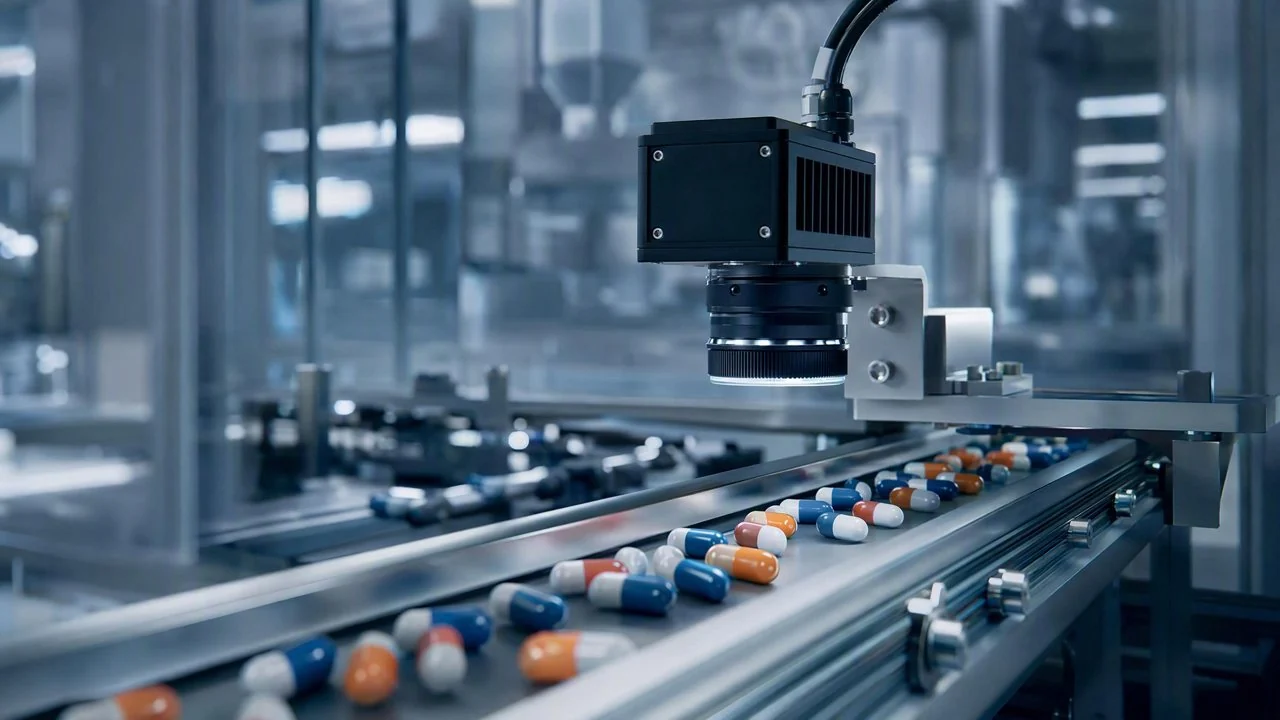
DaoAI ACI OS (featuring visual foundation model for feature recognition, 0-code automated programming with one good sample in 5 minutes, APDT few-shot learning with 1-20 good samples, semantic false positive filtering, and SDK/API/Docker support for 100% on-premise deployment) dramatically reduced changeover downtime from an average of 2 hours to under 5 minutes for a leading pharmaceutical enterprise's multi-variety small-batch capsule production line, significantly enhancing production line flexibility and efficiency. In the pharmaceutical industry, especially in oral solid dosage manufacturing, capsules are common drug carriers whose appearance quality directly impacts drug safety and patient compliance. However, facing growing personalized medication demands and market segmentation, pharmaceutical companies commonly encounter challenges in multi-variety small-batch production, where traditional inspection solutions struggle to adapt to frequent changeover requirements.
In the pharmaceutical industry, capsule manufacturing involves multiple stages, from filling and sealing to polishing and sorting. Among these, appearance defect inspection is a critical step to ensure product quality and regulatory compliance. Common capsule defects include, but are not limited to: color variations, scratches, dents, breakages, foreign objects, deformation due to under- or over-filling, and blurry or missing printing. Especially for oral solid dosage forms, any subtle defect can impact drug stability and patient adherence. Traditional inspection methods often rely on manual visual inspection or rule-based AOI (Automated Optical Inspection) systems. However, with the growing demand for small-batch, multi-variety production, pharmaceutical companies require more flexible and efficient inspection solutions to adapt to frequent product changeovers. For instance, a leading pharmaceutical manufacturer, whose capsule product line covers hundreds of different specifications, colors, and dosage forms, may need to perform multiple changeovers daily. Each changeover means production line downtime and complex parameter adjustments, severely limiting production efficiency.
Pain Points: Why This Hurdle Is Difficult to Overcome
Multi-defect capsule inspection in multi-variety, small-batch production faces multiple pain points. First, **high changeover costs and downtime** are central challenges. Traditional AOI systems require engineers to manually adjust light sources, camera parameters, write new inspection rules, or load preset models when inspecting different types of capsules. Production line data from a pharmaceutical factory shows that each capsule changeover typically causes 1.5 to 2 hours of downtime, directly leading to significant daily production capacity losses. Second, **defect model training is time-consuming and requires a large number of samples**. For each new model or defect type, traditional machine learning models need numerous labeled samples for training, which is difficult to achieve in small-batch production, resulting in long new product launch cycles and poor flexibility. Third, **it's difficult to balance false positive and false negative rates**. Traditional rule-based AOI systems often struggle to distinguish between real defects and normal variations when dealing with complex and diverse capsule surface features (such as reflections, textures, subtle color differences), leading to high false positive rates and increased manual re-inspection burden. Conversely, reducing false positives often sacrifices detection rates, leading to missed defects and impacting product quality compliance. These issues collectively represent major obstacles for pharmaceutical companies in upgrading their capsule inspection automation.
The root causes of these difficulties are, first, the stringent regulatory requirements of pharmaceutical products demand extremely high stability and reliability from any vision system, with very low tolerance for false positives and false negatives. Second, the inherent diversity of capsule products (color, size, material, gloss) and the subtle, random nature of defects make traditional algorithms based on fixed features and thresholds difficult to generalize. For example, while ultrasonic welding technology, used to improve production efficiency and product quality in high-precision assembly lines, differs in mechanism from capsule appearance inspection, its pursuit of micron-level precision and high stability is analogous to the exacting demands for detail in capsule defect detection. Traditional solutions lack the 'cognitive' ability to understand defect features; they can only 'memorize' defects through numerous rules or samples. Once a product changes, previous experience is difficult to reuse, leading to extensive changeover programming.
Technical Principles
DaoAI ACI OS fundamentally addresses the aforementioned pain points. Its core technology lies in the **feature recognition capability of its visual foundation model**. Unlike traditional AOI, which relies on engineers to manually extract features and set rules, ACI OS's built-in visual foundation model learns and understands the underlying visual features of images through deep learning and self-supervised learning from large amounts of unlabeled data, forming a general understanding of “what is normal.” When specific defects need to be detected, it doesn't start learning from scratch. Instead, based on its existing general cognition, through the **APDT (Automated Programming with Data-driven Transfer) few-shot learning** mechanism, it only requires 1–20 good sample images to complete adaptive programming for new products within 5 minutes. This mechanism enables DaoAI ACI OS to quickly capture the normal morphology of new products and identify abnormalities—defects—that deviate from the normal state. Furthermore, its **semantic false positive filtering** function utilizes advanced contextual understanding to distinguish between image noise, normal texture variations, and true defect signals, significantly reducing the false positive rates common in traditional AOI systems.
Compared to traditional methods, the advantage of DaoAI ACI OS lies in its learning efficiency and generalization capabilities. Traditional rule-based AOI systems require engineers to write complex scripts and thresholds for each defect, which is time-consuming, labor-intensive, and sensitive to changes in lighting and background. While traditional deep learning-based AOI can reduce rule writing, it still requires hundreds or thousands of labeled defect samples for training, which is difficult to collect in real production, especially in small-batch, multi-variety scenarios. DaoAI ACI OS, however, completely changes this model with its **“0-code automated programming with one good sample in 5 minutes,”** drastically lowering the technical barrier and deployment cost. The system supports SDK/API/Docker for 100% on-premise private deployment, ensuring data security and stable line operation, meeting the stringent IT compliance requirements of the pharmaceutical industry.
Typical Application Scenarios
- **Capsule Appearance Size and Integrity Inspection**: DaoAI ACI OS can inspect if capsule length and diameter meet standards, and detect structural defects such as breakage, cracks, dents, or deformation. The challenge lies in the varying reflective properties of different colored and material capsules, and the detection of minute cracks. ACI OS's visual foundation model is better adapted to these optical variations.
- **Color Difference and Off-Color Capsule Detection**: During production, capsules may exhibit color differences or be mixed with off-color capsules due to material mixing or contamination. DaoAI ACI OS can accurately identify capsules that do not match the standard color through its fine-grained cognitive understanding of color features. The difficulty is distinguishing subtle color variations from different raw material batches; ACI OS's semantic false positive filtering can differentiate normal fluctuations from true color defects.
- **Surface Foreign Objects and Stains Detection**: Capsule surfaces may have dust, fibers, oil stains, or other foreign objects from the production environment. DaoAI ACI OS can detect these tiny attachments with micron-level precision. The challenge is distinguishing between the capsule's own texture and foreign objects; ACI OS's few-shot learning capability can quickly identify new types of foreign objects.
- **Printed Character Defect Detection (OCR/OCV)**: For capsules with printed information like batch numbers and expiration dates, DaoAI ACI OS can perform OCR (Optical Character Recognition) and OCV (Optical Character Verification) to detect issues such as blurry, missing, misaligned, or double-printed characters. The difficulty lies in distortions from printing on curved surfaces and varying contrast of different inks; ACI OS can accurately recognize characters in complex backgrounds through its feature recognition capabilities.
Implementation Case Study
A leading domestic pharmaceutical enterprise operates multiple high-speed capsule production lines, producing a wide variety of products, including hundreds of types of ordinary, enteric-coated, and sustained-release capsules. For a long time, this enterprise faced challenges with difficult changeovers and low efficiency in traditional AOI systems under a multi-variety, small-batch production model. Each product changeover required engineers to manually adjust inspection parameters and recalibrate, taking an average of 1.5 to 2 hours, severely impacting line utilization. The manual re-inspection process also consumed significant labor due to high false positive rates. After introducing the DaoAI ACI OS solution, the situation changed dramatically. In the initial deployment phase, we focused on their 20 main capsule products. Leveraging DaoAI ACI OS's “0-code automated programming with one good sample in 5 minutes” capability, production line data from the enterprise showed that the time required for each changeover was significantly reduced from an average of 2 hours to under 5 minutes. Simultaneously, in actual production, the system increased the comprehensive detection rate for various capsule defects to over 99.7%, while the false positive rate decreased from the traditional solution's 3%–5% to below 0.4%, greatly reducing the burden of manual re-inspection. In this case, DaoAI ACI OS not only improved inspection efficiency and accuracy but, more importantly, its rapid changeover capability provided the production line with unprecedented flexibility, enabling the enterprise to respond more agilely to market demands and lower production costs.
DaoAI ACI OS delivers not just an upgrade in inspection technology, but a revolution in production models, making multi-variety small-batch production no longer a bottleneck for efficiency.
DaoAI Solution and Products
The core solution provided by DaoAI to this leading pharmaceutical enterprise is based on the DaoAI ACI OS operating system. We deployed it via SDK onto the customer's existing industrial PCs, achieving 100% on-premise private deployment to ensure data security and low latency. During the modeling phase, the customer only needed to provide 1–20 good sample images of the capsules to be inspected. DaoAI ACI OS then leveraged its visual foundation model's feature recognition capability to automatically complete model training and parameter configuration within 5 minutes, achieving 0-code programming. For new, minute defects, the APDT few-shot learning mechanism allows for rapid model iteration without requiring a large number of defect samples. For production line integration, DaoAI ACI OS offers flexible API interfaces, enabling integration with the customer's existing MES and SCADA systems for real-time upload of inspection results and closed-loop management of production data. Furthermore, if the customer has higher precision morphological inspection needs, DaoAI 2D / 3D ACI equipment (self-developed 3D camera + 3D morphological reconstruction) can also complement the solution to detect micron-level morphological defects, such as tiny pits or bulges on capsule surfaces, further enhancing product quality control. However, in this specific case, the primary reliance was on ACI OS's 2D vision capabilities.
Through the deployment of DaoAI ACI OS, the pharmaceutical factory achieved significant quantifiable results. Production line data shows that capsule changeover downtime was reduced from an average of 2 hours to under 5 minutes, an improvement in changeover efficiency of over 95%. Actual measurements demonstrated that the comprehensive detection rate for various capsule defects consistently remained above 99.7%, while the false positive rate decreased from the traditional solution's 3%–5% to below 0.4%, effectively reducing the workload of manual re-inspection. These improvements not only directly lowered production and labor costs but, more importantly, enhanced production line flexibility and responsiveness, enabling the enterprise to launch new products faster and seize market opportunities. The successful implementation of this solution validates the strong practical value and competitiveness of DaoAI ACI OS in the pharmaceutical industry, characterized by multi-variety small-batch production and high-precision requirements.
FAQ
How does DaoAI ACI OS achieve “0-code quick changeover” for capsule inspection?
DaoAI ACI OS's core lies in its visual foundation model's feature recognition capability and APDT few-shot learning mechanism. It can automatically identify normal features of new products by learning from 1–20 good sample images within 5 minutes, without requiring code writing or manual adjustment of complex parameters, thus enabling quick changeovers.
What are the advantages of DaoAI ACI OS in capsule defect detection compared to traditional AOI or manual inspection?
DaoAI ACI OS's advantages are its learning efficiency and generalization capabilities. It understands the concept of 'normal' through its visual foundation model, quickly adapting to new products and defects with minimal samples, and features semantic false positive filtering to effectively reduce false positive rates. Traditional methods suffer from time-consuming changeovers, high sample demands, and high false positive rates.
What is the budget and deployment timeline for implementing DaoAI ACI OS solutions?
The budget and deployment timeline for DaoAI ACI OS depend on your specific production line scale, integration requirements, and inspection complexity. We offer 100% on-premise private deployment via SDK/API/Docker, typically completing integration and debugging within a few weeks. For a precise quote, please contact us for a customized solution based on an on-site evaluation.
Full solution for this scenario: the full inspection solution for ACI OS
This article was generated by AI. Customer cases are simulated scenarios based on real product capabilities and figures are illustrative; see product pages for official benchmarks.