
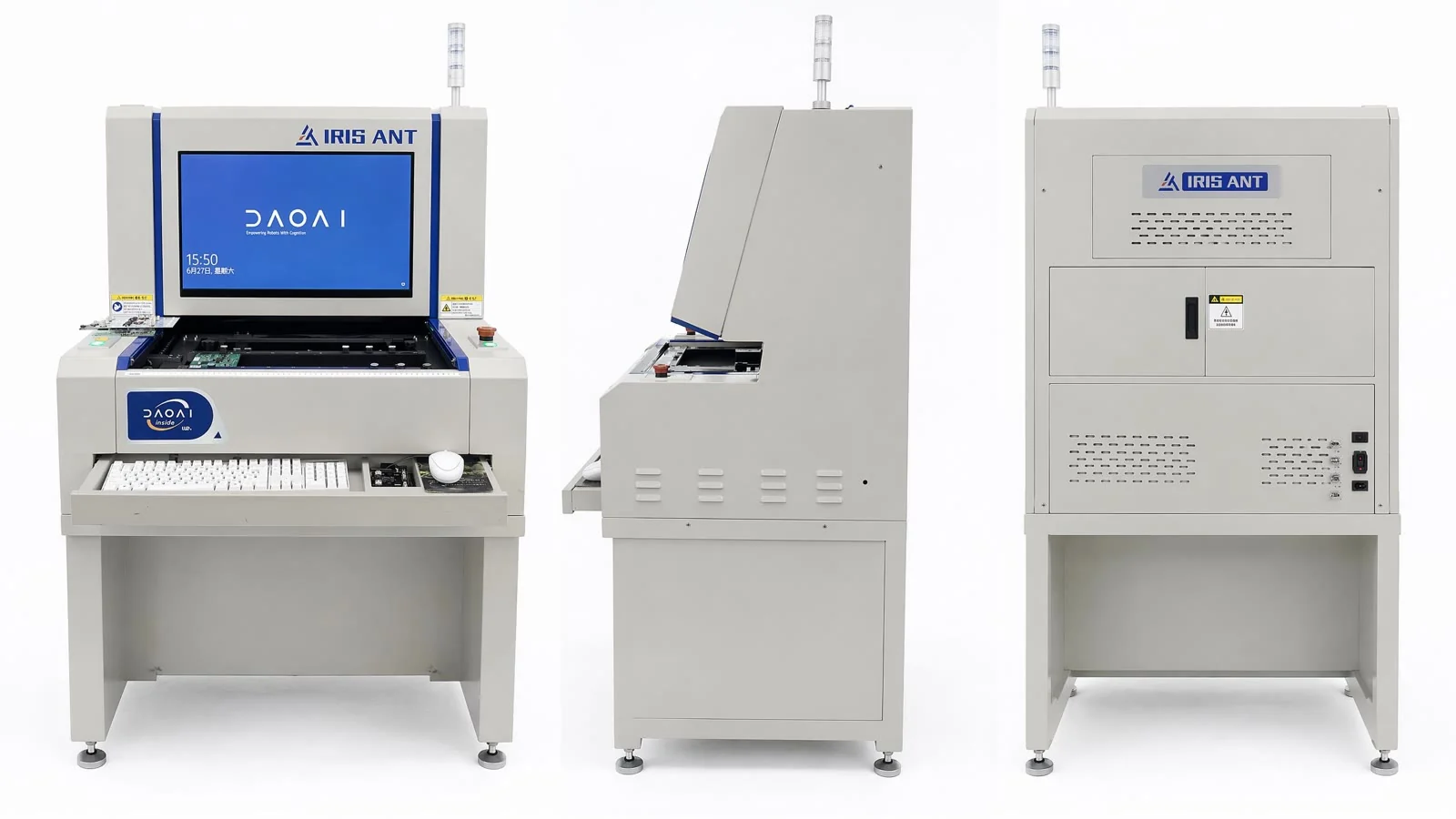
DaoAI 3D ACI equipment (self-developed 3D camera + structured light 3D metrology/point cloud, detects hidden solder joints/coplanarity/micron-level topography/open pores & surface depressions (2D optical blind spots), 2D-3D fusion; structured light measures surface geometry only, internal defects of opaque objects are detected by X-ray/CT imaging and ACI interpretation) leverages its high-precision 3D inspection capabilities and high-speed image processing engine to reduce the defect escape rate for new energy battery tab welding quality gates from the traditional manual inspection's 2.5% to <0.3%, while achieving 100% inline inspection and matching production takt time.
ACI in this article stands for Auto Cognitive Inspection — the next-generation term for AI AOI: keep the A and the I, and replace the O (optical) with C (cognitive), because the decision basis is cognition rather than the imaging method. The full argument is set out in From AI AOI to ACI.
In the entire chain of new energy battery manufacturing, tab welding is one of the critical processes for battery performance and safety. As the electric vehicle market demands increasingly stringent requirements for battery energy density, cycle life, and safety, any tiny welding defect can lead to serious quality issues or even safety hazards. Traditionally, the inspection of tab welding quality relies heavily on manual visual inspection or 2D optical AOI equipment. However, facing growing production capacity demands and complex defect types, these traditional methods encounter significant challenges in inspection efficiency and accuracy.
Pain Points: Why This Hurdle is Difficult to Overcome
In the quality gate for new energy battery tab welding, traditional inspection solutions face multiple challenges. First is the **contradiction between production takt time and 100% full inspection capacity**. A leading battery manufacturer's production line operates at a takt time of up to 60ppm, a speed that traditional manual inspection simply cannot match. This results in a low sampling rate and persistently high defect escape rates; according to production line data, the defect escape rate under manual inspection was as high as 2.5%. Second is the **complexity and limitations of defect identification**. Tab welding defects such as cold solder joints, burrs, solder joint collapse, and slight misalignment often have micron-level features and can be difficult to distinguish in 2D images due to factors like lighting, reflections, and material color differences. This leads to traditional 2D AOI having false positive rates as high as 8-12%, severely impacting production line efficiency. Furthermore, with rapid iteration of new energy battery products, **frequent model changeovers** mean that traditional rule-based AOI equipment requires several hours or even days of reprogramming and debugging for each changeover, significantly hindering production line flexibility.
The root cause of these pain points lies in the inherent complexity of tab welding and the physical limitations of traditional inspection technologies. Battery tabs are typically made of highly reflective materials such as copper and aluminum, and subtle morphological changes on their surface (e.g., solder joint height, weld width, burr protrusion) are difficult to accurately capture in 2D images. Cold solder joints might manifest as tiny internal voids or poor adhesion, with only subtle morphological anomalies on the surface, or even be completely obscured by 2D optical 'blind spots'. Traditional 2D AOI, lacking depth information, naturally cannot effectively identify these 3D morphological defects. Manual visual inspection, due to fatigue from prolonged operation, subjective judgment differences, and the limitations of human eye's ability to identify micron-level defects, fails to meet the precision and consistency requirements of modern battery manufacturing. These factors collectively lead to a vicious cycle of missed defects, false positives, and low efficiency, becoming a critical bottleneck limiting the increase in new energy battery production line capacity.
Technical Principles
The core advantage of DaoAI 3D ACI equipment lies in its **self-developed 3D camera and structured light 3D metrology reconstruction technology**. This equipment projects encoded structured light onto the object under inspection and uses high-resolution cameras to capture deformed light strip images from different angles. These images are processed by high-speed algorithms built into the DaoAI ACI OS operating system, enabling precise reconstruction of the object's 3D point cloud data. Each point cloud data contains X, Y, Z three-dimensional coordinate information, thereby completely restoring the true 3D morphology of the battery tab solder joint. Unlike traditional 2D AOI, which relies solely on grayscale or color images for planar feature analysis, DaoAI 3D ACI equipment can directly measure the height, volume, coplanarity, and any micron-level surface depressions, protrusions, or burrs of the solder joint. For instance, cold solder joints might lead to slight surface collapse or irregular morphology due to poor internal bonding; burrs are tiny protrusions formed by material overflow. These defects, which might be obscured by reflections or shadows in 2D images, are fully visible in the 3D point cloud generated by DaoAI 3D ACI equipment, with quantifiable metrics like height and volume directly used for precise defect classification and severity assessment. This equipment achieves **micron-level morphological detection accuracy**, far exceeding the recognition limits of traditional 2D optical equipment.
Compared to traditional methods, the advantages of DaoAI 3D ACI equipment are evident in several aspects. Firstly, **precise identification of 2D optical blind spot defects**. Traditional 2D AOI lacks depth information and is often powerless against defects such as solder joint collapse, micron-level height differences caused by cold solder joints, or open pores. DaoAI 3D ACI equipment, through 3D morphology reconstruction, directly quantifies these height and depth information, reducing the defect escape rate to <0.3%. Secondly, **significantly reduced false positive rates**. In 2D images, 'false defects' caused by lighting variations, material reflections, or surface textures often lead to high false positive rates. DaoAI 3D ACI equipment, based on true 3D morphology judgment, effectively avoids these interferences, reducing the false positive rate by over 75%. Finally, **greatly improved adaptability to production takt time**. DaoAI 3D ACI equipment combines high-speed 3D scanning with AI vision foundation models, allowing its inspection speed to fully match the high takt time demands of new energy battery production lines, achieving 100% full inspection and completely resolving the bottleneck where traditional manual inspection could not keep up with production speed. Furthermore, its integrated DaoAI ACI OS operating system supports APDT few-shot learning, requiring only 1-20 good samples for model training, drastically reducing changeover time to 5 minutes and significantly enhancing production line flexibility.
Typical Application Scenarios
- **Detection of Cold Solder Joints and False Soldering on Battery Tabs**: DaoAI 3D ACI equipment precisely measures the 3D morphology of solder joint surfaces to identify insufficient solder joint height, surface collapse, or irregular undulations caused by cold solder joints. These micron-level morphological anomalies are easily overlooked in 2D images, but 3D ACI equipment provides precise height and volume data for judgment.
- **Detection of Burrs and Spatter on Battery Tabs**: Tiny burrs or spatter generated during welding may be difficult to detect in 2D images due to their small size or blending with the background. DaoAI 3D ACI equipment can accurately identify and measure the micron-level height and shape of these protrusions, ensuring the cleanliness around the solder joint.
- **Solder Joint Coplanarity and Flatness Inspection**: For multi-point welding or tabs requiring strict flatness, DaoAI 3D ACI equipment can calculate the overall coplanarity of the solder joint array and the surface flatness of individual solder joints, ensuring the reliability of internal battery connections.
- **Solder Joint Size and Position Deviation Detection**: Precisely measure 2D dimensions such as length, width, and area of solder joints, and combine with 3D information to confirm if the solder joint deviates from the preset position or if there are abnormally large/small instances. DaoAI 3D ACI equipment utilizes 2D-3D fusion technology to comprehensively evaluate these geometric parameters.
- **Detection of Open Pores and Surface Depressions**: Air pores or surface depressions that may appear during welding might only be blurry dark spots in 2D images. DaoAI 3D ACI equipment can accurately measure the depth and opening size of these defects, providing a basis for defect classification and process optimization.
Implementation Case Study
A leading new energy battery manufacturer, a global leader in power battery suppliers, has long faced severe quality challenges in its tab welding production line. Before introducing DaoAI 3D ACI equipment, the quality gate for tab welding at this factory primarily relied on manual visual inspection and a small number of 2D AOI devices. Due to a production takt time of up to 60ppm, manual inspection could not achieve 100% full inspection, only sampling, leading to an actual defect escape rate that once reached 2.5%. Concurrently, 2D AOI equipment had limited capabilities in identifying 3D morphological defects such as cold solder joints and tiny burrs, with false positive rates hovering around 9%, requiring extensive manual re-inspection and severely slowing down overall production efficiency. The DaoAI team conducted an in-depth investigation and deployed multiple sets of customized 3D ACI equipment, integrating them with the client's existing MES system.
In this case, after the DaoAI 3D ACI equipment was put online, the defect escape rate for the tab welding quality gate plummeted from 2.5% to <0.3%, the false positive rate decreased by 78%, achieving 100% inline inspection and perfectly matching the 60ppm production takt time.
After the DaoAI 3D ACI equipment was put online, production line data showed that the defect escape rate for the tab welding quality gate dramatically decreased from the traditional 2.5% to <0.3%, with detection accuracy improving to over 99.7%. Simultaneously, due to its high-precision 3D inspection capabilities, the false positive rate also decreased from 9% to only about 2%, representing a **78% reduction in false positive rate**, significantly reducing the workload for manual re-inspection. More importantly, the DaoAI 3D ACI equipment perfectly matched the production line's 60ppm takt time, enabling 100% full inspection of the tab welding process, completely eliminating the risk of missed defects under traditional sampling methods, and significantly improving product quality consistency and reliability. Furthermore, thanks to the APDT few-shot self-learning function supported by the DaoAI ACI OS operating system, production line changeover time was reduced from several hours to an average of less than 5 minutes, greatly enhancing production line flexibility and providing strong support for this leading manufacturer's market competitiveness in the new energy battery sector.
The figures above are a typically achievable range in anonymized industry scenarios — a different line or a different batch of parts will move the result either way; on-site measurement governs.
DaoAI Solutions and Products
The core solution provided by DaoAI for new energy battery tab welding quality gates centers around the **DaoAI 3D ACI equipment**, combining advanced hardware and software technologies. This equipment integrates DaoAI's self-developed high-speed 3D camera and structured light 3D metrology reconstruction system, capable of acquiring complete 3D point cloud data of tab solder joints in milliseconds. On the software front, it is equipped with the **DaoAI ACI OS operating system**, which features built-in visual foundation model-based cognitive capabilities, enabling it to quickly learn and identify various complex welding defects with very few samples (APDT positive/few-shot learning, 1-20 good samples). For defects such as burrs, cold solder joints, and solder joint collapse in tab welding, DaoAI 3D ACI equipment achieves detection accuracy and robustness far beyond 2D AOI through precise measurement of Z-axis height, volume, surface flatness, and other parameters. In terms of deployment, DaoAI 3D ACI equipment supports 100% local private deployment, ensuring that all sample and inspection images remain within the factory, thus safeguarding customer data security and production information privacy.
In practical implementation, the modeling process of the DaoAI solution is highly efficient. With the ACI OS's 0-code automatic programming function, clients only need to provide one good sample, and the basic detection model can be established within 5 minutes. For subsequent expansion of defect types or process adjustments, the APDT few-shot learning mechanism allows clients to quickly iterate models without professional programming skills. The high-speed data processing capability of DaoAI 3D ACI equipment ensures that it can fully match the high takt time demands of new energy battery production lines, achieving true 100% full inspection. By precisely identifying traditional 2D optical blind spot defects, this equipment significantly improves the detection rate and greatly reduces the false positive rate for tab welding quality gates. In the case of a leading battery manufacturer, through the application of DaoAI 3D ACI equipment, the defect escape rate for the tab welding quality gate was successfully **reduced to <0.3%**, the **false positive rate was reduced by 78%**, and **production line changeover time was shortened to 5min**, bringing significant economic benefits and quality improvements to the client, ensuring the safety and reliability of new energy battery products.
FAQ
How does DaoAI 3D ACI equipment ensure 100% full inspection capacity for new energy battery tab welding?
DaoAI 3D ACI equipment, through its self-developed high-speed 3D camera and optimized structured light 3D metrology reconstruction algorithms, can perform 3D scanning and data processing of tab solder joints at extremely high speeds. Combined with the efficient AI vision foundation models of the DaoAI ACI OS operating system, the inspection speed fully matches the high takt time demands of new energy battery production lines, ensuring that every product is detected in real-time and accurately, thereby achieving 100% full inspection and eliminating the risk of missed defects from traditional sampling.
What are the cost advantages of DaoAI 3D ACI equipment compared to traditional 2D AOI or manual visual inspection for tab welding inspection?
While the initial investment for DaoAI 3D ACI equipment might be higher than ordinary 2D AOI, its long-term operational cost advantages are significant. It drastically reduces defect escape and false positive rates, cutting down recall, rework costs, and brand damage due to defective products. Simultaneously, automated inspection replaces extensive manual re-inspection, saving labor costs. Its rapid changeover capability also reduces downtime, improving overall OEE. Specific cost benefits require detailed evaluation based on production line scale and defect rates; please contact us for a customized quotation.
How does DaoAI 3D ACI equipment handle the impact of frequent new energy battery product changeovers on inspection models?
The DaoAI ACI OS operating system integrated into DaoAI 3D ACI equipment features APDT few-shot self-learning capabilities. This means that when product models change, clients only need to provide 1-20 good samples, and the system can complete the training and deployment of new models within minutes (an average of 5 minutes in this case), without complex code programming. This greatly enhances the flexibility and efficiency of production line changeovers, effectively reducing downtime caused by model changes.
Full solution for this scenario: 3D ACI Equipment industry solutions · New-Energy Battery Module Weld Misalignment Detection
This article is an original publication by WeLinkirt (DaoAI).