
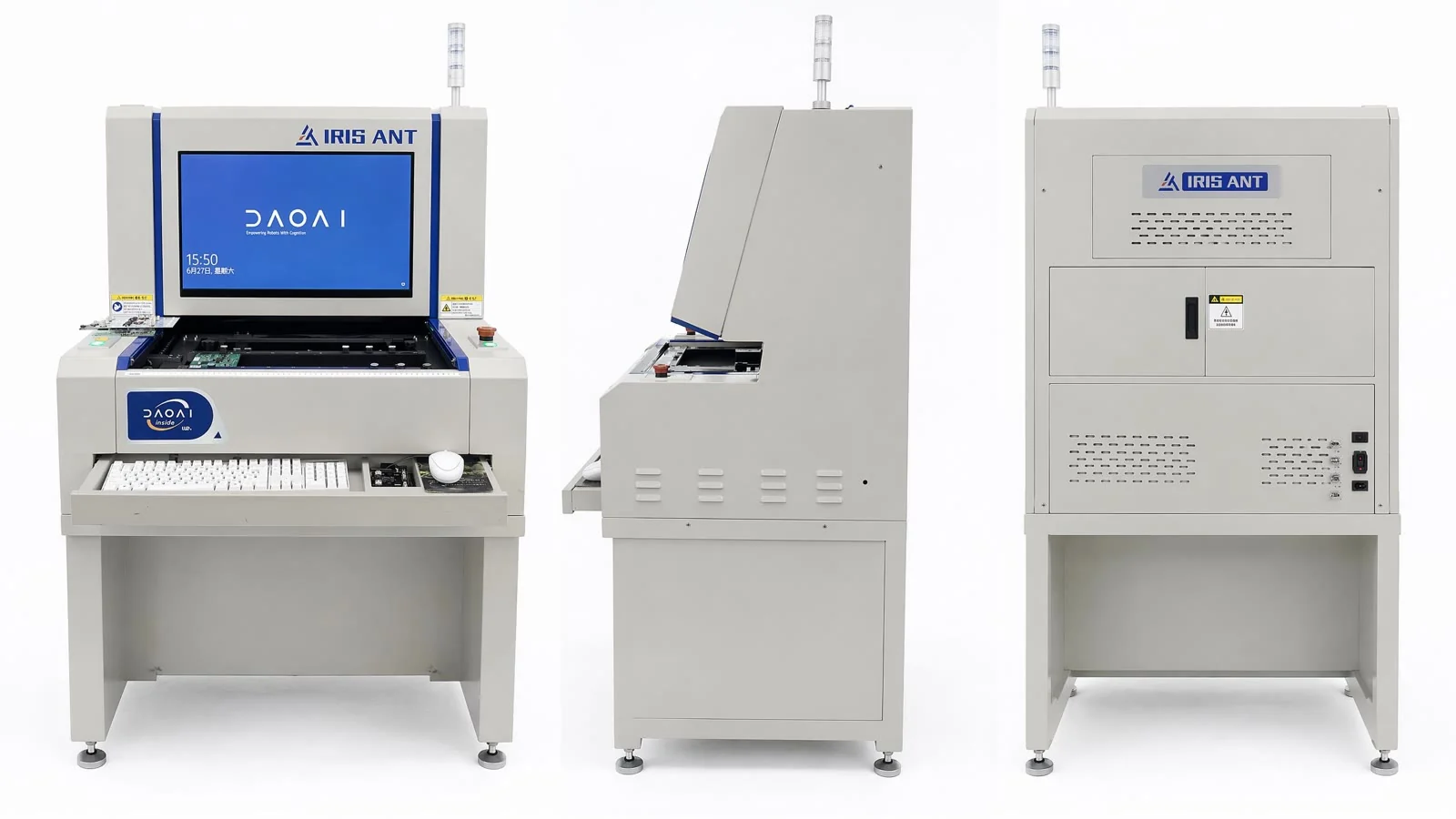
DaoAI 3D ACI devices (featuring proprietary 3D cameras + structured light 3D metrology/point cloud reconstruction, detecting hidden solder joints/coplanarity/micron-level topography/open pores and surface depressions—defects blind to 2D optics, with 2D-3D fusion; structured light measures only surface geometry, internal opaque defects are detected by X-ray/CT imaging and ACI interpretation) leverage their innovative zero-code rapid changeover capability to reduce changeover downtime for hidden BGA solder joint inspection from hours to minutes for small to medium-sized PCBA manufacturers, significantly boosting efficiency and flexibility in high-mix, low-volume production. In the electronics/PCBA industry, particularly during the assembly of circuit boards with complex packages like BGA and QFN, solder joint quality inspection is central to product reliability. With increasing demand for rapid product iteration and customization in consumer electronics, industrial control, and automotive electronics, PCBA manufacturing is increasingly adopting a "high-mix, low-volume" (HMLV) model. This trend necessitates frequent switching between different board types, each requiring reprogramming and debugging of inspection equipment. Traditional inspection solutions often struggle to accommodate such high-frequency changeovers, leading to production inefficiencies and increased costs.
ACI in this article stands for Auto Cognitive Inspection — the next-generation term for AI AOI: keep the A and the I, and replace the O (optical) with C (cognitive), because the decision basis is cognition rather than the imaging method. The full argument is set out in From AI AOI to ACI.
Pain Points: Why This Hurdle Is So Difficult
In PCBA production with BGA/QFN packages, quality inspection of hidden solder joints (e.g., solder balls beneath BGA array packages) faces multiple challenges. First, traditional 2D AOI cannot directly inspect solder joints under BGA components, necessitating reliance on equipment like X-ray, which is complex to interpret and costly. Second, for high-mix, low-volume production, each product changeover requires engineers to manually adjust parameters and write complex inspection programs for traditional equipment, leading to changeover downtime of 2-4 hours, severely impacting production rhythm. For instance, a mid-sized PCBA manufacturer, facing dozens of new product introductions monthly, found that programming and debugging for inspection equipment consumed over 15% of their total monthly production time. Furthermore, traditional solutions often have high false alarm rates, resulting in significant manual re-inspection hours, further dragging down production efficiency. Mirroring the current challenges in warehouse automation where 3D vision struggles with parcel dimension measurement precision and efficiency, PCBA inspection changeovers also demand a flexible solution that balances high precision with high efficiency.
The root cause of these pain points lies in the limited perception capabilities of traditional inspection technologies for complex geometries and the inflexibility of software programming. BGA solder joints are tiny and located beneath components, so 2D images cannot provide height information, making it difficult to assess defects like solder collapse, bridging, or voids. Traditional AOI software, based on rule-based programming, requires extensive rule and template creation for each new product. This is not only time-consuming and labor-intensive but also highly dependent on engineer experience, making rapid deployment and scaling difficult. When a production line needs to switch from one BGA-packaged circuit board to another, even minor layout or size changes can invalidate existing programs, requiring starting from scratch or extensive modifications—this is the core issue in high-mix, low-volume production.
Technical Principles
DaoAI 3D ACI devices fundamentally solve the challenges of hidden BGA solder joint inspection through proprietary high-precision 3D cameras and advanced structured light 3D metrology reconstruction technology. The device first projects specific coded patterns onto the surface of the object using structured light, then captures the deformed patterns with high-resolution cameras. Utilizing the principle of triangulation, it precisely calculates 3D point cloud data for the solder joint surface. This point cloud data contains micron-level topographic information such as height, volume, and coplanarity for each solder joint, enabling accurate identification of defects blind to 2D optics, such as solder collapse, missing solder, bridging, poor coplanarity, and tiny open pores and surface depressions. DaoAI ACI achieves a cold-start detection accuracy of 98%, which can reach 99.99% after online iteration.
Compared to traditional methods, DaoAI 3D ACI offers significant advantages. Traditional rule-based AOI relies solely on 2D image information like brightness and contrast for defect judgment, lacking depth information and being ineffective for hidden BGA solder joints. While X-ray can penetrate to reveal internal defects, its image interpretation is complex, and it cannot provide high-precision surface topography data. DaoAI 3D ACI devices employ 2D-3D fusion inspection, utilizing both 2D image texture and color information, as well as 3D topographic data for comprehensive judgment, greatly enhancing the completeness and accuracy of inspection. Crucially, the DaoAI ACI OS operating system utilizes vision foundation models and supports APDT (Adaptive Pre-trained Detection Transformer) few-shot learning, requiring only 1–20 good samples to achieve zero-code automatic programming in 5 minutes. This completely overturns the complex programming model of traditional inspection equipment, providing the technical foundation for rapid changeover.
Typical Application Scenarios
- **BGA Solder Joint Coplanarity Inspection**: Ensuring all solder balls are on the same plane to avoid open circuits or short circuits. DaoAI 3D ACI devices precisely measure the Z-axis height of each BGA solder ball through high-precision 3D measurement, determining if its coplanarity meets standards, addressing the inability of traditional 2D to assess height information.
- **QFN Package Bottom Pad Defect Inspection**: QFN package bottom pads are large and prone to voids, poor wetting, and other defects. DaoAI 3D ACI devices can reconstruct the complete 3D topography of the bottom pad, identifying micron-level solder voids and uneven wetting areas that are difficult for 2D optics to detect.
- **Micron-Level Solder Collapse and Bridging**: In high-density integrated circuits, solder joint spacing is extremely small, and even minor collapse or bridging can lead to functional failure. DaoAI 3D ACI devices accurately measure solder joint height and shape, identifying subtle collapses and potential bridging risks that traditional 2D cannot distinguish.
- **Open Pores and Surface Depressions**: During the soldering process, gas in the solder may form pores, or surface depressions may occur, affecting solder joint strength. DaoAI 3D ACI devices, through their 3D topography reconstruction capabilities, can clearly identify open pores and tiny depressions on the solder joint surface, providing a more comprehensive quality assessment.
Implementation Case Study
A mid-sized PCBA contract manufacturer, primarily producing various industrial control boards and IoT modules, handles hundreds of product models with batch sizes ranging from dozens to thousands, a typical high-mix, low-volume scenario. Before implementing DaoAI 3D ACI devices, BGA package board inspection relied mainly on an outdated X-ray machine for sampling, supplemented by manual visual inspection. Each time a new product was launched or a changeover occurred, AOI engineers spent several hours programming and debugging, leading to frequent line stoppages. During a typical changeover, from old product shutdown to stable production of the new product, downtime usually ranged from 3-4 hours, severely impacting overall production efficiency. The DaoAI team deployed 3D ACI devices and provided on-site training on the zero-code programming capabilities of DaoAI ACI OS. After implementation, the production line data showed that for new BGA package board models, engineers only needed to import a good sample board into the DaoAI 3D ACI system for 5 minutes of automatic learning to quickly generate inspection programs, reducing single changeover downtime to 5-10 minutes. This meant that changeover work that previously took half a day or even a full day could now be completed in a very short time, significantly enhancing line flexibility and responsiveness. What used to be manual re-inspection of ambiguous defects in X-ray images now only requires human verification of the few anomalies flagged by the DaoAI 3D ACI system, greatly reducing manual re-inspection hours.
The figures above are a typically achievable range in anonymized industry scenarios — a different line or a different batch of parts will move the result either way; on-site measurement governs.
DaoAI 3D ACI's zero-code rapid changeover transforms high-mix, low-volume production from an efficiency bottleneck into a competitive advantage.
DaoAI Solutions and Products
The core of the DaoAI 3D ACI solution lies in its integrated software and hardware design. On the hardware front, proprietary high-precision 3D cameras combined with structured light technology ensure micron-level metrology accuracy and high-speed scanning capabilities. On the software front, the DaoAI ACI OS operating system provides an intuitive, user-friendly zero-code programming interface. Engineers do not need to write any code; by simply performing graphical operations and importing 1–20 good samples, the system can automatically learn and generate inspection models within 5 minutes. This is enabled by its built-in vision foundation models and APDT (Adaptive Pre-trained Detection Transformer) few-shot self-learning capability, which allows for rapid generalization from minimal data and effective filtering of semantic false alarms. For deployment, DaoAI solutions support various integration methods like SDK/API/Docker, enabling 100% on-premise private deployment to ensure samples and inspection images do not leave the factory, meeting stringent client requirements for data security and privacy. Furthermore, the DaoAI World foundation model provides powerful semantic understanding and cross-scenario generalization capabilities for 3D ACI, continuously learning and iterating through production line feedback to optimize inspection performance.
Through the deployment of DaoAI 3D ACI devices, clients not only resolved the pain points of hidden BGA solder joint inspection but also achieved a transformation and upgrade in their production model. The device boasts a single judgment latency of 12 milliseconds and enables 100% full inspection, ensuring stable and reliable product quality. In practical application, after a certain electronics factory went live, its BGA package board inspection accuracy reached 99.4%, while reducing the previously hours-long changeover time to 5 minutes, significantly enhancing line flexibility. These quantitative achievements directly translate into business value: production efficiency is greatly improved, labor costs are substantially reduced, and product quality risks are effectively controlled, enabling clients to better respond to market changes and seize business opportunities presented by high-mix, low-volume production.
FAQ
How does DaoAI 3D ACI device achieve zero-code rapid changeover?
DaoAI 3D ACI devices are equipped with the DaoAI ACI OS operating system, featuring built-in vision foundation models and APDT few-shot self-learning capabilities. Users only need to import 1–20 good samples, and the system can automatically learn and generate inspection models within 5 minutes, eliminating the need for manual code writing and enabling quick, straightforward changeover operations.
What are the advantages of DaoAI 3D ACI devices compared to traditional X-ray inspection?
Traditional X-ray is primarily used for internal defect penetration, with complex interpretation and high costs. DaoAI 3D ACI devices, through structured light 3D metrology, precisely acquire micron-level height, volume, coplanarity, and other surface information of solder joints, effectively detecting defects blind to 2D optics. Combined with 2D-3D fusion, it provides more comprehensive and intuitive quality assessment, with easier programming and changeover.
What is the typical deployment cost and timeline for DaoAI 3D ACI devices?
The deployment cost of DaoAI 3D ACI devices is influenced by specific configurations, production line integration complexity, and inspection requirements, typically including hardware, software licenses, and integration services. The deployment period generally ranges from several weeks to several months, depending on the client's site conditions and project scope. We recommend contacting our sales team for a detailed assessment to receive a customized quote and implementation plan.
Full solution for this scenario: 3D ACI Equipment industry solutions · Battery Module Weld Spot Inspection
This article is an original publication by WeLinkirt (DaoAI). Under customer confidentiality, cases are anonymized industry scenarios and figures are illustrative; see product pages for official benchmarks.