
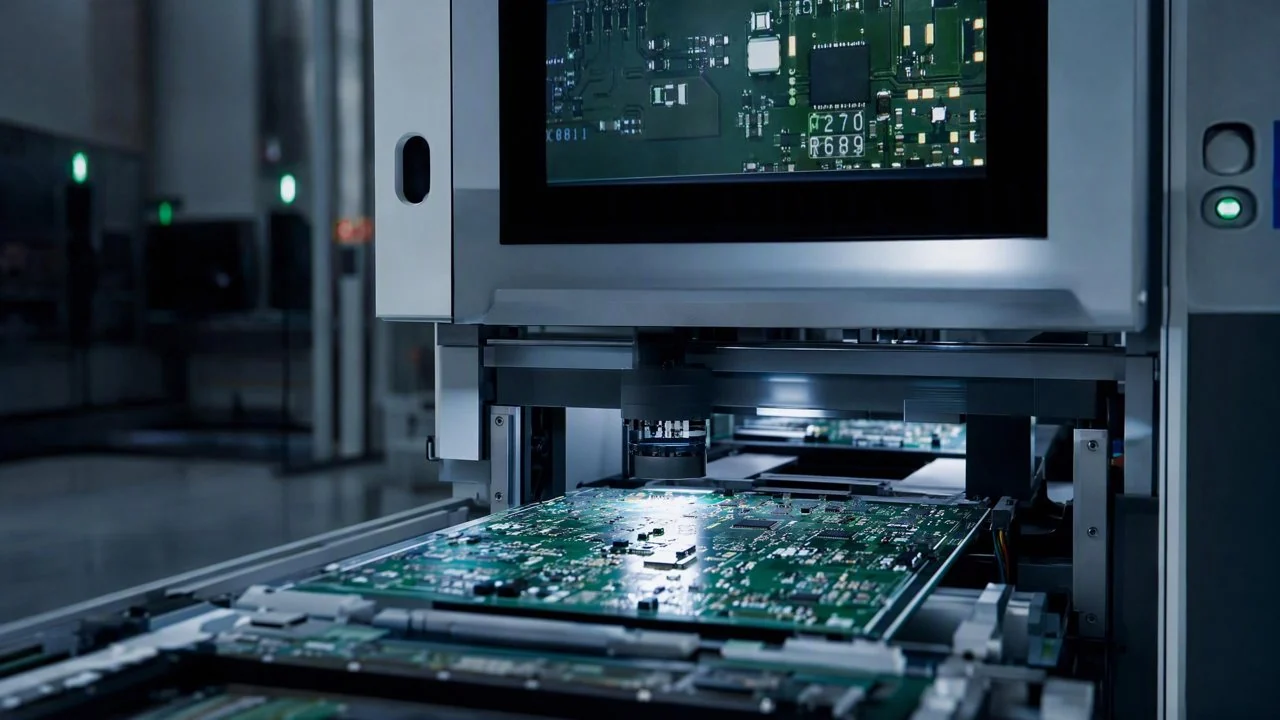
DaoAI 2D ACI equipment (high-resolution 2D imaging + deep learning secondary judgment, targeting surface/print/character OCR/assembly omissions and other planar defects, high-speed online full inspection, micron-level, semantic false alarm filtering) precisely identifies and traces defects in PCBA board-level silkscreen and OCR characters, reducing traditional manual re-inspection hours from over 4 hours per day to less than 1 hour, significantly enhancing product quality management efficiency and data closed-loop capabilities.
In electronics manufacturing, particularly PCBA (Printed Circuit Board Assembly) production, the quality of board-level silkscreen and OCR characters is crucial for product functionality and traceability. These characters often contain vital information such as component models, production batches, and date codes. Any blurred, missing, misaligned, or incorrect silkscreen can lead to identification failures in subsequent processes, product mix-ups, and even severe product recall risks. As consumer electronic products become increasingly integrated and PCBA sizes shrink, silkscreen characters become denser and smaller. Traditional manual inspection or rule-based AOI (Automated Optical Inspection) systems face significant challenges in terms of inspection accuracy, speed, and false alarm rates, making it difficult to meet the stringent requirements of zero-defect manufacturing.
Pain Points: Why This Hurdle Is Difficult to Overcome
The difficulty in detecting PCBA silkscreen/OCR characters lies in their diversity and complexity. A medium-sized PCBA manufacturer previously faced multiple dilemmas: Firstly, due to inherent fluctuations in the silkscreen process, character edges often exhibited burrs, breaks, or uneven ink, leading to a false alarm rate of over 15% with traditional AOI. This required at least 4 hours of manual re-inspection per day to sort out good products. Secondly, character fonts, sizes, colors, and background color differences varied significantly between different batches or suppliers. Each model changeover required 1-2 hours to reprogram rules, severely impacting production rhythm. Thirdly, the omission rate for some critical characters remained around 0.5% in complex backgrounds. If these defects reached the market, they would create huge obstacles for quality traceability and potentially incur rework or recall costs of hundreds of thousands of yuan. Finally, traditional inspection systems lacked deep integration with MES/WMS and other systems, resulting in isolated inspection data that could not form an effective quality data closed loop, making it difficult to support high-level quality traceability and production optimization.
The root causes of these difficulties are: the imaging contrast of silkscreen characters is affected by various factors such as substrate color, character color, and lighting conditions, easily leading to artifacts or low-contrast areas; the characters themselves have micron-level deformations and defects that are difficult for the human eye to identify with high intensity over long periods; traditional rule-based AOI algorithms are highly sensitive to character deformations and blurring, leading to rejection even with slight deviations, while struggling to identify actual character content errors (e.g., 'O' misprinted as '0'), resulting in both high false alarms and high omissions. Against the backdrop of pursuing zero-defect manufacturing, how to achieve high-precision, low-false-alarm, quick-changeover silkscreen/OCR inspection with data traceability capabilities is a pressing challenge for the electronics manufacturing industry.
Technical Principles
The DaoAI 2D ACI equipment fundamentally solves the aforementioned problems through its unique high-resolution 2D imaging and deep learning secondary judgment technology. The equipment employs self-developed high-resolution industrial cameras and customized multi-spectral lighting systems, capable of capturing micron-level silkscreen details and effectively handling substrates and characters of varying colors and glosses. Its core lies in the integrated DaoAI ACI OS operating system, which features a vision foundation model based on the Transformer architecture, possessing powerful feature recognition capabilities. For silkscreen/OCR character inspection, DaoAI 2D ACI utilizes advanced OCR algorithms combined with deep learning models for secondary judgment. It not only identifies physical defects such as character completeness, clarity, and position but also deeply understands the semantic information of characters, distinguishing between similar-looking but semantically different characters like 'O' and '0'. Compared to traditional rule-based AOI, the deep learning model of DaoAI 2D ACI achieves high-precision detection models quickly through APDT positive/few-shot learning (requiring only 1-20 good product images). It also significantly reduces false alarms caused by environmental noise or non-defect features through its semantic false alarm filtering mechanism, with actual measurements showing a reduction in false alarm rate by over 80% at a medium-sized PCBA manufacturer.
Compared to traditional manual inspection, the DaoAI 2D ACI equipment offers higher inspection consistency, speed, and traceability. Manual inspection is susceptible to fatigue, subjective judgment, and environmental factors, making it difficult to guarantee stable inspection quality and unable to provide quantitative defect data. While rule-based AOI achieves automation, its generalization ability is poor, and it adapts weakly to new defect types or process fluctuations, requiring frequent rule adjustments. DaoAI 2D ACI, leveraging its deep learning's adaptive capabilities, can handle complex and varied silkscreen defect patterns and supports high-speed online full inspection, ensuring production rhythm is not affected. More importantly, every piece of inspection data collected by DaoAI 2D ACI can be precisely recorded and archived, providing a solid foundation for subsequent quality traceability and analysis.
Typical Application Scenarios
- **PCBA Silkscreen Character Completeness and Clarity Inspection:** DaoAI 2D ACI accurately identifies defects such as breaks, blurring, missing parts, and uneven ink in silkscreen characters like component models and production batches on circuit boards. The challenge lies in the typically small and process-sensitive silkscreen characters, but the equipment effectively overcomes these challenges through high-resolution imaging and deep learning algorithms, ensuring character readability.
- **OCR Character Content Recognition and Verification:** For OCR characters like QR codes, barcodes, or serial numbers, DaoAI 2D ACI not only detects their presence but also performs content recognition and comparison with databases to ensure accuracy. The difficulty lies in varying fonts, character spacing, and background interference, but the system accurately extracts information through powerful character segmentation and recognition models.
- **Silkscreen Character Position and Orientation Deviation Detection:** DaoAI 2D ACI can detect precise position and angle deviations of silkscreen characters relative to pads or component bodies, preventing subsequent assembly issues caused by misalignment. The challenge involves micron-level positioning accuracy requirements and feature point extraction in complex backgrounds, achieved through sub-pixel level positioning algorithms for high-precision detection.
- **Assembly Omission and Orientation Error Character Identification:** In some special cases, silkscreen characters may indicate component polarity or assembly direction. DaoAI 2D ACI, combined with character recognition, can determine if components are present or if their orientation is correct, preventing misassembly or omissions. The challenge involves simultaneous character recognition and component feature matching, but the equipment can perform multi-task parallel inspection.
- **Inner Layer Character Inspection for Multi-layer Boards:** For certain special PCBAs, silkscreen characters might be located in hard-to-observe areas, or visible only through micro-vias or transparent layers. DaoAI 2D ACI, with its flexible lighting and high-penetration imaging technology, can also assist in detecting the visibility and integrity of such hidden characters to some extent, ensuring the correctness of internal markings.
Case Study
A medium-sized PCBA manufacturer, specializing in industrial control and automotive electronics circuit boards, has extremely high demands for quality traceability and reliability. Before introducing the DaoAI 2D ACI equipment, the factory's board-level silkscreen and OCR character inspection relied primarily on traditional rule-based AOI combined with extensive manual re-inspection. Production line data showed that the false alarm rate of traditional AOI remained high, requiring an average of 4-5 inspectors to spend over 4 hours daily on re-inspection, and the omission rate for critical characters was still around 0.5%, creating immense pressure on quality management. Each new product changeover required engineers to spend 1-2 hours adjusting rule parameters, severely impacting production efficiency.
After introducing the DaoAI 2D ACI equipment, the factory utilized the APDT few-shot learning function of the DaoAI ACI OS system. They trained the silkscreen/OCR inspection model for the first product model using only 15 good product images, taking less than 30 minutes. Upon live operation, production line data showed that the DaoAI 2D ACI reduced the false alarm rate for silkscreen/OCR characters from over 15% to <3%, significantly decreasing the workload of manual re-inspection. Daily manual re-inspection hours plummeted from over 4 hours to less than 1 hour, saving the factory substantial labor costs. More importantly, the omission rate for critical characters was effectively controlled at <0.05%, greatly enhancing the reliability of product quality traceability. The system also achieved integration with the factory's existing MES system, with all inspection results, defect images, and location information uploaded in real-time, forming a complete quality data closed loop that provided precise data support for subsequent production process optimization and batch traceability.
DaoAI 2D ACI not only enhances inspection accuracy and efficiency but, more importantly, builds a quality data closed loop from inspection to traceability, which is a core capability of modern intelligent manufacturing.
DaoAI Solutions and Products
DaoAI provides a comprehensive solution for silkscreen/OCR character inspection in the electronics/PCBA industry, centered around the DaoAI 2D ACI equipment. This equipment integrates a high-resolution 2D imaging system with the powerful DaoAI ACI OS operating system. During implementation, we first customize the multi-spectral lighting and high-pixel industrial cameras according to the client's specific needs and production line environment, ensuring high-quality image data acquisition in various complex backgrounds. Next, using the DaoAI ACI OS's 'one good sample, 5 minutes, 0 code automatic programming' feature, engineers can quickly build initial models without writing any code. For subsequent new product changeovers, the APDT few-shot learning function requires only 1-20 good samples to complete new model training within minutes, significantly reducing changeover downtime. DaoAI 2D ACI also supports 100% local private deployment, ensuring client data security and privacy, and all inspection data can be deeply integrated with the client's MES/ERP systems to achieve a full-link data closed loop from defect detection, data recording, to quality traceability. Furthermore, through the unified DaoAI World world model foundation, the system continuously learns from production line feedback, constantly optimizing detection models and improving generalization and robustness.
In this case, DaoAI 2D ACI helped the client achieve significant business value. Specific data shows that the solution reduced the omission rate for board-level silkscreen/OCR characters to <0.05%, far below the industry average. At the same time, through semantic false alarm filtering, the system controlled the false alarm rate to <3%, reducing manual re-inspection hours by over 75%. Production line changeover time was shortened from the original 1-2 hours to 5-10 minutes, greatly improving production efficiency and flexibility. These quantified results not only directly reduced operational costs but, more importantly, enhanced product quality reputation and strengthened market competitiveness, building an efficient, reliable, and future-proof intelligent inspection system for the client.
FAQ
How does DaoAI 2D ACI equipment achieve quality traceability for silkscreen/OCR characters?
During the inspection process, DaoAI 2D ACI equipment records real-time inspection results, defect images, location information, and timestamps for each inspected board. This data is then linked with critical information such as product batches and serial numbers. Through deep integration with the client's MES/ERP systems, all data can be uploaded to a central database, forming a complete quality archive. This enables fast and precise traceability of any defective product, achieving a closed loop for quality data management.
What are the deployment costs and return on investment period for DaoAI 2D ACI equipment?
The deployment cost of DaoAI 2D ACI equipment varies depending on specific configurations (e.g., camera count, lighting type, integration complexity) and client requirements. We offer flexible private deployment solutions to ensure data security. The typical ROI period is within 6-18 months, primarily achieved by significantly reducing false alarm rates, decreasing manual re-inspection hours, improving production line efficiency, and mitigating omission risks and potential recall costs. We recommend contacting our sales team for a customized quote and detailed ROI analysis.
How does DaoAI 2D ACI handle OCR character recognition for different fonts and languages?
The DaoAI ACI OS operating system embedded in DaoAI 2D ACI equipment features a powerful vision foundation model with excellent generalization capabilities. Through the APDT few-shot learning mechanism, it can quickly adapt to new fonts, character styles, and languages (including Chinese, English, Japanese, etc.) with just a few samples, eliminating the need for complex rule adjustments. Its deep learning model learns the intrinsic features of characters from images, enabling high-precision recognition across various fonts and languages, effectively meeting diverse production line demands.
Full solution for this scenario: 2D ACI Equipment industry solutions
This article was generated by AI. Customer cases are simulated scenarios based on real product capabilities and figures are illustrative; see product pages for official benchmarks.