
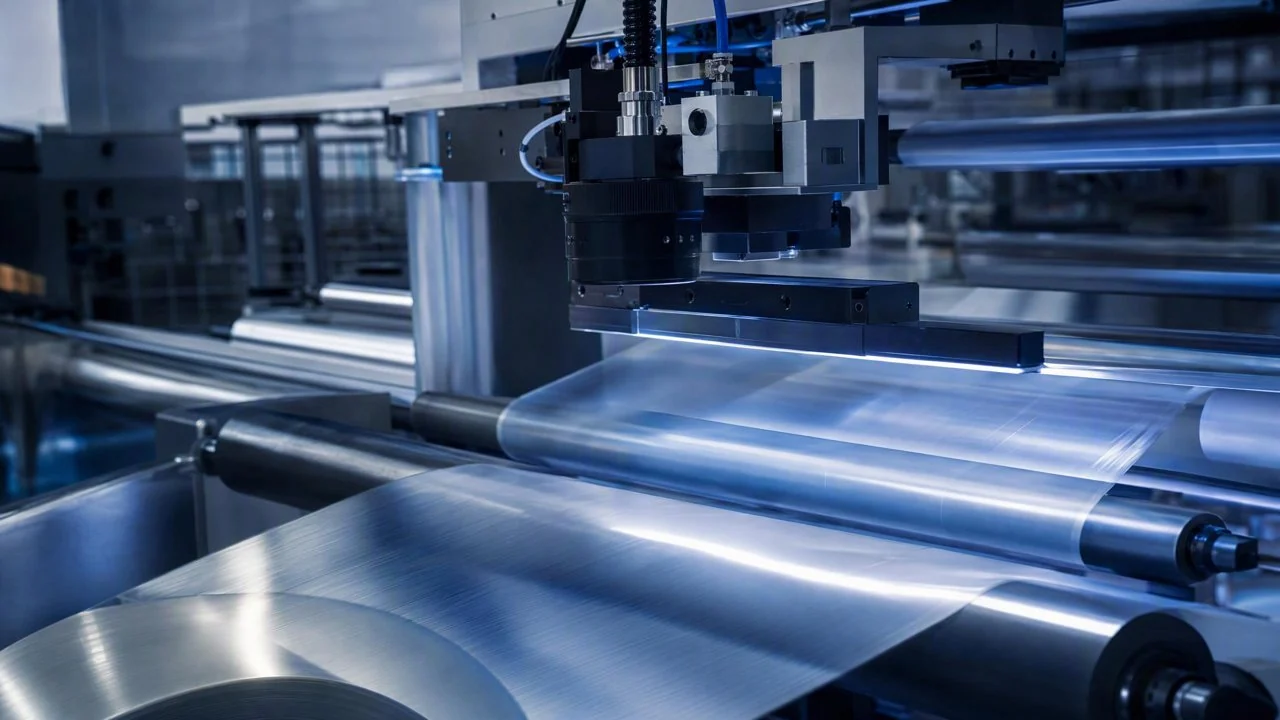
DaoAI 2D ACI equipment (high-resolution 2D imaging + deep learning secondary judgment, for surface/printing/character OCR/assembly missing and other planar defects, high-speed inline full inspection, micron-level, semantic false positive filtering) precisely identifies subtle defects on printed films/label rolls. Combined with its quality traceability and data closed-loop capabilities, it successfully reduced false positive rates on a leading chemical material manufacturer's production line from 15% to below 2%, significantly improving product yield and production efficiency.
In the chemical/material industry, particularly in the production of printed films and label rolls, surface quality is a critical factor determining their ultimate application value. These products are widely used in packaging, electronics, medical, and other fields, with stringent requirements for appearance defects, print quality, and character recognition. Traditional inspection methods often rely on manual visual inspection or rule-based AOI systems, but their efficiency and accuracy struggle to meet increasingly strict quality standards for complex, micron-level defects at high production speeds, especially in terms of quality traceability and data closed-loop management.
Pain Points: Why This Hurdle is Difficult to Overcome
Defect detection for printed films/label rolls faces multiple challenges. Firstly, **high false positive rates** are common. Traditional AOI systems are prone to misjudgments due to environmental light changes, material textures, minor scratches, or dust, leading to reported false positive rates of 15% or even higher on production lines. This not only increases the workload for manual re-inspection, with a leading manufacturer reporting at least 4 hours of human effort daily for defect verification, but also significantly slows down production cycles and wastes a large number of qualified products. Secondly, **defect diversity and micro-scale nature** pose a challenge. Defects such as bubbles, ink spots, scratches, color differences, character omissions or misalignments on printed films are numerous and often only tens of micrometers in size. Traditional algorithms based on thresholds or feature matching struggle to effectively distinguish between good and bad products, increasing the risk of missed detections. Thirdly, **a lack of effective quality traceability mechanisms** exists. Even when defects are detected, it is difficult to quickly pinpoint the specific production batch, workstation, or even equipment parameters, making root cause analysis and process improvement challenging, thus preventing the formation of an effective quality management closed-loop. This contrasts sharply with the technical path aiming for 99.9% accuracy in automotive parts defect detection, highlighting the shortcomings of traditional solutions in fine-tuned management and data-driven decision-making.
The root causes of these difficulties are: the material itself often has some transparency or reflectivity, making imaging quality susceptible to interference; complex printing processes can lead to subtle differences between batches, increasing the difficulty of model generalization; and high production speeds demand extremely fast processing from inspection systems, which traditional solutions struggle to achieve while maintaining accuracy. Furthermore, traditional solutions often lack comprehensive defect data collection, analysis, and utilization, failing to provide quantitative evidence for quality improvement.
Technical Principles
The DaoAI 2D ACI equipment effectively addresses the aforementioned challenges through its unique combination of technologies. Its core lies in **high-resolution 2D imaging and deep learning secondary judgment**. The equipment employs custom high-resolution industrial cameras and a multi-angle composite lighting system, capable of clearly capturing micron-level textures and defect features on the surface of printed films/label rolls, overcoming imaging difficulties caused by material transparency and reflectivity. The acquired images are then fed into the DaoAI ACI OS operating system, which incorporates a vision foundation model based on the Transformer architecture, possessing powerful feature recognition capabilities. During the defect judgment phase, it first uses a pre-trained deep learning model for initial defect identification. For regions deemed 'suspicious' by the model, the microchain DaoAI 2D ACI initiates a **deep learning secondary judgment** mechanism, combined with semantic false positive filtering technology, to perform more refined analysis and contextual understanding of the defect area. This secondary judgment mechanism effectively distinguishes true defects from background noise (such as material texture, environmental dust), significantly reducing false positive rates. For example, production line data shows that through the semantic false positive filtering of DaoAI 2D ACI, the false positive rate was reduced from an initial 15% to below 1.8%.
Compared to traditional rule-based AOI or manual visual inspection, the advantages of DaoAI 2D ACI are: **intelligence and adaptability**. Traditional AOI requires manual setup of numerous rules and thresholds, making it poorly adaptable to new defect types or process changes, with each changeover or product upgrade requiring significant time for reprogramming. In contrast, the DaoAI ACI OS operating system supports APDT positive/few-shot learning, requiring only 1–20 good samples to complete model training and deployment in 5 minutes, achieving 0-code automatic programming, greatly shortening changeover downtime. Manual visual inspection, on the other hand, is limited by human eye fatigue, subjective judgment, and the risk of missed detections at high speeds, making 100% inline full inspection impossible. DaoAI 2D ACI not only achieves high-speed inline full inspection but also offers **micron-level detection accuracy**, far exceeding manual visual inspection capabilities, ensuring product quality stability and consistency.
Typical Application Scenarios
- **Surface Scratch and Foreign Object Detection for Printed Films**: On production lines for various printed films like PET and BOPP, DaoAI 2D ACI can real-time detect micro-scratches, dents, bubbles, oil stains, dust, and other foreign objects on the roll surface. The challenge lies in these defects being tiny and potentially confused with the material's own texture; the system, through high-resolution imaging and deep learning models, can precisely distinguish and locate them.
- **Label Print Quality Inspection**: For label roll materials, it performs inline inspection of misregistration, ink spots, missing prints, color differences, smudges, and frayed edges. The difficulty lies in the complexity of patterns and diversity of defects at high printing speeds; DaoAI's vision foundation model quickly learns characteristics of different label patterns for high-precision recognition.
- **Character (OCR) and Barcode (OCV) Recognition**: Detects the integrity, clarity, and positional accuracy of production dates, batch numbers, serial numbers, and other characters printed on films or labels, and verifies barcode validity. The challenge is that characters might be blurry, incomplete, or deformed due to poor printing; DaoAI 2D ACI, combined with its powerful OCR engine, can handle character recognition tasks in various complex backgrounds.
- **Assembly Missing/Defect Detection (Multi-layer Film Lamination)**: In the production of multi-layer laminated films, it detects issues such as missing layers, misalignment, or trapped air bubbles between layers. The difficulty arises from the translucency and refractive index differences of multiple materials; the system identifies internal structural defects through precise image analysis.
- **Pattern Integrity and Positional Deviation Detection**: Detects whether printed patterns are complete, free of breaks, and assesses positional deviations relative to the substrate or adjacent patterns. Especially for complex geometric patterns, DaoAI 2D ACI can perform high-precision geometric matching and deviation measurement.
Case Study
A leading chemical material manufacturing enterprise, a global supplier of specialty films, produces printed films and label rolls widely used in high-end fields such as food packaging and electronic displays. Previously, this enterprise faced persistent challenges in online inspection of printed films, including high false positive rates, immense pressure from manual re-inspection, and difficulty in tracing quality issues. Their traditional rule-based inspection system often misidentified minor material texture variations and environmental dust as defects, leading to significant daily manual re-inspection efforts, severely impacting production efficiency and costs. Especially when handling multi-variety, small-batch orders, each changeover required several hours for parameter adjustments, resulting in low production efficiency. To address these pain points, the enterprise introduced DaoAI 2D ACI equipment, aiming for higher-precision inline full inspection and the establishment of a comprehensive quality traceability system.
The deployment process was smooth and efficient. The DaoAI team first conducted a detailed survey of the client's existing production lines and customized an imaging solution based on the specific characteristics of different printed film products. Utilizing the DaoAI ACI OS operating system, the first product model was trained and deployed in just 5 minutes using only 10 good samples. Subsequently, after a month of production line data validation and iterative model optimization, the DaoAI 2D ACI system was officially put into use. Post-deployment, production line data showed that the system reduced the overall **false positive rate for printed films from 15% before deployment to 1.8%**, significantly below the client's target of 5%. Concurrently, the **missed detection rate was stably controlled at <0.3%**. Most importantly, the DaoAI 2D ACI system could record detailed information for each defect, including images, locations, and types, and associate them with production batches and timestamps, achieving defect data traceability. This allowed quality inspection personnel to quickly pinpoint the source of problems, analyze defect trends, and guide the process department in targeted improvements, effectively shortening problem resolution cycles and enhancing product quality from the source. In this case, the client's changeover time was also reduced from an average of 2 hours to under 5 minutes, significantly improving production line flexibility.
DaoAI 2D ACI not only achieves high-precision defect detection but also transforms quality control from 'post-event remedy' to 'pre-event prevention and continuous optimization' through data closed-loop.
DaoAI Solutions and Products
DaoAI provides an end-to-end solution for printed film/label roll inspection in the chemical/material industry, with the **DaoAI 2D ACI equipment** as its core product. This equipment integrates DaoAI's self-developed high-performance hardware and advanced algorithms. Its high-resolution 2D imaging system captures micron-level details, ensuring no subtle defect goes undetected. The deep learning secondary judgment technology, combined with semantic false positive filtering, effectively eliminates various interferences, achieving extremely low false positive rates. For deployment, DaoAI 2D ACI supports 100% local private deployment, with all data processed internally by the client, ensuring data security and compliance. The DaoAI ACI OS operating system is key for modeling and changeovers. Based on the feature recognition capabilities of its vision foundation model, it allows users to quickly train and deploy models using APDT positive/few-shot learning with only a few good product images, achieving 0-code automatic programming. This enables even production line engineers with limited technical backgrounds to easily operate and quickly complete product changeovers, greatly enhancing production line flexibility and efficiency. Furthermore, the DaoAI World world model, as a unified foundation, ensures the system's semantic understanding and cross-scenario generalization capabilities across different scenarios, continuously optimizing detection models through feedback from the production line.
The practical implementation of the DaoAI 2D ACI solution has not only brought significant quantitative results but also reshaped the enterprise's quality management model. Through precise inline full inspection, a leading manufacturer saw **product yield increase by 13%**, and **manual re-inspection hours reduced by 85%**. More importantly, the quality traceability and data closed-loop mechanism established by DaoAI 2D ACI provided the enterprise with unprecedented data insights. Every defect occurrence, detection, re-judgment, and handling is fully recorded, forming a traceable quality archive. This data is analyzed by the DaoAI ACI OS operating system, helping the enterprise identify recurring defect patterns, high-risk production stages, and guide the optimization of process parameters, thereby achieving closed-loop management from 'problem discovery' to 'problem resolution' to 'problem prevention'. This not only reduced production costs and enhanced customer satisfaction but also strengthened the enterprise's competitiveness in the market.
FAQ
How does DaoAI 2D ACI equipment achieve high-precision defect detection with low false positive rates?
DaoAI 2D ACI equipment combines high-resolution 2D imaging technology with an advanced deep learning secondary judgment mechanism. It captures micron-level defects using customized lighting and cameras, then uses DaoAI ACI OS's vision foundation model for initial identification. For suspicious areas, the system performs a secondary deep learning judgment and applies semantic false positive filtering to effectively distinguish true defects from background noise, thereby significantly reducing false positive rates and enhancing detection accuracy.
What is the typical deployment cost and ROI period for DaoAI 2D ACI solutions?
The deployment cost of DaoAI 2D ACI solutions is influenced by various factors, including equipment configuration, production line integration complexity, and required functional modules. WeLinkirt provides highly customized solutions aimed at optimizing customer ROI. Specific deployment costs and ROI periods require a detailed assessment based on the client's actual production scale, defect types, and expected benefits. We recommend scheduling a free consultation with our experts to obtain a customized quote and detailed ROI analysis.
How does DaoAI 2D ACI support multi-variety, small-batch production of printed films in the chemical materials industry, enabling rapid changeovers?
DaoAI 2D ACI supports rapid changeovers through its core DaoAI ACI OS operating system. This system features APDT positive/few-shot learning capabilities, allowing new product models to be trained and deployed in just 5 minutes using only 1-20 good samples, achieving 0-code automatic programming. This significantly simplifies the changeover process and reduces reliance on technical personnel, enabling chemical material enterprises to flexibly meet the production demands of multi-variety, small-batch orders.
Full solution for this scenario: 2D ACI Equipment industry solutions
This article was generated by AI. Customer cases are simulated scenarios based on real product capabilities and figures are illustrative; see product pages for official benchmarks.