
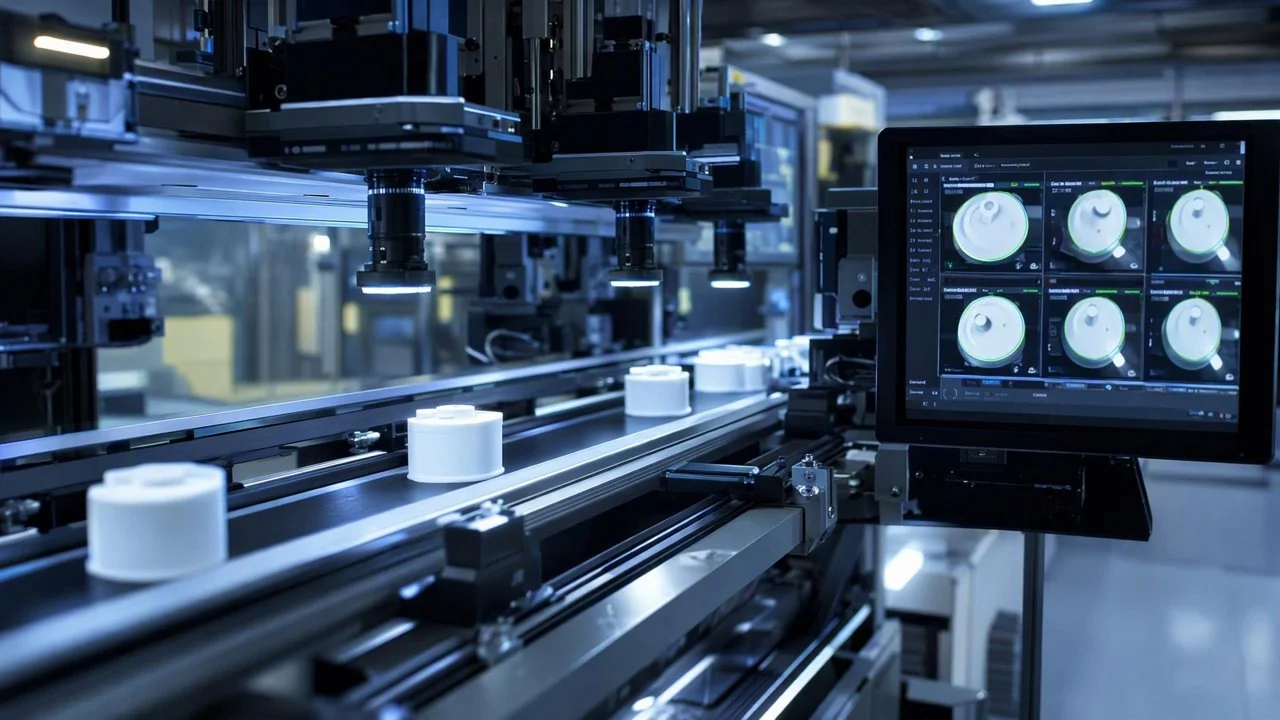
In consumer product manufacturing, the quality of body logo silk screen directly impacts brand image and user experience. DaoAI 2D ACI equipment (high-resolution 2D imaging + deep learning secondary judgment, for surface/print/character OCR/assembly defects and other planar flaws, high-speed online full inspection, micron-level, semantic false positive filtering), by combining high-resolution optical imaging with advanced deep learning models, reduced the missed detection rate for body logo silk screen defects from a common 1.2% with traditional manual inspection and rule-based AOI solutions to <0.08%, while significantly lowering false positives, achieving efficient and precise quality control on production lines. The consumer goods industry demands extremely high precision in product appearance, especially for critical identifiers like brand logos and product information silk screens. Any subtle defect can lead to product downgrading or even recalls. These defects include, but are not limited to, character omissions, uneven ink, blurred edges, scratches, bubbles, misalignment, or foreign matter adhesion, which are crucial factors in consumers' direct perception of product quality.
Pain Points: Why This Hurdle is Difficult to Overcome
Traditional inspection solutions for body logo silk screens face multiple challenges, leading to high missed detection rates and frequent false positives. Firstly, manual inspection, due to human eye fatigue, subjective judgment variations, and speed limitations, can result in missed detection rates exceeding 1.5% in high-speed production environments and struggles to meet cycle time requirements. Production line data from a mid-sized consumer electronics manufacturer shows that peak periods of manual re-inspection led to an additional 200 man-hours of labor cost daily. Secondly, rule-based traditional AOI equipment lacks robustness when dealing with complex backgrounds, varying material reflections, and micron-level minute defects. For instance, slight ink spread at the logo edge or tiny scratches are difficult for rule-based AOI to accurately distinguish between normal process variations and actual defects, leading to false positive rates typically between 5% and 10%, severely slowing down production line efficiency. These false positives not only waste manual re-inspection resources but can also lead to good products being misidentified as defective, causing unnecessary losses. Furthermore, consumer product iterations are fast, with frequent updates to logo designs and silk screen processes. Each changeover requires significant time to rewrite rules, resulting in long downtime and impacting capacity.
The root cause of these difficulties lies in the high randomness and diversity of silk screen defects. For example, uneven ink density appears differently under various lighting conditions, and micron-sized bubbles or foreign matter are easily overlooked against complex textured backgrounds. Simultaneously, the variety of product surface materials (e.g., matte, high-gloss, dull) and the color differences of silk screen inks make it challenging to standardize imaging conditions, posing extremely high demands on traditional vision algorithms. Against the backdrop of the industry hot topic “Key Technologies and Challenges of AI Vision Inspection in Achieving Industrial Zero-Defect Manufacturing,” overcoming these complexities and variabilities to achieve more precise and intelligent defect identification has become an urgent problem for consumer product manufacturers.
Technical Principles
The core advantage of DaoAI 2D ACI equipment lies in its combination of high-resolution 2D imaging technology and a deep learning secondary judgment engine. At the hardware level, we utilize customized high-resolution industrial cameras and multi-angle ring lights, capable of capturing micron-level details of the product surface logo silk screen, while effectively suppressing reflections, shadows, and other interferences to ensure stable and consistent image quality. The acquired image data is processed by DaoAI's self-developed Wemio engine. The Wemio engine, based on large-scale industrial vision foundation models, possesses powerful feature recognition and generalization capabilities. It first preprocesses the images, including distortion correction and brightness equalization, then feeds them into a deep learning model trained with extensive silk screen defect data. This model can learn and identify various complex silk screen defect patterns, including blur, gradients, and color variations that are difficult for traditional rules to define, achieving a defect detection rate of up to 99.8%.
Compared to traditional rule-based AOI, the deep learning secondary judgment mechanism of DaoAI 2D ACI offers significant advantages. Traditional rule-based AOI relies on manually set thresholds and geometric rules, which are highly prone to false positives or missed detections when facing subtle variations in silk screen defects and complex backgrounds. For example, a minor ink dot might be missed by rule-based AOI if its size is below the set threshold; if slightly larger but actually an acceptable process variation, it might be falsely reported. In contrast, DaoAI's deep learning model learns from vast amounts of data to understand the “semantic” information of defects, distinguishing between true defects and normal process variations or environmental noise. For instance, for a tiny burr on a logo edge, if its shape is similar to minor irregularities on a good product's edge, traditional AOI might falsely report it, but the Wemio engine can, through its understanding of the overall logo structure, determine it to be a good product feature rather than a defect. This semantic false positive filtering capability allows DaoAI 2D ACI to reduce the false positive rate by over 80% in practical production line applications, significantly improving detection efficiency and yield.
Typical Application Scenarios
- **Logo Character Defect Detection:** Detect whether characters on the brand logo are complete and clear, and if there are breaks, blurriness, omissions, or uneven ink. The challenge lies in varying character sizes, diverse fonts, and tiny ink dots or scratches easily obscured by background noise. DaoAI 2D ACI, through high-resolution imaging and deep learning models, accurately identifies various character defects, ensuring perfect brand representation.
- **Pattern Silk Screen Surface Foreign Objects and Scratches:** Identify the presence of dust, fibers, oil stains, and other foreign matter on the silk screen pattern surface, as well as scratches and indentations generated during production. The difficulty lies in the minute size and irregular shape of foreign objects and scratches, which are often confused with silk screen textures. DaoAI equipment utilizes its micron-level detection capability and semantic understanding to effectively distinguish true defects from background interference.
- **Silk Screen Misalignment and Deformation:** Check whether the silk screen pattern is accurately positioned relative to the product body, and if there is offset, rotation, or pattern deformation. The challenge involves high-precision positioning and detection of subtle deformations, especially on high-speed production lines. DaoAI 2D ACI combines high-precision positioning algorithms and image registration technology to achieve sub-pixel level misalignment detection.
- **Ink Layer Thickness and Uniformity Anomalies:** Indirectly evaluate the uniformity and thickness of the silk screen ink layer, using image brightness and texture analysis to identify issues such as ink being too deep, too shallow, missing, or piling up. The difficulty arises from the influence of lighting conditions on ink layer appearance and the varying reflective properties of different colored inks. The Wemio engine's feature learning capability adapts to these variations for robust judgment.
Case Study
A leading consumer product manufacturer, whose smartphone casing brand logo silk screen is a critical quality control point. Previously, this production line primarily relied on manual inspection and a small number of traditional AOI devices for detection. Traditional solutions faced high missed detection rates when dealing with high-gloss casing surfaces and fine logo printing, especially for minute ink dots, edge burrs, and slight scratches. Manual inspection often overlooked these due to fatigue, while traditional AOI frequently produced false positives due to reflections and rule limitations. Production line data from this client showed that before deployment, the average missed detection rate for logo silk screen defects was approximately 1.2%, leading to hundreds of defective products flowing into the next stage each month, increasing rework costs and customer complaint risks; simultaneously, the false positive rate was as high as 8%, causing a large number of good products to be sent for manual re-inspection, severely impacting production line cycle times and human resource efficiency.
After introducing DaoAI 2D ACI equipment, the manufacturer's logo silk screen inspection process achieved a qualitative leap. The DaoAI team, through on-site deployment and debugging, leveraged the APDT positive/few-shot learning capability. Using only 15 good product images and 30 minutes of training time, they quickly established a defect detection model for the product's logo silk screen. After deployment, the DaoAI 2D ACI system achieved 100% online full inspection with a detection cycle time of 600ms/piece. Production line test data showed that the missed detection rate for logo silk screen defects was successfully reduced to <0.08%, meaning that for every ten thousand products, the number of missed defective products decreased from approximately 120 to fewer than 8. Simultaneously, thanks to the Wemio engine's powerful semantic false positive filtering capability, the false positive rate also significantly dropped from 8% to 1.5%, greatly reducing the workload for manual re-inspection. In this case, the client's overall quality control efficiency improved by 35%, and brand image damage due to appearance defects was effectively avoided.
DaoAI 2D ACI not only reduced the missed detection rate to an industry-leading level but also achieved precise quality control in smart manufacturing by filtering semantic false positives through deep learning.
DaoAI Solution and Products
DaoAI 2D ACI equipment, as the core solution, provides end-to-end support for consumer product body logo silk screen defect detection. Its integrated DaoAI ACI OS operating system features “one good product 5-minute 0-code automatic programming” capability, greatly simplifying the process for new product or new logo changeovers. Users do not need to write complex code; they only need to provide a small number of good product samples, and the system can quickly learn and generate a detection model, reducing changeover downtime from several hours to less than 10 minutes. Furthermore, the APDT positive/few-shot learning function requires only 1-20 good product images to complete model training, making it especially suitable for small-batch, multi-variety production modes. DaoAI 2D ACI also supports 100% local private deployment, ensuring customer data security and meeting high-standard data compliance requirements. In terms of deployment and integration, DaoAI offers various deployment methods such as SDK/API/Docker, allowing flexible integration into existing MES/SCADA systems on the production line to achieve data interoperability and closed-loop quality management. For example, detected defect data can be transmitted in real-time to upper-level systems to guide process optimization, further improving overall production quality. The micron-level detection accuracy of DaoAI 2D ACI equipment enables it to meet the stringent requirements for appearance details in the consumer product industry.
Through the aforementioned solution, DaoAI 2D ACI equipment has brought significant quantifiable results and business value to customers. In consumer product logo silk screen inspection, the system reduced the missed detection rate from 1.2% with traditional solutions to <0.08%, and the false positive rate from 8% to 1.5%, directly reducing the outflow of defective products and the cost of manual re-inspection. In the case of a leading consumer product manufacturer, by introducing DaoAI 2D ACI, product quality stability significantly improved, customer satisfaction increased, and brand risk due to appearance defects was mitigated. Its high-speed online full inspection capability ensures that production line cycle times are not affected, and even, to some extent, enhances overall capacity. The solution provided by DaoAI is not just a technological upgrade but a crucial step for enterprises to achieve industrial zero-defect manufacturing and enhance their core competitiveness.
FAQ
How does DaoAI 2D ACI equipment reduce the missed detection rate for body logo silk screens?
DaoAI 2D ACI equipment combines a high-resolution optical imaging system to capture micron-level image details and is powered by the deep learning-based Wemio engine. This engine can learn and recognize complex and diverse silk screen defect patterns, including subtle imperfections often missed by human eyes and traditional rule-based AOI, thereby significantly increasing defect detection rates and effectively reducing missed detections.
How does the false positive rate of DaoAI 2D ACI equipment compare to traditional solutions, and how is this achieved?
DaoAI 2D ACI equipment reduces the false positive rate by over 80% in practical applications. This is primarily due to the Wemio engine's powerful semantic false positive filtering capability. The deep learning model can distinguish between true defects and normal process variations or background noise, preventing good products from being misidentified as defective, significantly reducing the workload for manual re-inspection.
How is the cost budget for deploying DaoAI 2D ACI equipment for logo silk screen inspection evaluated?
The cost evaluation for DaoAI 2D ACI equipment involves multiple dimensions, including hardware configuration, software licensing, custom integration, and after-sales services. The specific budget will vary based on the client's production line scale, detection accuracy requirements, integration complexity, and desired functional modules. We recommend contacting our sales team directly for a detailed quote and customized solution tailored to your specific needs.
Full solution for this scenario: the full inspection solution for 2D ACI Equipment
This article was generated by AI. Customer cases are simulated scenarios based on real product capabilities and figures are illustrative; see product pages for official benchmarks.