
Your core need is 3D SMT solder-joint measurement and inspection, you are primarily in electronics manufacturing, and you value mature measurement-based 3D AOI and a large automation ecosystem (including Saki's AXI/SPI), plus a global brand and service network.
SELECTION GUIDE · DAOAI vs OMRON 3D AOI
DaoAI vs Omron 3D AOIMeasurement-based 3D AOI, or AI-native 3D?
Omron's VT-S series is a mature measurement-based 3D AOI hardware platform — MDMC multi-direction multi-color imaging, five-camera hybrid 3D, AI threshold self-optimization and skill-less programming, strong at SMT solder-joint inspection, backed by a large automation ecosystem (and it has acquired Saki). DaoAI takes the AI-native 3D + good-sample-only few-shot route: a world-model foundation, full-stack hardware+software, 8 industries and 100% on-premise deployment. This is an honest, no-spin selection guide.
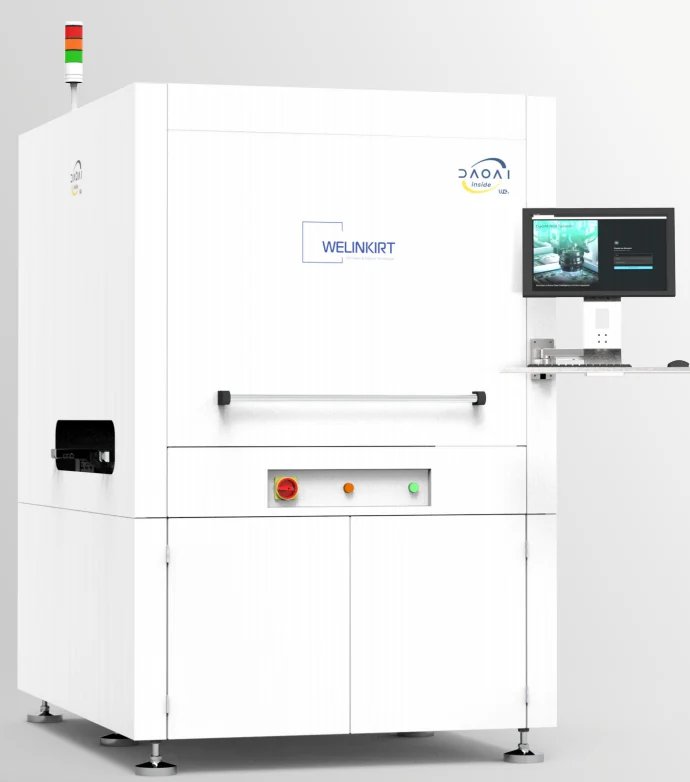
Good-onlyPositive-sample, as few as 1
AI-native3DPoint cloud / multispectral
8ind.Deployed inspection
FullstackWhole-line or overlay
NoveldefectsFlagged as anomalies
Localon-prem100% on-premise
CORE COMPARISON · DAOAI vs OMRON 3D AOI
| Dimension | Omron VT-S | DaoAI |
|---|---|---|
| Inspection paradigm | Measurement-based 3D AOI + AI assist (thresholds / programming) | AI-native 3D + good-sample-only few-shot |
| Imaging | MDMC multi-direction multi-color, five-camera hybrid 3D | 2D+3D point cloud / multispectral |
| Learning / programming | AI threshold self-optimization, skill-less programming (still measurement + sample driven) | APDT good-only / 1 image, flags novel defects |
| Best at | SMT solder joints / 3D component measurement and inspection | Amorphous / novel defects, multi-industry surface and 3D |
| Industries | Mainly electronics / SMT (+ Saki's AXI/SPI) | Electronics · semiconductor · automotive · battery · pharma · food · chemical · consumer goods (8 industries) |
| Form factor | Dedicated hardware + large automation ecosystem | Software + 2D/3D systems, whole-line delivery or overlay |
| Deployment / service | Global major brand | Local 100% on-premise + hands-on Asia support |
WHICH TO CHOOSE · HONEST TAKE
Choose DaoAI when you want extreme good-sample-only few-shot, need to flag amorphous / novel defects as anomalies, are deploying across non-electronics industries, want full-stack flexibility (whole-line or overlay), and value local 100% on-premise deployment with hands-on support and controllable cost.
WHY DAOAI · DIFFERENTIATORS
DaoAI World modelAPDT good-only learningFew-shot · novel defectsAI-native 3DFull-stack SW + HWRobotic vision8 industriesLocal 100% on-premise
FAQ
What is the biggest difference between DaoAI and Omron VT-S 3D AOI?
Omron VT-S is measurement-based 3D AOI hardware (MDMC multi-direction multi-color imaging + AI-assisted thresholds / programming), strong at SMT solder-joint inspection and backed by a large automation ecosystem; DaoAI is AI-native 3D + good-sample-only few-shot (on a world-model foundation), full-stack, 8 industries and 100% on-premise. The former is measurement-first, the latter is AI-first.
When is Omron VT-S the better choice?
When your core need is 3D SMT solder-joint measurement and inspection, you are primarily in electronics manufacturing, and you value mature measurement-based 3D AOI and a large automation ecosystem (including Saki's AXI/SPI) plus a global brand and service network.
When is DaoAI the better fit?
When you want extreme good-sample-only few-shot, need to flag amorphous / novel defects as anomalies, are deploying across non-electronics industries, want full-stack flexibility, and value local 100% on-premise deployment with hands-on support and cost sensitivity.
How does DaoAI's few-shot differ from Omron's AI self-optimization?
Omron's AI is largely used to self-optimize defect thresholds and enable skill-less programming within a measurement framework — still measurement plus a certain amount of samples; DaoAI's APDT positive-sample learning models good units only and flags never-before-seen novel defects as anomalies. The generalization paths differ.
Is this comparison objective?
Each vendor has its strengths (see "Which to choose"). This page is based on public materials, is for selection reference only, does not disparage any third party, and should be validated against each vendor's official positioning and your own trial.