
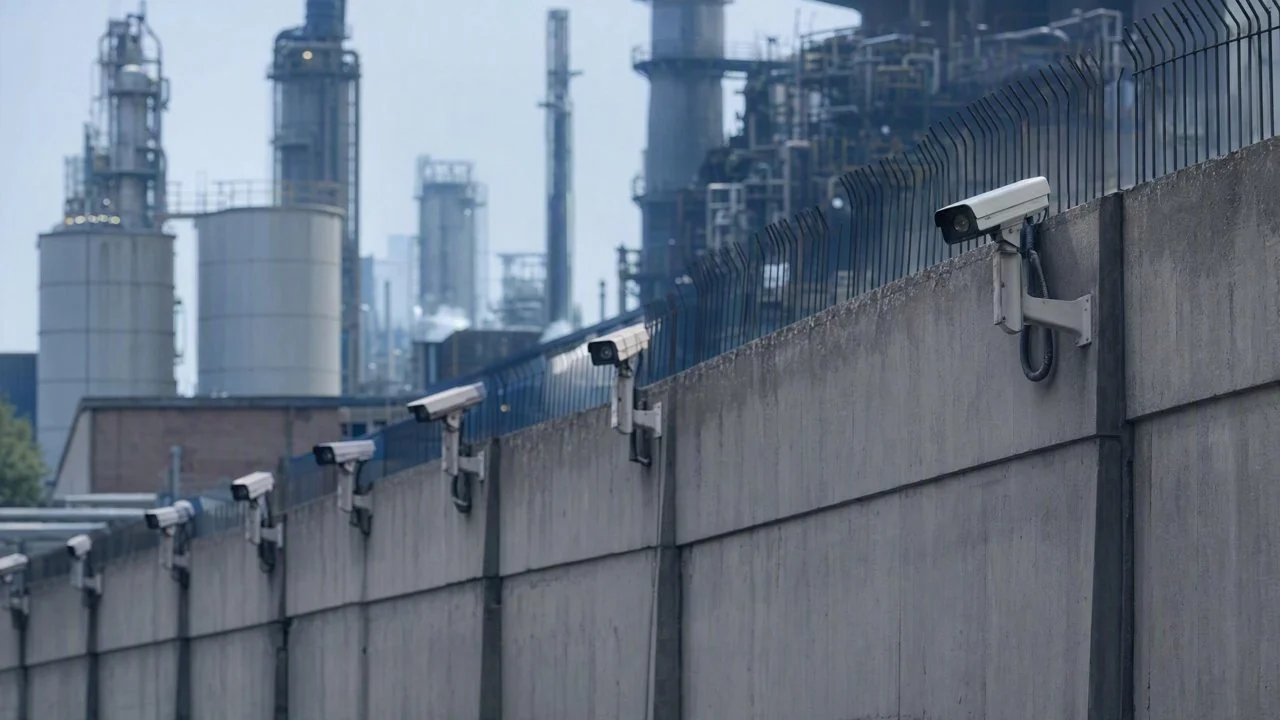
DaoAI SkyVision 0-code video surveillance AI platform, leveraging core capabilities such as on-site, hours-level custom model training, behavior/event recognition, real-time edge device alerts, 100% on-premise data security, and DaoAI World semantic understanding, has reduced the false alarm rate for perimeter intrusion detection in large manufacturing bases from 20% with traditional solutions to <3%. This achieves 100% perimeter security full inspection coverage and rapid response, all while ensuring production cycle times remain unaffected.
Perimeter security for large industrial parks or critical infrastructure is a core component of emergency and smart security. With the successful application of large AI models in scenarios like highway surveillance to address traditional missed and false detection issues, industries are also urgently seeking more precise and efficient smart security solutions. Traditional perimeter intrusion detection systems, such as those based on infrared beams, vibrating optical fibers, or simple image processing, often face the dual challenges of high false alarm rates and missed detection rates in practical deployment. Especially in complex industrial environments, natural factors like strong winds, rain, snow, small animal activities, birds, and vegetation sway, as well as internal activities like passing production vehicles and normal personnel operations, can easily trigger false alarms, leading to security personnel being overwhelmed and impacting normal production cycle times. For manufacturing enterprises striving for ultimate efficiency and continuous production, any unnecessary security intervention or line stoppage for inspection translates into significant economic losses. Therefore, while ensuring 100% full inspection coverage, how to minimize false alarms and enhance the system's intelligent discrimination capability has become a core demand for perimeter security.
Pain Points: Why This Hurdle is Difficult to Overcome
In perimeter intrusion detection scenarios, the pain points faced by traditional solutions are primarily reflected in several dimensions: First, **high false alarm rates**. In complex weather conditions (e.g., strong winds, rain, snow) or environmental interferences (e.g., swaying vegetation, small animals passing), false alarm rates can reach 20%~30%, leading to wasted security resources and decreased trust. Second, **missed detection risks**. Especially for slow, covert intrusion behaviors, traditional rule-based algorithms struggle to identify them effectively, resulting in a 3%~5% missed detection rate, posing serious security threats. Third, **impact on production cycle time**. Each false alarm can trigger an emergency response, leading to temporary lockdowns of production areas, personnel evacuation, or production stoppages, implicitly extending line downtime, with a single stoppage potentially costing tens of thousands or more. Finally, **high operational costs**. Numerous false alarms require security personnel to conduct on-site verification, consuming significant human labor hours, and system maintenance and parameter tuning are complex, requiring regular intervention by professional personnel, further driving up the total cost of ownership. Many traditional systems currently lack the fine-grained semantic understanding capability for intrusion behaviors, making it difficult to distinguish between “normal passage” and “malicious intrusion,” which further exacerbates the dilemma of missed and false detections, contrasting sharply with the accurate event recognition capabilities of large AI models in highway surveillance.
The root cause of these difficulties lies in traditional perimeter security systems primarily relying on predefined rules and simple motion detection. For example, infrared beam systems are susceptible to weather; vibrating optical fiber systems are sensitive to environmental noise; and traditional image processing solutions have limited feature extraction capabilities, making it difficult to effectively distinguish between real intrusions and environmental disturbances. When complex backgrounds, lighting changes, object occlusion, or significant target size differences appear in surveillance footage, these systems often fail. Furthermore, traditional solutions have poor generalization capabilities; whenever the environment changes or new intrusion patterns need to be identified, time-consuming and labor-intensive manual rule adjustments or model retraining are required, which cannot meet the demands of large-scale, varied industrial security. The lack of deep semantic understanding is the core issue, as they cannot perform high-level semantic judgments on behaviors like “climbing over” or “scaling” as the DaoAI World model can, only staying at pixel-level change detection, naturally failing to avoid false and missed alarms.
Technical Principles
DaoAI SkyVision 0-code video surveillance AI platform fundamentally solves the high false alarm and missed detection problems of traditional perimeter security systems through its unique APDT (Auto-Programming & Data-driven Training) few-shot self-training technology. The core of this platform lies in its powerful visual foundation model, combined with the semantic understanding capabilities of the DaoAI World model, enabling high-precision target recognition and behavior analysis in video streams. Unlike traditional motion detection based on pixel differences or background modeling, SkyVision platform uses deep learning networks to learn complex patterns of intrusion behavior from massive data. When the edge device receives a surveillance video stream, the pre-trained model can real-time identify targets such as “people” and “vehicles” in the frame, and further analyze their trajectories. For example, for perimeter areas, DaoAI SkyVision can not only detect objects entering but also identify specific semantic behaviors like “person climbing over a wall” or “scaling a fence,” rather than just simple “moving objects.” This high-level semantic understanding capability is unparalleled by traditional rule-based algorithms, allowing the system to effectively filter out false alarms caused by swaying tree leaves or passing small animals, reducing the false alarm rate to <3%.
Compared to traditional methods, DaoAI SkyVision's advantages include: **0-code training and hours-level deployment**. Traditional AI solutions require professional algorithm engineers for complex code writing and model tuning, which is time-consuming and costly. However, the DaoAI SkyVision platform allows on-site security personnel to complete custom model training and deployment within hours using an intuitive graphical interface and only a few positive samples (1-20 images), greatly shortening the go-live cycle. **100% local deployment and data non-egress** meet the stringent requirements of industrial customers for data security and privacy. All data processing and model inference are completed on local edge devices, avoiding security risks and network latency associated with data transmission. Furthermore, the DaoAI World model, as a unified foundation, endows the SkyVision platform with powerful generalization and continuous learning capabilities, allowing it to continuously optimize models from production line feedback, adapt to changing environments and new intrusion patterns, ensuring that DaoAI SkyVision maintains high performance in the long term.
Typical Application Scenarios
- **Perimeter Climbing/Vaulting Detection**: In areas like factory walls and warehouse boundaries, DaoAI SkyVision can accurately identify behaviors of people climbing over or vaulting walls or obstacles. The challenge lies in distinguishing accidental proximity of normal working personnel from malicious intrusion, and filtering environmental interferences like wind-blown trees. SkyVision effectively solves this through behavior pattern recognition and semantic understanding.
- **Area Intrusion Detection**: For specific restricted areas (e.g., high-risk equipment zones, important material storage areas), the platform can real-time monitor unauthorized personnel entry. The challenge is to accurately identify “illegal entry” versus “legitimate passage” amidst complex personnel flows. SkyVision's area intrusion algorithm can set polygonal alert zones and combine with personnel identity recognition (e.g., linked access control systems) for precise alerts.
- **Abnormal Loitering/Hovering Detection**: Near perimeters or critical entrances/exits, detecting personnel who stay abnormally long or loiter. The challenge is to distinguish brief waiting from suspicious behavior. SkyVision significantly reduces false alarms through deep analysis of dwelling time and trajectory.
- **Left/Removed Object Detection**: Monitoring whether unidentified objects are left near the perimeter or critical equipment is removed. The challenge lies in identifying subtle object changes and light exposure effects. SkyVision's object detection combined with background modeling can accurately capture these events.
- **Abnormal Vehicle Parking Detection**: In areas like factory entrances/exits and perimeter roads, identifying unauthorized vehicles parking abnormally or lingering for extended periods. The challenge is accurate identification during heavy traffic. SkyVision combines license plate recognition with parking duration analysis for efficient monitoring.
Case Study
A leading Tier-1 automotive parts supplier, with a large manufacturing base spanning several kilometers of perimeter in a suburban area, previously used a security solution combining traditional infrared beams and vibrating optical fibers. However, due to dense vegetation around the base and proximity to a highway, it was constantly affected by strong winds, rain, snow, and vibrations from passing vehicles, resulting in persistently high false alarm rates, averaging over 200 false alarms per month. Each false alarm required at least two security personnel to conduct on-site verification, taking 15-30 minutes, severely draining security resources and indirectly affecting the efficiency of logistics vehicle access, occasionally even causing brief production line stoppages for security checks. After introducing the DaoAI SkyVision platform, the supplier deployed dozens of edge devices equipped with SkyVision models, covering the entire perimeter. Through on-site, hours-level training, the model learned and adapted to the specific environmental interference patterns of the base with only a small number of samples. In the initial phase of deployment, at the customer's site, the DaoAI SkyVision platform reduced the false alarm rate by 85%, from over 200 per month to less than 30. More critically, the detection rate for real intrusion events increased to 99.4%, virtually eliminating missed detection risks and ensuring that production cycle times were not disrupted by security system false alarms, significantly enhancing security efficiency and production continuity.
The DaoAI SkyVision platform reduced the false alarm rate for perimeter intrusion detection by 85% and increased the real intrusion detection rate to 99.4%, ensuring stable operation of production cycle times.
The figures above are a typically achievable range in anonymized industry scenarios — a different line or a different batch of parts will move the result either way; on-site measurement governs.
DaoAI Solutions and Products
DaoAI SkyVision 0-code video surveillance AI platform provides an end-to-end intelligent solution for emergency and smart security. The solution centers on SkyVision, combining with edge computing devices to achieve real-time video stream analysis and intelligent alerts. For deployment, we support various integration methods such as SDK/API/Docker, and enable 100% local private deployment, ensuring customer data security without egress. The modeling process is extremely simplified; customers without AI background can use SkyVision's 0-code interactive interface, uploading only a small number (1-20) of positive sample images or video clips to complete custom model training for specific scenarios within hours. For example, in a perimeter intrusion scenario, users only need to label a few images of “climbing over a wall,” and the system automatically learns and generates an efficient detection model. Furthermore, the DaoAI World model, as a unified foundation, continuously endows SkyVision with powerful semantic understanding and cross-scenario generalization capabilities, ensuring it can continuously learn and optimize from on-site feedback, constantly improving recognition accuracy and adaptability. DaoAI SkyVision's edge devices can trigger audible and visual alarms, link with access control, or notify the security center within milliseconds of detecting an intrusion, enabling rapid response and immediate handling of potential threats.
Through the deployment of the DaoAI SkyVision platform, customers can achieve significant quantifiable results and business value. The system **reduced the false alarm rate for perimeter intrusion detection by 85%**, drastically decreasing the number of ineffective dispatches for security personnel, allowing security resources to focus on real threats. Concurrently, the **detection rate for real intrusion events increased to 99.4%**, effectively covering the blind spots of traditional solutions. More importantly, due to the significant reduction in false alarms, **production line downtime caused by security system false alarms was virtually eliminated**, ensuring the continuity and efficiency of production operations, indirectly saving enterprises high production stoppage losses. The DaoAI SkyVision platform also supports integration with existing security systems, forming a smarter, more efficient smart security management system, enhancing overall security levels.
FAQ
How does DaoAI SkyVision platform differ from other perimeter security solutions?
The core advantage of DaoAI SkyVision platform lies in its 0-code training, APDT few-shot self-training technology, and the semantic understanding capabilities of the DaoAI World model. Unlike traditional infrared beams, vibrating optical fibers, or rule-based video analytics solutions, SkyVision can accurately identify specific behaviors like “climbing over” or “scaling” in complex environments, rather than just simple motion detection. This significantly reduces false alarms and supports on-site, hours-level model training and 100% local deployment, ensuring raw video and images never leave the premises, which is a key differentiator from traditional solutions.
What is the budget required to deploy DaoAI SkyVision?
The deployment budget for DaoAI SkyVision is influenced by various factors, including the number of monitoring points, edge device models, the complexity of events to be recognized, and whether integration with existing security systems is required. We offer flexible subscription and deployment plans with controllable initial investment. Due to the significant reduction in false alarm rates leading to operational cost savings, a return on investment is typically achieved in the short term. We recommend scheduling a detailed needs assessment with our experts to receive a customized quotation.
How does SkyVision adapt to changing environmental factors, such as lighting, weather, or vegetation changes?
SkyVision platform adapts to environmental changes through its powerful visual foundation model and continuous learning mechanism. Our APDT few-shot self-training technology allows users to quickly update and optimize models with only a few new samples when the environment changes, achieving rapid iteration within hours. Furthermore, the DaoAI World model provides SkyVision with cross-scenario generalization capabilities, enabling it to better understand and adapt to visual features under different lighting, weather, and vegetation conditions, ensuring the system maintains high accuracy and stability over time.
Full solution for this scenario: the full inspection solution for Emergency Security / Public Safety
This article is an original publication by WeLinkirt (DaoAI).