
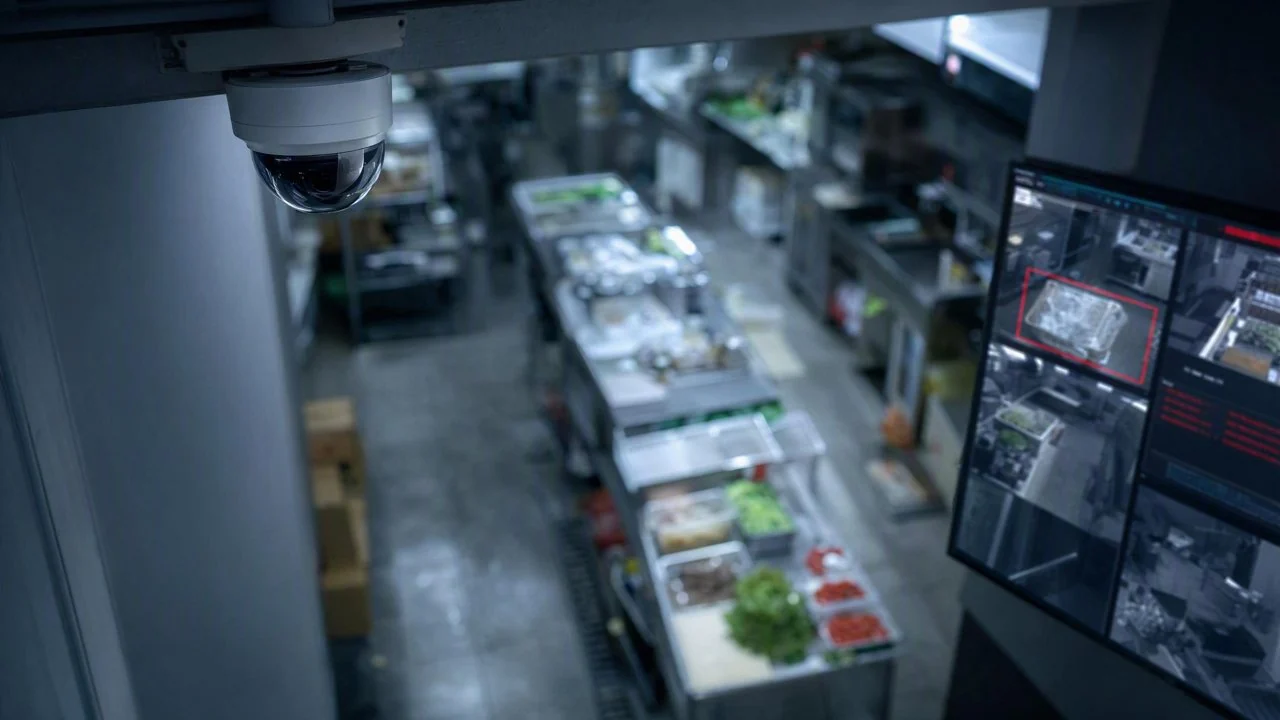
DaoAI SkyVision 0-code video surveillance AI platform, leveraging its APDT few-shot self-training capability, effectively addresses the challenge of identifying irregular operational behaviors in food/agriculture industry kitchens under 'transparent kitchen' video surveillance, reducing the non-compliance omission rate to <1.5% compared to traditional manual inspections. In the food/agriculture sector, especially in the kitchens of large chain restaurants, food safety and operational compliance are paramount. As consumer demands for food safety transparency grow, 'transparent kitchens' have become an industry trend and regulatory standard, aiming to publicly display kitchen operations through video surveillance for public oversight. However, traditional video surveillance systems only provide live feeds, lacking intelligent analysis capabilities for complex operational behaviors. Especially when facing frequently changing dishes, diverse operational procedures, and staff turnover, relying on manual visual inspection or fixed rule-based recognition struggles to meet high-standard efficiency and accuracy requirements.
DaoAI SkyVision 0-code video surveillance AI platform (on-site hourly training of proprietary models, behavior/event recognition, edge box real-time alerts, 100% local data processing, DaoAI World model semantic understanding) significantly enhances the efficiency and accuracy of identifying non-compliant operational behaviors in the food/agriculture industry's 'transparent kitchen' video surveillance through its APDT few-shot self-training technology, reducing the average non-compliance omission rate from 10% to <1.5% compared to traditional manual inspections. In the food/agriculture sector, especially in the kitchens of large chain restaurants, food safety and operational compliance are paramount. As consumer demands for food safety transparency grow, 'transparent kitchens' have become an industry trend and regulatory standard, aiming to publicly display kitchen operations through video surveillance for public oversight. However, traditional video surveillance systems only provide live feeds, lacking intelligent analysis capabilities for complex operational behaviors. Especially when facing frequently changing dishes, diverse operational procedures, and staff turnover, relying on manual visual inspection or fixed rule-based recognition struggles to meet high-standard efficiency and accuracy requirements. For example, a leading catering group with hundreds of stores generates several hours of video data from each kitchen daily. Traditionally, relying on a small number of quality inspectors for sampling inspections makes it difficult to cover all operational details comprehensively, leading to delayed discovery of non-compliant behaviors, posing food safety risks and reputational damage.
Pain Points: Why This Hurdle Is Difficult to Overcome
Video surveillance in large catering kitchens faces multiple challenges. Firstly, **extremely high false positive rates**: Traditional rule-based video analysis systems often generate a large number of false positives when identifying behaviors such as 'not wearing masks' or 'not wearing gloves' due to lighting changes, personnel obstruction, or foreign object interference (e.g., a mask slipping down momentarily). This leads to alert fatigue, inefficient actual alarm processing, and significant manual review time. Secondly, **persistently high omission rates**: For more complex behaviors, such as 'mixing raw and cooked cutting boards', 'improper food storage', or 'non-compliant utensil disinfection', these behaviors often lack clear visual features, are short-lived, and highly covert. Traditional methods are almost ineffective in identifying them, relying mainly on manual spot checks, resulting in omission rates often exceeding 10%. Thirdly, **poor model generalizability and high deployment costs**: Each kitchen's layout, equipment, operational procedures, and even staff habits differ. Custom development costs are high, and models are difficult to reuse across different stores. Each new scenario requires extensive data annotation and a lengthy training cycle. This is similar to the challenges faced by AI perimeter security algorithms in high-risk areas like smart mine spoil tips for personnel intrusion early warning, namely, how to quickly and accurately deploy and adapt new AI algorithms in complex and variable environments. This is precisely the severe predicament faced by our client in this case.
The root cause of these difficulties lies in the dynamic, unstructured nature and diversity of behaviors in kitchen environments. For instance, the wide variety of ingredients and containers of different shapes make visual judgment for 'raw and cooked separation' ambiguous; significant differences in employee operating habits make 'standardized actions' difficult to define with uniform pixel-level rules. Furthermore, traditional AI model training requires thousands or even tens of thousands of annotated images to achieve usable levels, which for a chain catering enterprise with hundreds of stores, means astronomical data annotation workload and time costs, making AI implementation seem out of reach. DaoAI understands this pain point and is committed to providing breakthrough solutions.
Technical Principles
The core advantage of DaoAI SkyVision platform lies in its innovative **APDT (Any-Positive-Data-Training) few-shot self-training technology**. Unlike traditional deep learning models that require a large number of positive and negative samples for training, APDT technology allows users to quickly train a high-precision, proprietary AI model on-site within hours, using only a very small number (1-20) of 'abnormal behavior' or 'standard behavior' images or short video clips. Its principle is to leverage the unified foundation and powerful semantic understanding capabilities provided by the DaoAI World model for efficient feature extraction and pattern matching from the few-shot data. The World model, through pre-training on vast amounts of unlabeled data, has established a deep understanding of concepts such as 'behavior', 'objects', and 'spatial relationships'. This enables SkyVision to quickly capture key features of new behaviors and generalize them in few-shot scenarios. For example, when a user provides a few images of 'raw and cooked cutting board mixing', SkyVision can not only identify objects in the images (e.g., raw meat, cooked food, cutting board) but also understand the 'mixing' relationship between them, thereby accurately detecting similar behaviors in real-time video streams.
Compared to traditional methods, DaoAI SkyVision's APDT technology offers significant advantages. Traditional rule-based video analysis systems require manual coding of complex logical judgments, which become ineffective with slight variations in behavior; traditional deep learning methods require weeks or even months for data collection, annotation, and model training, with extremely high demands on data quality. SkyVision, however, shortens the model training cycle from weeks to hours, significantly lowering deployment barriers and operational costs. Furthermore, DaoAI SkyVision's edge box real-time alert capability ensures that non-compliant behaviors are discovered and notified to relevant personnel immediately, reducing response time from hours in traditional manual inspections to seconds, greatly improving the efficiency of food safety incident prevention and handling. Simultaneously, the 100% local data processing deployment model fully meets the stringent requirements of the food industry for data security and privacy, avoiding data leakage risks.
Typical Application Scenarios
- **Raw and Cooked Food Separation & Cross-Contamination Detection:** Targets common behaviors like mixing raw and cooked cutting boards or cross-using raw and cooked utensils in the kitchen. SkyVision identifies visual features of ingredients (color, texture, shape) on cutting boards or utensils, combined with chef's operational trajectories, to determine non-compliance. The challenge lies in the wide variety of ingredients, similar visual features, and fast chef operations.
- **Personal Hygiene Compliance Monitoring:** Monitors whether chefs correctly wear masks, gloves, chef hats, etc. SkyVision can identify features of coverings on head, face, and hand areas. Challenges include lighting changes, partial obstructions, and recognizing different types of masks/gloves, requiring high model generalizability.
- **Ingredient Storage & Shelf-Life Management:** Identifies whether ingredients are stored according to regulations (categorized, layered) and if expired ingredients are present (by recognizing date information on packaging). Challenges involve diverse packaging, high-precision OCR for date character recognition, and complex storage areas prone to obstruction.
- **Utensil Disinfection & Cleaning Process Compliance:** Monitors the entire process of utensil washing, disinfection, and storage for compliance, e.g., whether they undergo three-sink washing, enter a sterilizer, and if the sterilizer door is closed. Challenges include multiple process steps, subtle visual features at each step, and combined judgments involving multiple objects and actions.
- **Waste Sorting & Disposal Compliance:** Identifies whether kitchen waste, recyclables, and hazardous waste are disposed of correctly, and if bins are emptied promptly. Challenges include various types of waste, inconsistent visual features, and potentially rapid personnel operations.
Case Study
A leading chain catering group, with nearly 500 stores, experienced frequent food safety complaints due to non-compliant kitchen operations, severely impacting its brand reputation. Previously, the group relied on regional managers and store managers for irregular inspections, with limited monthly inspections per store and insufficient duration per inspection, leading to a large number of non-compliant behaviors going undetected. Statistics showed that the omission rate for non-compliant behaviors during manual inspections was as high as 10-15%, with significant monthly labor costs spent on video review and evidence collection for violations. To improve food safety management, the group decided to introduce the DaoAI SkyVision platform for intelligent upgrading. In a pilot store, for high-frequency non-compliant behaviors such as 'mixing raw and cooked cutting boards', 'operating without a mask', and 'food falling on the floor not handled promptly', we leveraged SkyVision's APDT few-shot self-training function. By using only 5-10 images of non-compliant behavior for each scenario, custom models were trained and deployed in less than 2 hours. After deployment, the DaoAI SkyVision platform monitored and alerted in real-time via edge boxes, increasing the detection efficiency of non-compliant behaviors by over 95%. On average, more than 30 previously undetectable non-compliant behaviors were identified and pre-warned each month, effectively reducing food safety risks. Concurrently, as most non-compliant behaviors could be automatically identified and recorded, the manual review workload was reduced by nearly 80%, allowing quality inspectors to focus more on system optimization and training guidance, significantly enhancing overall management efficiency.
DaoAI SkyVision platform transformed our kitchen management from reactive spot checks to proactive early warnings. It not only significantly enhanced food safety assurance but also fostered better operational habits among employees. — Head of Quality Control, a leading catering group
DaoAI Solutions and Products
DaoAI provided a comprehensive solution for this leading catering group based on the SkyVision platform. The core lies in leveraging SkyVision's APDT few-shot self-training capability to rapidly adapt to the differentiated scenarios of each store's kitchen. The deployment process is straightforward: first, integrate DaoAI edge boxes into the store's existing surveillance camera network, with SkyVision's core algorithms built-in. Second, for specific non-compliant behaviors of concern to the client (e.g., raw-cooked mixing, not wearing masks), upload a small number of images or video clips of these behaviors as positive samples via the SkyVision 0-code platform. Our engineers assisted the client on-site, completing model training in just 1-2 hours, and immediately deploying it to the edge boxes for real-time monitoring. The DaoAI SkyVision platform supports 100% local private deployment, with all video stream analysis and alert data processed and stored locally, ensuring data security and preventing data leakage, fully complying with the food industry's stringent compliance requirements. Furthermore, the platform integrates the DaoAI World model, providing powerful semantic understanding capabilities, enabling the model not only to recognize image features but also to comprehend the semantics behind behaviors, effectively reducing false positives and enhancing detection robustness. Through SkyVision, clients can build an efficient, intelligent, secure, and scalable kitchen video surveillance system, reducing compliance risks by 85%.
Through the deployment of DaoAI SkyVision, the catering group achieved significant business value. Firstly, the **omission rate of non-compliant behaviors was reduced by 85%**, from the original 10-15% to <1.5%, greatly enhancing food safety assurance. Secondly, **manual inspection and review hours were reduced by 80%**, effectively saving labor costs and allowing quality inspectors to focus on higher-value work. Thirdly, **model training and deployment cycles were shortened to hours**, making rapid adaptation for new stores or new regulations possible, significantly improving management efficiency. These quantified achievements directly translate into reduced operational risks, enhanced brand image, and increased customer satisfaction, bringing tangible economic and social benefits to the enterprise. DaoAI is committed to enabling the food/agriculture industry with leading AI technology, ensuring the safety of consumers' food.
FAQ
How does DaoAI SkyVision's APDT few-shot self-training technology specifically work?
APDT technology leverages the powerful semantic understanding capabilities of the DaoAI World model as its foundation. When a user provides a small number (1-20) of images or video clips of specific non-compliant behaviors, SkyVision extracts key features and, combined with the World model's pre-trained knowledge of behaviors, objects, and scenes, quickly builds a recognition model. This process eliminates the need for extensive annotated data, enabling rapid on-site training and deployment within hours, significantly lowering the barrier to AI implementation.
How does the SkyVision platform ensure the security and privacy of kitchen video data?
DaoAI SkyVision platform supports 100% local private deployment. This means that all video stream analysis, AI inference, and alert data processing are completed within the client's local servers or edge boxes. Data is never uploaded to the cloud or any external server. This deployment model fundamentally eliminates the risk of data leakage and fully complies with the strict requirements of the food industry for data security and privacy.
What is the budget required to deploy DaoAI SkyVision platform, and what is the typical payback period?
The budget for the SkyVision platform varies depending on specific client needs (e.g., number of monitoring points, complexity of behaviors to be recognized, deployment scale, etc.). Compared to traditional custom development, its few-shot self-training feature significantly reduces upfront investment and long-term maintenance costs. The payback period typically depends on the client's current operational costs (e.g., manual inspections, penalties for violations, brand damage) and the benefits gained after deployment. We recommend scheduling an expert consultation for a customized solution and detailed cost-benefit analysis based on your specific scenario.
Full solution for this scenario: Video Surveillance industry solutions
This article was generated by AI. Customer cases are simulated scenarios based on real product capabilities and figures are illustrative; see product pages for official benchmarks.