
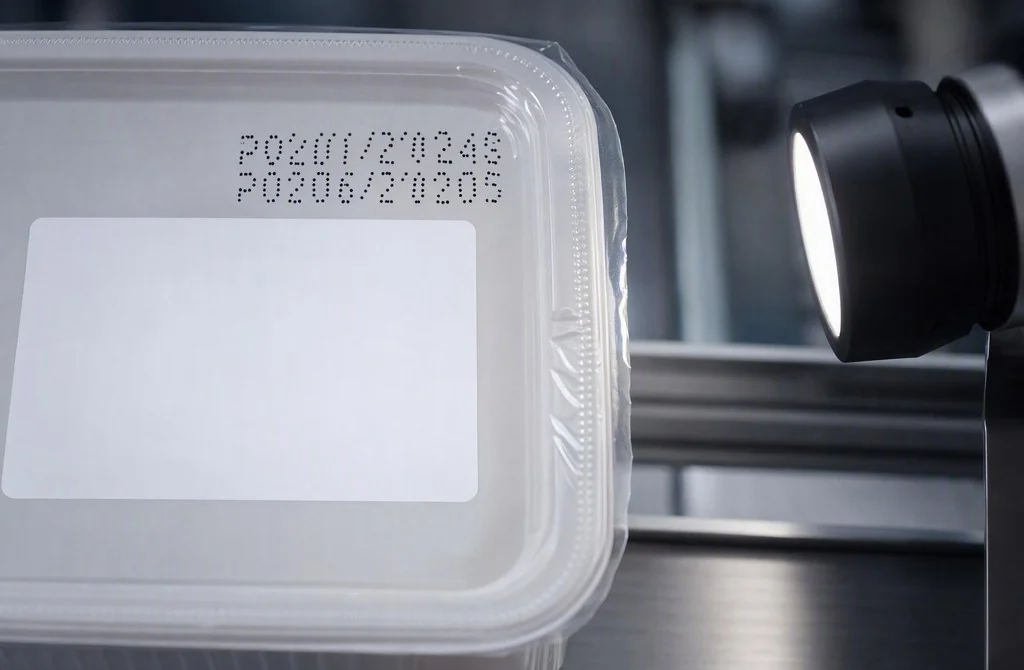
In the food packaging industry, the quality of product sealing, labeling, and coding is directly related to consumers' experience and brand reputation. Traditional inspection methods are often ineffective in dealing with complex and changeable production environments, while the application of AI technology provides a new way to solve this problem.
Scenario: The food packaging industry is a highly competitive industry with extremely strict quality requirements. Food packaging should not only ensure the sealing performance of products to extend the shelf-life but also ensure that the label information is accurate and the coding is clear and legible. These are the basic requirements for products to be legally launched on the market. For food packaging factories, they usually undertake contract filling and packaging for multiple brands, which means there are a large number of SKUs with different specifications on the production line, and line-change operations are frequent. In such a production environment, how to efficiently and accurately detect the integrity of product sealing, the position and adhesion of labels, and the presence and clarity of production date coding has become an important challenge for enterprises.
Pain Points: Why Is It Difficult?
From a quantitative perspective, the traditional solution of rule-based machine vision combined with manual sampling inspection has many problems. First of all, the misjudgment rate is extremely high. In actual production, due to factors such as light fluctuations, packaging reflection, and slight product displacement, the misjudgment rate can reach 30%–40%. Secondly, the missed-detection situation is serious. In order to reduce the frequent stops of the production line caused by misjudgments, enterprises have to relax the detection rules, which makes the missed-detection rate of real defects as high as 20%–30%. Moreover, the customer complaint and return rate remain high. Due to defective products flowing into the market, the terminal customer complaints caused by sealing, labeling, and coding problems have increased by about 150% year - on - year, and the return rate has also reached 10%–15%.
The root cause of these problems lies in the limitations of rule-based machine vision. The rule-based vision system makes judgments based on pre-set thresholds, and it is extremely sensitive to small changes such as light, reflection, and displacement. When the lighting conditions change, the reflection on the packaging surface will change, making it difficult for the system to accurately identify product features; the slight displacement of the product will also make the image detected by the system not match the preset template, resulting in a large number of misjudgments. Moreover, the rule-based vision system has difficulty adapting to the production environment with multiple SKUs. Every time a product specification is changed, complex parameter settings and debugging are required, and the debugging time may take several days, which seriously affects production efficiency.
Technical Principle
WeLinkirt's ACI (AI-AOI) deep learning solution is mainly based on the Convolutional Neural Network (CNN) algorithm. This algorithm can automatically extract the feature patterns of defects by learning a large number of defect samples. In terms of imaging, high-resolution industrial cameras are used to ensure that the subtle features of products can be clearly captured. Hardware-wise, high-performance computing devices are equipped to ensure the operation speed and real-time performance of the model.
Compared with the traditional rule-based vision method, the ACI solution has obvious advantages. The rule-based vision makes judgments based on the 'fixed thresholds'. Once the production environment changes, it is prone to misjudgments and missed detections. While ACI 'learns the defect features' and has stronger robustness to changes in light, reflection, and displacement. For example, when the light intensity fluctuates to a certain extent, the ACI model can still accurately identify product defects, while the rule-based vision may produce misjudgments because the image grayscale value exceeds the preset threshold due to light changes.
Typical Application Scenarios
- Sealing inspection: It mainly detects sealing wrinkles and false sealing. During the inspection process, the industrial camera takes images of the sealing area, and the ACI model analyzes the images to identify the texture and shape features of the seal. The difficulty lies in the diverse forms of sealing wrinkles, and false sealing may not be obvious in appearance. It is difficult for the traditional rule-based vision to accurately judge, but ACI can accurately identify these subtle defects through deep learning.
- Label inspection: It detects problems such as label edge-lifting, bubbles, and offset. High-resolution cameras are used to capture the overall image of the label, and the model analyzes the edge, flatness, and position of the label. The difficulty is that the label material may be reflective, and the degrees of edge-lifting and bubbles vary. The rule-based vision is easily affected by reflection and may produce misjudgments, while ACI can accurately judge label defects by learning different reflection situations.
- Coding inspection: It checks for missing characters, ghosting, and abnormal positions in the coding. After the camera takes an image of the coding, the model identifies the integrity, clarity, and position of the characters. The difficulty is that the font, size, and color of the coding may be different, and there may be uneven ink during the coding process. The rule-based vision is difficult to adapt to these changes, while ACI can accurately detect by learning different coding features.
- Multi-SKU line-change inspection: When different SKU specifications are changed on the production line, ACI uses the APDT few-shot learning ability. With only a small number of good product samples, it can quickly establish a new detection model. The difficulty is that the traditional method has a long line-change debugging time, while ACI can complete the modeling of new specifications in a short time and start production immediately after line-change.
Implementation Case
A large-scale food packaging factory undertakes contract filling and packaging for multiple well-known brands. There are hundreds of SKUs on its production line, and line-change operations are frequent. Before adopting WeLinkirt's ACI solution, the factory had been using the method of rule-based machine vision combined with manual sampling inspection for quality inspection, but the effect was not good. Customer complaints and returns seriously affected the enterprise's efficiency.
During the implementation process, WeLinkirt's technical team first conducted a detailed investigation and analysis of the factory's production process to determine the key points and difficulties of the inspection. Then, a large number of defect samples were collected for model training, and the industrial cameras and computing devices were reasonably arranged and installed. During the debugging stage, the model parameters were continuously optimized to ensure the accuracy and stability of the inspection.
After the implementation, the comprehensive accuracy of the three-item inspection exceeded 99.5%, and 100% online full inspection was achieved instead of sampling inspection; the terminal customer complaints caused by sealing, labeling, and coding problems decreased by about 61% year - on - year. The return and recall risks were significantly reduced, the line-change debugging time was greatly compressed from several days to hours, and the overall OEE of the production line was effectively improved.
WeLinkirt's Solution and Product
WeLinkirt's ACI deep learning solution is a complete quality inspection solution. This solution integrates advanced AI algorithms, high-resolution industrial cameras, and high-performance computing devices. It can combine the three inspections of sealing, labeling, and coding and complete all inspection tasks at a single station without connecting multiple sets of equipment in series. At the same time, the solution has the APDT few-shot learning ability. When switching between multiple SKUs, it can quickly adapt to new packaging specifications and significantly shorten the debugging time. In addition, the solution also supports the function of full-inspection record-keeping. The inspection results of each product can be traced, providing strong support for the brand owner's quality audit.
Quantitative Results: By adopting WeLinkirt's ACI solution, the food packaging factory has achieved significant quantitative results. The inspection accuracy has increased from less than 70% to over 99.5%; the customer complaints caused by quality problems have decreased by 61%; the line-change debugging time has been shortened from several days to hours, and the overall OEE of the production line has increased by about 20%. These data fully prove the effectiveness of this solution in improving inspection efficiency and quality.
FAQ
What were the problems with the previous inspection solution in the food packaging factory?
The food packaging factory previously relied on rule-based machine vision combined with manual sampling inspection. This solution was extremely sensitive to light fluctuations, packaging reflection, and product displacement, with a misjudgment rate of up to 30% 40%. After relaxing the rules to reduce false stops, the missed-detection rate of real defects reached 20%–30%, resulting in high customer complaints and returns. Customer complaints increased by about 150% year - on - year, and the return rate reached 10%–15%.
What are the advantages of DaoAI's ACI solution?
DaoAI's ACI solution has an inspection accuracy of over 99.5% and can achieve 100% online full inspection. It can integrate three inspections into one, reducing the need for multiple sets of equipment in series. It has the ability to quickly adapt with few samples, shortening the line-change debugging time from days to hours. The full-inspection record-keeping is traceable, reducing the risk of returns and recalls and increasing the overall OEE of the production line by about 20%.
What are the key differences between ACI and rule-based vision?
ACI shifts from 'fixed thresholds' to 'learning defect features' and is more robust to light, reflection, and displacement. It can complete the three inspections of sealing, labeling, and coding at a single station. When switching SKUs, it can quickly adapt with few samples, reducing the debugging time from days to hours. The full-inspection record-keeping allows each product to be traceable.
Full solution for this scenario: the full inspection solution for Food / agriculture · Food Package Missing-Item, Misload & Overfill Detection
This article was generated by AI. Customer cases are simulated scenarios based on real product capabilities and figures are illustrative; see product pages for official benchmarks.