
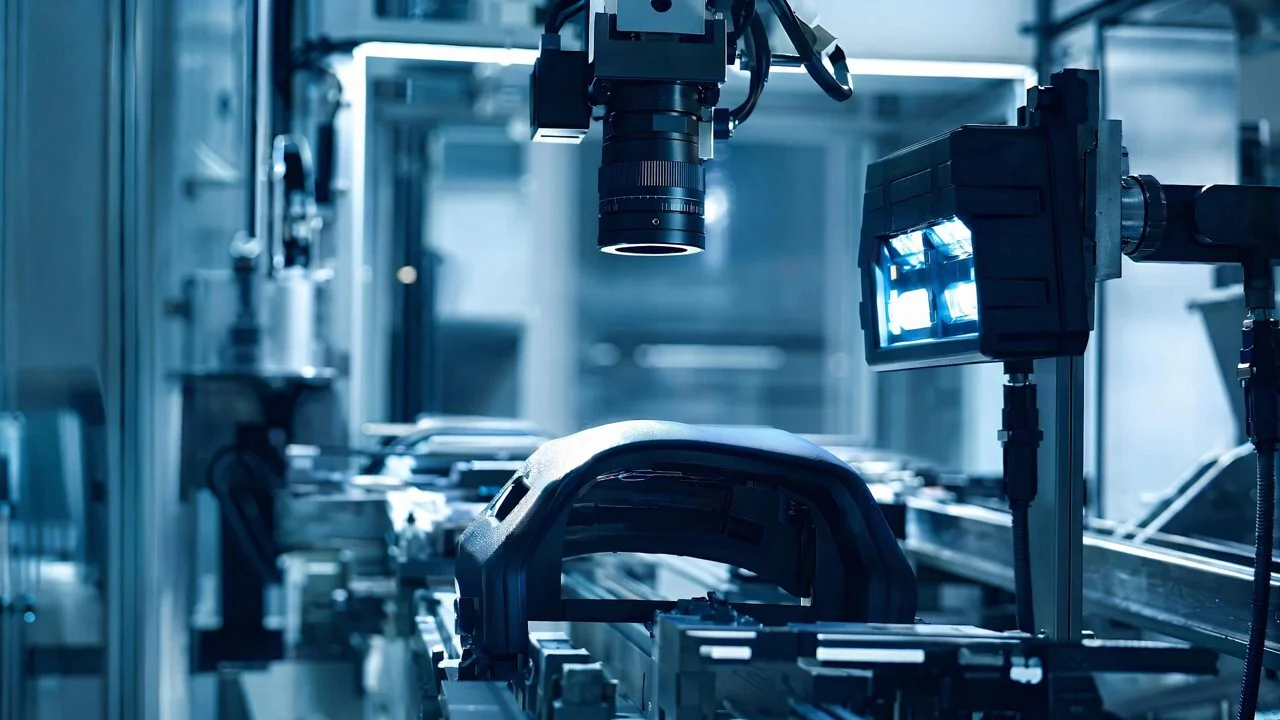
In the automotive manufacturing industry, the appearance quality of interior parts directly affects the overall vehicle quality and user experience. WeLinkirt provides an efficient and accurate solution for the appearance inspection of automotive interior parts with advanced AI vision technology.
User Scenario: On the interior parts production line of a leading automotive parts manufacturer, automotive seats, dashboards, door panels and other interior products are mainly produced. The inspection objects are the appearance defects of interior parts, such as scratches, stains, color differences, deformations, etc. These defects not only affect the aesthetics of interior parts, but also may reduce their service life and safety.
Pain Points: The traditional manual inspection method has many problems. First of all, the miss-detection rate is relatively high. Manual inspection is easily affected by factors such as fatigue and inattention. According to statistics, the miss-detection rate of manual inspection can reach about 5%. Secondly, the false-alarm rate cannot be ignored. Due to the subjectivity of manual judgment standards, the false-alarm rate is about 8%, which not only increases the re-inspection workload, but also reduces the production efficiency. In addition, the labor cost of manual inspection is high, and the model-change time is long. Generally, it takes more than 30 minutes to change the model, which cannot meet the needs of rapid model-change on the production line. At the same time, with the continuous improvement of product quality and compliance requirements in the automotive industry, the traditional inspection method is difficult to meet the strict quality control standards.
Technical Principles
WeLinkirt uses advanced AI algorithms and imaging technologies to solve these problems. In terms of algorithms, based on the DaoAI World model, it has a unified base, which can realize semantic understanding and cross-scenario generalization, and continuously learn from the feedback of the production line. Through deep-learning algorithms, a large number of appearance images of interior parts are trained, enabling the system to accurately identify the features of various appearance defects. In terms of imaging, the DaoAI 2D / 3D ACI (AI-AOI) equipment uses a self-developed 3D camera for imaging, which can achieve three-dimensional morphology reconstruction. This imaging method can detect hidden defects, such as tiny deformations, and can accurately measure the coplanarity and micron-level morphology. The principle is that the 3D camera can obtain the three-dimensional information of the object. Compared with the traditional 2D imaging, it can more comprehensively and accurately reflect the appearance of the interior parts, thus effectively improving the accuracy of the detection.
- The deep-learning algorithm trains a large number of images to improve the feature recognition ability.
- The 3D camera obtains three-dimensional information to achieve three-dimensional morphology reconstruction and detect hidden defects.
- The semantic understanding and cross-scenario generalization ability enable the system to adapt to the detection of different types of interior parts.
- Continuously learn from the feedback of the production line to optimize the detection model.
WeLinkirt's Solutions and Products Introduction
WeLinkirt provides a complete set of solutions, mainly involving the DaoAI ACI OS and the DaoAI 2D / 3D ACI equipment. The DaoAI ACI OS has strong feature-recognition ability. Through the visual basic model, a good product can be automatically programmed with 0 code in only 5 minutes. It also supports APDT positive-sample/few-sample learning, and only 1-20 good products are needed to complete the model training. At the same time, it has the function of semantic false-alarm filtering, which can effectively reduce the false-alarm rate. The DaoAI 2D / 3D ACI equipment combines the self-developed 3D camera and three-dimensional morphology reconstruction technology, which can detect hidden solder joints, coplanarity and micron-level morphology. In the implementation process, the equipment is installed in a suitable position on the production line, and through the collaborative work of the software system and the equipment, the efficient and accurate inspection of the appearance of interior parts is realized.
WeLinkirt's AI vision solution brings a more efficient and accurate inspection method for the appearance inspection of automotive interior parts.
Quantitative Results: By adopting WeLinkirt's solution, the automotive parts manufacturer has achieved remarkable results. First of all, the detection rate has been greatly improved, reaching 98.5%, and the miss-detection rate has been reduced to <1.5%, effectively ensuring the product quality. Secondly, the false-alarm rate has been reduced by 65%, greatly reducing the re-inspection workload and improving the production efficiency. In addition, the model-change time has been shortened from more than 30 minutes to 5 minutes, meeting the needs of rapid model-change on the production line and improving the production flexibility.
FAQ
What results can DaoAI bring to the appearance inspection of automotive interior parts?
DaoAI provides an efficient and accurate solution with advanced AI vision technology, achieving a 98.5% detection rate, a 65% reduction in false alarm rate, and a 5-minute change-over time, improving the quality and efficiency of automotive interior part appearance inspection.
What are the pain points of traditional manual inspection of automotive interior part appearance?
Traditional manual inspection has a missed detection rate of about 5% and a false alarm rate of about 8%. It has high labor costs, a change-over time of over 30 minutes, and is difficult to meet the strict quality control standards of the automotive industry, affecting production efficiency and product quality.
What does DaoAI's solution include?
DaoAI offers a complete solution, including the DaoAI ACI OS and the DaoAI 2D / 3D ACI equipment. The software enables zero-code programming and reduces false alarms, while the equipment combines 3D cameras to detect hidden defects.
Full solution for this scenario: Automotive / parts industry solutions · Fastener Tightening Visual Inspection
This article was generated by AI. Customer cases are simulated scenarios based on real product capabilities and figures are illustrative; see product pages for official benchmarks.