
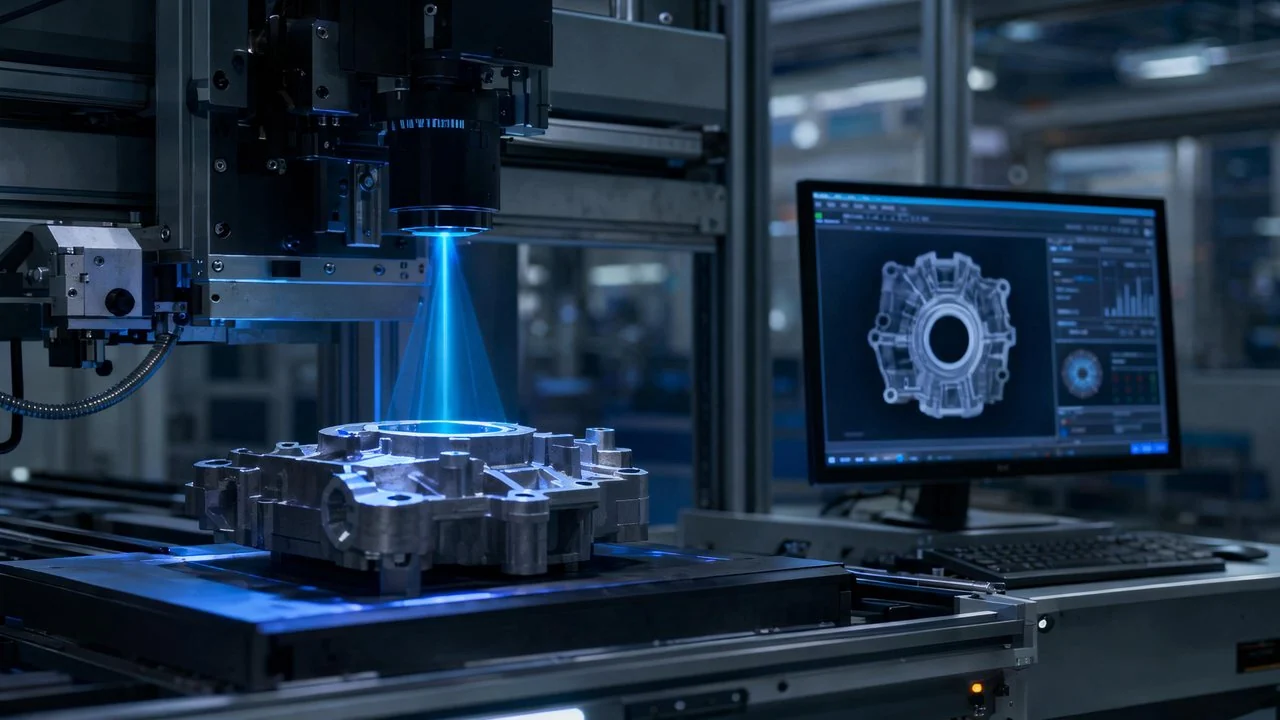
In the production of automotive parts, the quality of aluminum die-castings is crucial. WeLinkirt provides an efficient solution for the detection of porosity/inclusion in X-ray of aluminum die-castings through advanced AI vision technology.
User Scenario: On the aluminum die-casting production line of a leading automotive parts manufacturer, after the forming process of aluminum die-castings, it is necessary to detect porosity and inclusions. As important structural components of automobiles, the internal porosity and inclusion defects in aluminum die-castings may seriously affect the safety and reliability of automobiles. Therefore, the accurate detection of these defects is a key process to ensure product quality.
Pain Points: In the traditional X-ray detection of porosity/inclusion in aluminum die-castings, there are many difficulties. On the one hand, due to the material and structural characteristics of aluminum die-castings, during the X-ray imaging process, the reflective and mirror-like metal properties can lead to sparse, noisy, and missing 3D point clouds, making pose recognition and defect detection prone to failure. On the other hand, manual detection has a relatively high miss rate. According to statistics, the miss rate can reach about 3%, and the false alarm rate is also relatively high, about 15%. This not only increases labor costs but also affects production efficiency. In addition, when changing the production line model, the traditional detection method requires a long debugging time, about 30 minutes, which seriously affects the flexibility of production.
Technical Principle
WeLinkirt uses multi-view active vision technology and advanced AI algorithms to solve these problems. The multi-view active vision technology obtains more comprehensive and accurate image information by performing X-ray imaging of aluminum die-castings from multiple angles. Imaging from different angles can make up for the missing 3D point clouds caused by reflective and mirror-like metal properties in single-angle imaging, thus obtaining more complete object surface information and internal structure information.
- In terms of data processing, the AI algorithm can fuse and analyze multi-view images. Through the deep learning model, features in the images are extracted and learned, and the characteristic patterns of porosity and inclusions can be accurately identified. The deep learning model has a powerful feature learning ability. It can automatically learn the unique features of different types of porosity and inclusions in X-ray images, thereby improving the accuracy of detection.
- At the same time, the model can also filter and process the noise in the images, reducing the interference of noise on the detection results. Using semantic information, the model can distinguish real defects from false interference signals, realizing semantic false alarm filtering and further improving the reliability of detection.
- In addition, WeLinkirt also utilizes the feature recognition ability of the visual basic model. The model can learn with a small number of positive samples. Only 10 good product images are needed to complete the training of the model, greatly improving the training efficiency and applicability of the model.
WeLinkirt Solution and Products
WeLinkirt provides the DaoAI ACI (AI-AOI) software system and the DaoAI World model to solve the problem of X-ray detection of porosity/inclusion in aluminum die-castings. The DaoAI ACI OS has a powerful visual basic model feature recognition ability and can achieve 0-code automatic programming within 5 minutes for a good product. It uses the APDT positive sample/few-sample learning technology. Only 10 good product images are needed to complete the training of the model, greatly shortening the training time of the model. At the same time, the system also has a semantic false alarm filtering function, which can effectively reduce the false alarm rate.
The combination of the DaoAI ACI OS and the DaoAI World model provides an efficient and accurate solution for X-ray detection of aluminum die-castings.
The DaoAI World model, as a unified base, has the capabilities of semantic understanding, cross-scenario generalization, and continuous learning from production line feedback. It can detect different types of aluminum die-castings and adapt to different production environments and product specifications through cross-scenario generalization ability. At the same time, the model can continuously learn from the actual detection data of the production line and continuously optimize the detection results. The model supports SDK / API / Docker deployment methods and 100% local privatization, ensuring that data does not leave the factory and meeting the enterprise's data security requirements.
Quantitative Results: By adopting the solution provided by WeLinkirt, the automotive parts manufacturer has achieved remarkable results in the X-ray detection of porosity/inclusion in aluminum die-castings. The detection rate has increased from the original 97% to 99.2%, and the miss rate has been reduced to <0.8%. The false alarm rate has been reduced by 60%, from the original 15% to 6%. The production line model change time has been shortened from the original 30 minutes to 5 minutes, greatly improving the flexibility and efficiency of production.
FAQ
What solutions does DaoAI provide for the X-ray porosity/inclusion detection of automotive aluminum die-castings?
DaoAI uses advanced AI vision technology and provides the DaoAI ACI OS and DaoAI World model. By leveraging multi-view active vision technology and AI algorithms, it improves detection accuracy and reduces false and missed detection rates.
What pain points of traditional detection can DaoAI's automotive aluminum die-casting detection solution solve?
Traditional detection has issues such as missing 3D point clouds, prone - to - fail pose recognition and defect detection, high false and missed detection rates, and long commissioning time for production line changeovers. DaoAI's solution can enhance detection results and shorten changeover time.
What is the technical principle of DaoAI's detection solution?
It uses multi-view active vision technology to obtain comprehensive image information. AI algorithms fuse and analyze images, extract and learn features, and filter noise. It also uses the visual base model and can be trained with a small number of positive samples.
Full solution for this scenario: the full inspection solution for Automotive / parts
This article was generated by AI. Customer cases are simulated scenarios based on real product capabilities and figures are illustrative; see product pages for official benchmarks.