
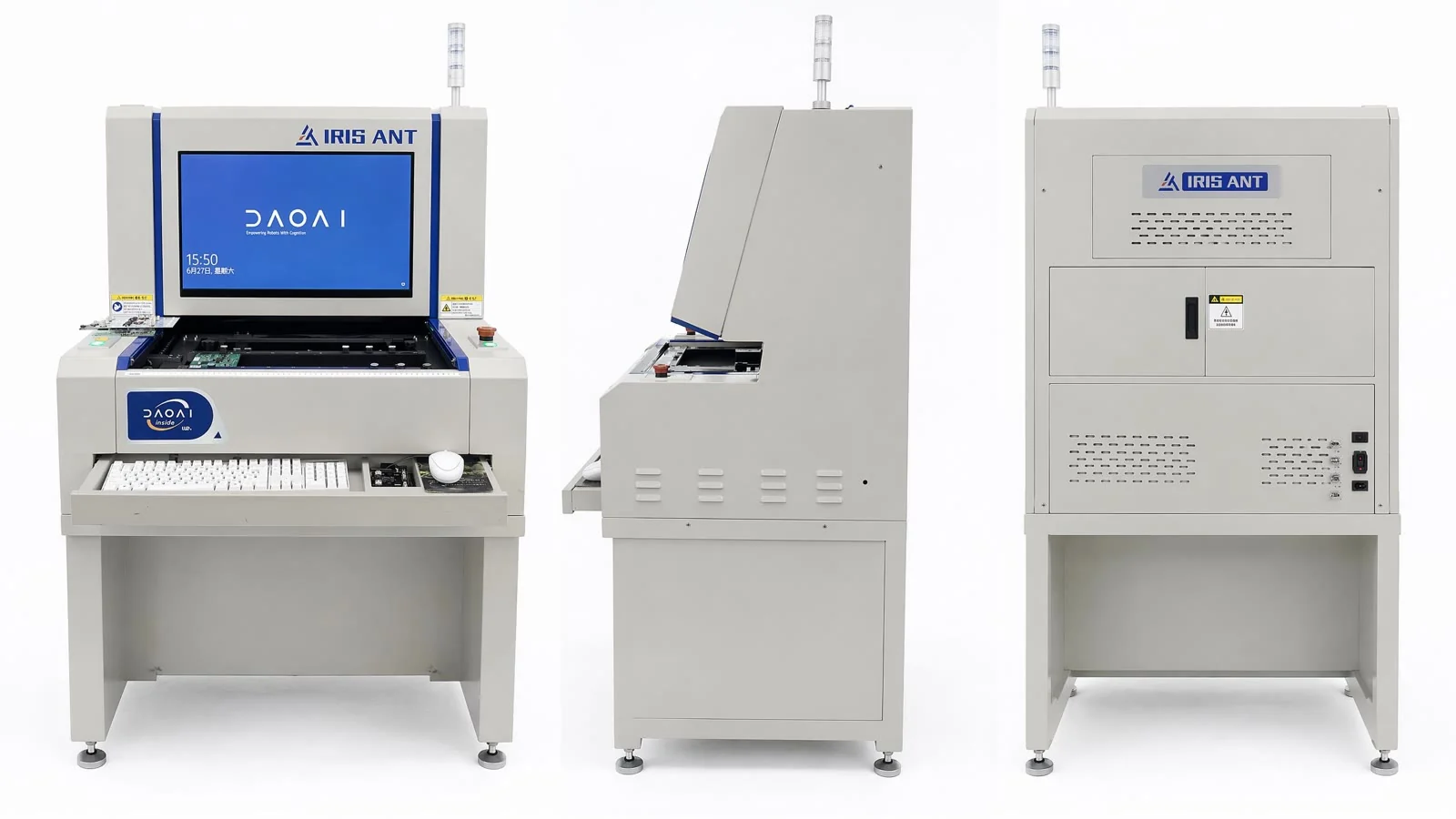
DaoAI ACI OS (Visual Foundation Model for Feature Recognition, 5-Minute 0-Code Programming with One Good Sample, APDT Positive/Few-Shot Learning (1–20 Good Samples), Semantic False Positive Filtering, SDK/API/Docker 100% On-Premise Deployment) leverages its powerful few-shot learning and semantic false positive filtering capabilities to reduce the high-intensity, high-cost burden of manual inspection for rare defects in semiconductor advanced packaging by 75% compared to traditional methods, significantly optimizing production operational efficiency and labor structure.
Advanced packaging technologies in the semiconductor/chip industry, such as Flip Chip, Wafer Level Packaging (WLP), and System-in-Package (SiP), are increasingly critical for enhancing chip performance, integration, and reliability. These complex processes inevitably generate various defects during production. Among these, rare defects—those that occur with extremely low frequency but can cause product failure—pose a severe challenge to quality control. At a mid-sized semiconductor advanced packaging factory, which produces complex integrated circuit modules for high-performance computing and communication, comprehensive quality inspection of packages is required after precision assembly processes like ultrasonic welding. Due to the extremely low occurrence rate of these rare defects, traditional automated inspection equipment struggles to identify them effectively, leading to a heavy reliance on skilled inspectors for prolonged manual visual inspection. This results in significant labor costs and management pressure. DaoAI ACI OS operating system addresses this pain point with a new solution.
Pain Points: Why This Challenge Is Difficult to Overcome
The semiconductor advanced packaging factory faced defect detection challenges primarily across three dimensions: First, **high manual inspection costs**. Due to the low-frequency nature of rare defects, a large number of skilled inspectors were required to be stationed on the production line for extended periods, performing highly repetitive and fatiguing visual inspection tasks. According to production line data, under the traditional model, the re-inspection of rare defects alone accounted for nearly 60% of the total inspection workforce, leading to persistently high annual labor costs. Second, **detection consistency and missed detection risks**. Manual visual inspection is highly susceptible to factors such as individual inspector experience, fatigue level, and emotional state, leading to inconsistent inspection standards and a high risk of missing subtle or ambiguous rare defects. Historical data from the factory showed that during peak periods, the manual visual inspection missed detection rate could reach up to 1.5%, posing potential risks to product reliability. Finally, **efficiency and changeover costs**. Even minor process adjustments for different batches and models of chip packages could introduce new types of rare defects. Traditional AOI equipment required hours or even days for rule parameter adjustments, while manual training and adaptation to new defect patterns were also time-consuming, severely impacting production line changeover efficiency and cycle time.
The root cause of these difficulties lies in the complexity of advanced packaging processes and the rarity of defects. For instance, in ultrasonic welding, defects such as micro-cracks in solder joints, solder ball collapse, or wire displacement might occur occasionally due to material, equipment parameters, or environmental fluctuations. Their visual features are often subtle, variable, and not significantly different from normal textures. Traditional rule-based or statistical AOI algorithms struggle to capture these low-frequency, high-variability features. Simultaneously, because defect samples are extremely scarce, the condition of 'massive defect data' required for deep learning model training is difficult to meet, further limiting the widespread adoption of automated inspection. Manual visual inspection, in turn, suffers from inherent drawbacks like visual fatigue and subjective judgment differences, making the identification of rare defects a persistent challenge in semiconductor quality control.
Technical Principles
DaoAI ACI OS operating system fundamentally solves the problem of rare defect detection in semiconductor advanced packaging through its innovative Visual Foundation Model architecture. This system abandons the traditional AOI reliance on a large number of defect samples for training. Instead, it leverages pre-trained general visual feature extraction capabilities and a powerful Few-Shot Learning mechanism. Specifically, ACI OS first acquires a deep understanding of various visual features in images, including edges, textures, shapes, and colors, through self-supervised learning on massive unlabeled images, without needing to know beforehand 'what a defect is'.
In practical applications, for rare defects, DaoAI ACI OS employs APDT (Adaptive Positive Data Training) few-shot learning technology. This means that with only 1–20 good sample images, the system can complete 0-code automatic programming in 5 minutes, quickly building a precise understanding of 'normal' products. When an area with subtle deviations from good product features is detected, the system flags it as a potential anomaly. More importantly, the ACI OS's built-in semantic false positive filtering function can intelligently distinguish between true defects and non-critical process variations or background noise, such as differentiating slight shadows near solder joints from genuine micro-cracks, thereby significantly reducing false positive rates. Compared to traditional rule-based AOI, which requires experts to manually adjust hundreds of parameters for each changeover and has limited capabilities in detecting rare defects, DaoAI ACI OS's few-shot learning and semantic filtering mechanisms demonstrate excellent generalization and robustness when facing low-frequency, variable defects, significantly improving detection efficiency and accuracy, and effectively replacing a large amount of manual inspection work.
Typical Application Scenarios
- **Ultrasonic Solder Joint Defect Detection**: In advanced packaging, ultrasonic welding is used to connect chips to substrates, and solder joint quality is critical. ACI OS can effectively detect rare defects such as micro-cracks in solder joints, incomplete soldering, solder ball collapse, and solder joint displacement. The challenge lies in these defects often being hidden within or on the surface of the solder joint, with subtle features that are similar to normal solder joint textures, making them difficult for traditional methods to distinguish. DaoAI ACI OS, through its precise feature recognition of solder joint areas, can identify these tiny anomalies.
- **Flip Chip Bump Bridging and Missing**: In flip-chip processes, tiny solder bumps can experience bridging (short circuit) or missing (open circuit). These defects are rare events in mass production but have a significant impact. ACI OS leverages its few-shot learning capability to quickly establish a normal model with only a few good bump images, accurately identifying abnormal bump morphology for efficient detection.
- **Wafer Level Packaging (WLP) RDL Micro-scratches and Disconnections**: The RDL layer in WLP technology is a multi-layer metal interconnect structure, where micron-level scratches or disconnections may occur during production. Due to the complex structure of the RDL layer and the typically very small size of defects, they are difficult to detect with the naked eye. DaoAI ACI OS, with its Visual Foundation Model's powerful feature extraction capability, can precisely locate these hard-to-find rare defects in high-resolution images.
- **Wire Bonding Gold Wire Displacement and Breakage**: Although wire bonding technology is relatively mature, occasional defects such as slight gold wire displacement, abnormal arc, or localized breakage can still occur during high-speed production. ACI OS can quickly identify abnormalities with significant deviations from the standard by learning the geometric morphology and connection point features of normal gold wires, effectively preventing missed detections from manual inspection.
Case Study
A mid-sized semiconductor advanced packaging factory, specializing in providing chip packaging services for high-performance computing and communication, heavily relied on manual visual inspection for rare defects after ultrasonic welding before adopting DaoAI ACI OS. They required 15 experienced inspectors working three shifts daily for high-intensity tasks, incurring nearly 300,000 RMB in monthly labor costs. Manual inspection was not only inefficient but also suffered from high missed detection rates due to fatigue from prolonged work, peaking at 1.5%, posing significant risks to product quality. Furthermore, each new product introduction or minor process adjustment required extensive time to retrain inspectors to identify new rare defect patterns, severely impacting production line flexibility and time-to-market.
After thorough evaluation, the factory decided to introduce DaoAI ACI OS for production line upgrade. During the deployment, the DaoAI team assisted the client in Docker deployment of ACI OS and SDK/API integration with existing production line camera systems. For rare defects such as micro-cracks in solder joints and gold wire displacement after ultrasonic welding, ACI OS completed model training in 5 minutes with only 5–10 good samples. After deployment, DaoAI ACI OS immediately demonstrated excellent performance. Production line data showed that the system consistently improved the detection rate for rare defects to over 99.7%, while reducing the false positive rate to below 0.2%. More critically, ACI OS successfully replaced 12 manual inspectors, retaining only 3 personnel for occasional re-inspection and equipment maintenance, reducing monthly manual inspection costs from 300,000 RMB to 75,000 RMB, **successfully reducing labor costs for rare defect manual inspection by 75%**. Concurrently, due to ACI OS's 0-code rapid changeover capability, the detection model configuration time for new product introductions was shortened from several hours to under 15 minutes, significantly enhancing production line flexibility and response speed.
DaoAI ACI OS not only significantly reduced our labor costs for rare defect detection but, more importantly, it elevated detection accuracy and consistency to an unprecedented level, truly giving us confidence in our product quality.
DaoAI Solutions and Products
The core solution provided by DaoAI for this semiconductor advanced packaging factory is the ACI OS operating system. As the unified foundation for visual foundation models, its powerful feature recognition capability allows it to understand complex image information, rather than merely matching preset rules. For deployment, DaoAI ACI OS supports various integration methods such as SDK/API/Docker, achieving 100% on-premise private deployment, ensuring absolute security of customer's core production data and intellectual property. For rare defects, ACI OS's APDT positive/few-shot learning function is critical. Engineers only need to provide a small number of good sample images, and the system can quickly learn the feature distribution of normal products through adaptive learning, thereby efficiently identifying various anomalies. Furthermore, DaoAI ACI OS's semantic false positive filtering mechanism effectively reduces false positives caused by non-defect factors like ambient light or material textures, further enhancing the system's stability and reliability in complex industrial environments. Through integration with the client's existing production line control system, ACI OS achieves full-process automation from image acquisition to defect judgment, greatly simplifying the inspection process and freeing up a significant amount of human labor.
In addition to ACI OS, DaoAI can also provide DaoAI 2D / 3D ACI equipment, which, combined with self-developed 3D cameras and 3D morphology reconstruction technology, performs high-precision inspection of micron-level morphological defects such as hidden solder joints and coplanarity, further expanding detection range and capability. In this case, DaoAI ACI OS operating system, by accurately identifying rare defects in advanced packaging, production line data shows that it reduced manual inspection labor costs by 75% and increased the rare defect detection rate to over 99.7%, while also shortening new product detection model configuration time from several hours to under 15 minutes, bringing significant economic benefits and quality improvements to the client.
FAQ
How does DaoAI ACI OS handle rare defects in semiconductor advanced packaging?
DaoAI ACI OS utilizes a visual foundation model and APDT few-shot learning technology, requiring only 1-20 good sample images to quickly train models within 5 minutes. It effectively identifies low-frequency, high-variability rare defects and significantly reduces false positives through semantic false positive filtering, thereby substantially reducing reliance on manual inspection.
What are the costs and deployment timeline for DaoAI ACI OS?
The deployment cost of DaoAI ACI OS is influenced by various factors, including production line scale, integration complexity, and required detection functionalities. We support 100% on-premise private deployment via SDK/API/Docker to ensure data security. Specific pricing and deployment timelines require evaluation based on your detailed requirements. Please contact our expert team for a customized solution.
What are the advantages of DaoAI ACI OS compared to traditional AOI equipment?
Traditional AOI relies on a large number of defect samples and complex rule configurations, leading to inefficiency when dealing with rare defects or rapid changeovers. DaoAI ACI OS, with its visual foundation model's feature recognition capabilities and few-shot learning, can quickly adapt to new defect types without needing massive defect data, enabling 0-code programming. This significantly improves detection accuracy and efficiency, and substantially reduces manual intervention and labor costs.
Full solution for this scenario: ACI OS industry solutions
This article was generated by AI. Customer cases are simulated scenarios based on real product capabilities and figures are illustrative; see product pages for official benchmarks.