
In the pharmaceutical industry, high-speed, 100% full inspection of capsule products and precise identification of various defects are critical challenges for ensuring product quality and production efficiency. DaoAI ACI OS (featuring vision foundation model-based feature recognition, 5-minute zero-code programming with one good sample, APDT positive/few-shot learning with 1-20 good samples, semantic false positive filtering, and 100% on-premise deployment via SDK/API/Docker) has boosted the capsule defect detection line throughput by 25% for a mid-sized pharmaceutical plant. Simultaneously, it reduced the false positive rate from approximately 10% with traditional solutions to under 2%, significantly enhancing 100% full inspection capacity.
The stringent quality requirements in the pharmaceutical sector make capsule appearance defect detection an indispensable process. Whether hard or soft capsules, various surface defects such as dents, scratches, color variations, foreign objects, cracks, hollowness, or deformation directly impact drug efficacy and patient safety. Traditional detection methods often rely on manual visual inspection or rule-based AOI equipment. However, facing increasing production demands and diverse defect patterns, these solutions prove inadequate in meeting line throughput requirements and achieving 100% full inspection.
Pain Points: Why This Hurdle Is Difficult to Overcome
Current pharmaceutical production lines face multiple challenges in capsule defect detection. Firstly, the efficiency bottleneck of traditional manual visual inspection is significant. On high-speed lines (e.g., thousands of capsules per minute), manual inspection typically has a false negative rate of 3%~5% and struggles to maintain consistency during prolonged, high-intensity operations, leading to high re-inspection labor costs. Secondly, while traditional rule-based AOI equipment improves speed, its false positive rate generally ranges from 8%~12%, particularly lacking in identifying subtle color variations or irregular deformations ('soft defects'). This results in numerous good products being falsely rejected, increasing unnecessary re-inspection burdens and material waste. For example, in a mid-sized pharmaceutical plant with a line processing approximately 2000 capsules per minute, traditional AOI solutions generated tens of thousands of re-inspected capsules monthly due to false positives, severely dragging down overall line throughput and failing to meet the 100% full inspection target. Finally, with numerous capsule types, parameter adjustments and model retraining for traditional AOI equipment consume hours or even days when switching between different colors, sizes, or dosages, leading to long line downtime and inefficient changeovers, directly impacting the flexibility of multi-variety, small-batch production. The root causes of these challenges lie in the reflective properties of capsule materials, their tiny size, and the diversity and unpredictability of defect morphologies, making feature extraction and rule matching based on traditional image processing difficult to implement. Manual inspection, constrained by human eye fatigue and subjectivity, cannot meet modern industrial demands for high throughput, high precision, and 100% full inspection. In line with current industrial large model practices in improving industrial vision defect recognition rates, effectively utilizing vast data for feature learning and overcoming generalization challenges in few-shot scenarios is a common technical hurdle faced by the industry.
Technical Principles
The DaoAI ACI OS demonstrates exceptional performance in capsule defect detection, primarily due to its integration of vision foundation model-based feature recognition and efficient few-shot learning mechanisms. The system first leverages pre-trained vision foundation models for feature extraction from capsule images. These models, trained on vast generic image datasets, acquire powerful visual semantic understanding capabilities, enabling them to identify subtle texture, color, and shape variations on the capsule surface, beyond mere pixel-level differences. Secondly, addressing the scarcity of capsule defect samples, DaoAI ACI OS incorporates APDT (Adaptive Positive/Few-Shot Defect Training) technology, requiring only 1–20 good samples or a few defect samples for 0-code automatic programming within 5 minutes. This mechanism allows for rapid identification and learning of new defect patterns, significantly shortening model iteration cycles. Compared to traditional rule-based AOI solutions, DaoAI ACI OS eliminates the need for manual creation of complex rule sets, avoiding the problem of rules failing to cover all defect variations, thus substantially reducing the false positive rate from approximately 10% with traditional methods. Unlike traditional deep learning methods that require thousands or even tens of thousands of annotated samples to train a usable model, the few-shot learning capability of DaoAI ACI OS reduces new product changeover time from hours to minutes, greatly enhancing production line flexibility. Furthermore, its built-in semantic false positive filtering function intelligently discriminates between genuine defects and background noise or normal textures based on contextual information and morphological features, further reducing false positives and ensuring detection accuracy.
Typical Application Scenarios
- **Capsule Surface Dent and Scratch Detection:** DaoAI ACI OS precisely identifies subtle dents and surface scratches on capsules caused during production or transportation. The challenge lies in these defects often being shallow and narrow, varying under different lighting conditions, making them prone to false negatives with traditional methods. ACI OS effectively captures these irregular micro-deformations using its vision foundation model's feature recognition capability.
- **Capsule Color Variation and Foreign Object Detection:** For subtle color differences between capsule batches or tiny foreign objects (e.g., fibers, dust) adhering to the capsule surface, DaoAI ACI OS provides high-precision identification. The difficulty arises from color variations often being continuous spectrum changes and foreign objects having inconsistent shapes, which traditional threshold segmentation struggles with. ACI OS's semantic understanding allows it to distinguish between normal color fluctuations and anomalous color patches.
- **Capsule Deformation and Size Anomaly Detection:** DaoAI ACI OS offers reliable detection for capsules with abnormal ovality, uneven end seals, or overall dimensions outside tolerance. The challenge is that capsules might appear blurred due to deformation during high-speed movement, and size tolerances are typically at the micron level. DaoAI ACI OS combines high-resolution imaging with precise geometric measurement algorithms to achieve stable detection.
- **Capsule Content Filling Anomalies (Hollow/Bubbles):** For transparent or translucent capsules, DaoAI ACI OS can detect internal issues like hollowness, air bubbles, or uneven filling using transmitted or reflected imaging. The difficulty lies in internal defects being hard to visualize and having low imaging contrast. ACI OS's image enhancement and weak feature extraction capabilities effectively highlight these elusive internal defects.
Case Study
A mid-sized pharmaceutical plant, specializing in the production of various vitamin and health supplement capsules, previously relied on a combination of manual visual inspection and traditional AOI equipment for capsule detection. The line throughput was constrained by manual re-inspection, and the false positive rate was persistently high. The monthly costs and time spent on rework due to false positives were substantial, and meeting increasingly stringent pharmaceutical quality standards proved challenging. To enhance line efficiency and product quality, the manufacturer introduced the DaoAI ACI OS. Before implementation, the average false negative rate for capsule detection on this line was approximately 0.8%, with a false positive rate around 9%, severely impacting line throughput and achieving only about 80% of theoretical production capacity. After integrating DaoAI ACI OS, this pharmaceutical plant utilized APDT few-shot learning, deploying and optimizing the model within less than a week using only a few good and defective samples. Production line data shows that after the system went live, the capsule defect detection rate consistently improved to over 99.4%, the false negative rate was successfully reduced to <0.6%, and the false positive rate dramatically dropped to 1.8%. Crucially, DaoAI ACI OS boosted the actual line throughput by 25%, enabling 100% full inspection capacity and significantly alleviating production pressure. When switching between different capsule models, the system required only 5 minutes to complete automatic programming and deployment of new models, significantly reducing downtime compared to the hours required by traditional solutions, thereby enhancing production flexibility.
“DaoAI ACI OS has not only significantly improved the detection speed and accuracy of our capsule production line, but more importantly, it has enabled our line to truly achieve 100% full inspection while substantially reducing false positives. This is crucial for our pharmaceutical quality control and production cost optimization.”
DaoAI Solutions and Products
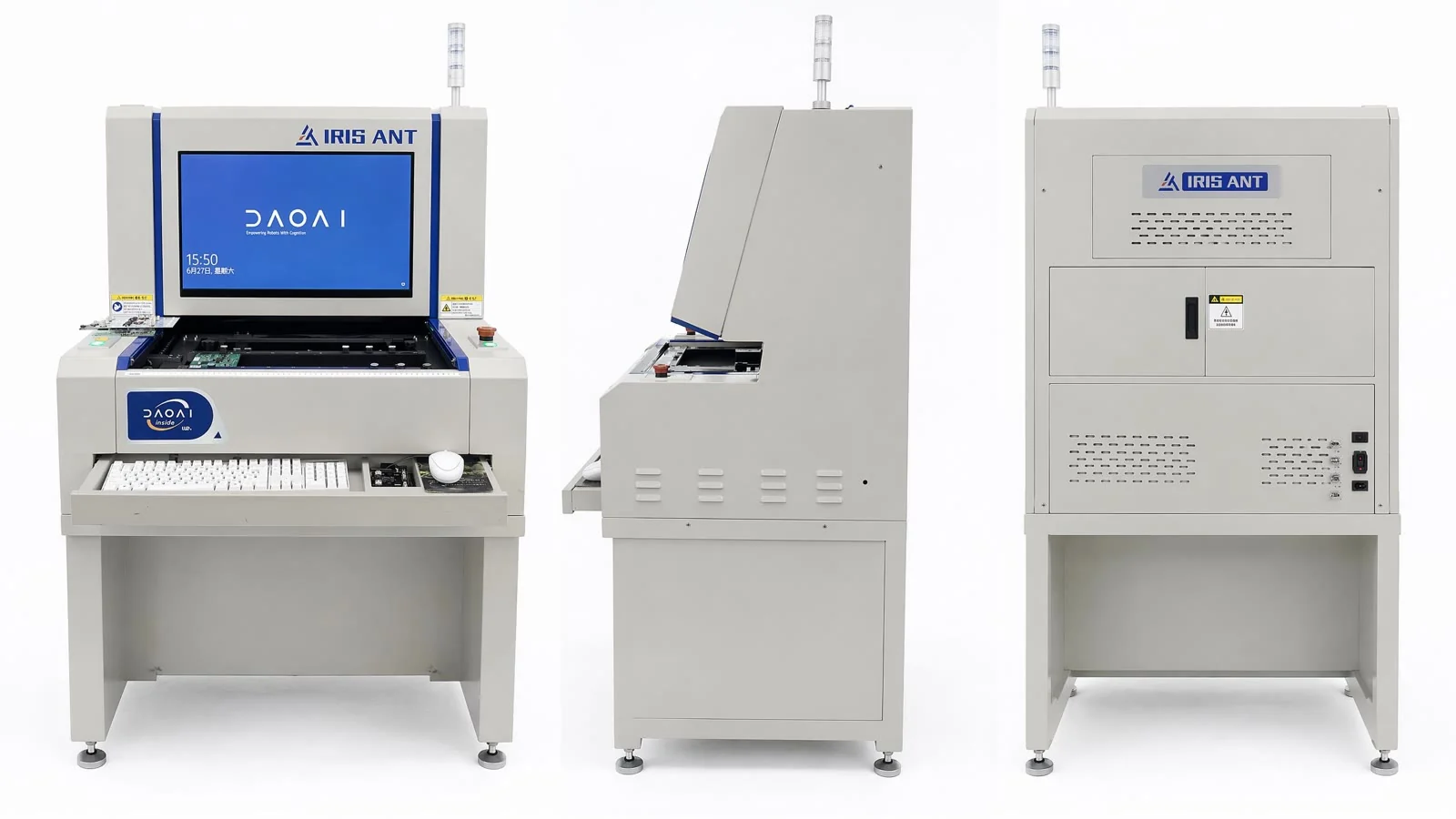
DaoAI ACI OS provides an end-to-end intelligent solution for this capsule defect detection scenario. Firstly, through the powerful feature recognition capabilities of its vision foundation model, DaoAI ACI OS can deeply understand and represent complex textures and subtle defects on capsule surfaces. During deployment, customers only need to provide 1–20 good sample images, and DaoAI ACI OS can complete 0-code automatic programming within 5 minutes to quickly generate an initial detection model, greatly simplifying the model building process and reducing reliance on AI engineers. For occasional rare defects, the APDT few-shot learning function allows operators to quickly add a small number of defect samples for incremental learning during production, enabling the model to continuously adapt to new defect patterns and maintain high detection rates and low false positive rates. Furthermore, the semantic false positive filtering mechanism of DaoAI ACI OS effectively prevents misjudgments caused by lighting changes, background interference, or normal capsule textures, ensuring detection stability. The system supports various deployment methods such as SDK/API/Docker and can be 100% deployed on-premise, ensuring strict control over sensitive production data and intellectual property for pharmaceutical companies, fully complying with industry regulatory requirements. In terms of integration, DaoAI ACI OS can connect with existing production line PLCs and MES systems, achieving real-time synchronization of detection data with production processes, building a data closed-loop, and providing strong support for quality traceability and process optimization. DaoAI can also provide DaoAI 2D/3D ACI equipment as hardware support to ensure high-resolution image acquisition and multi-dimensional defect capture capabilities.
Through DaoAI ACI OS, this pharmaceutical plant has achieved significant improvements in both production efficiency and product quality. The capsule defect detection rate increased from 97% to over 99.4%, and the false positive rate decreased from 9% to under 1.8%, directly reducing re-inspection workload by approximately 80%. Line throughput increased by 25%, making 100% full inspection a reality. In terms of changeovers, model training and deployment time for new products or defect pattern changes were reduced from hours to 5 minutes, cutting downtime by about 95% and significantly enhancing line flexibility and responsiveness. These quantified achievements translate into tangible business value: reduced operating costs, minimized material waste, shortened time-to-market, and ultimately strengthened the company's competitiveness in the pharmaceutical market.
FAQ
How does DaoAI ACI OS ensure 100% full inspection capacity for capsule detection?
DaoAI ACI OS combines high-speed image acquisition systems with its efficient vision foundation model algorithms to process a large volume of capsules on high-throughput lines without sacrificing detection accuracy. Its few-shot learning capability allows the model to quickly adapt to diverse defects, reducing downtime for changeovers, thereby consistently maintaining high capacity to achieve and sustain 100% full inspection.
What are the main differences between DaoAI ACI OS and traditional AOI equipment for capsule defect detection?
The core advantage of DaoAI ACI OS lies in its vision foundation model-based feature recognition and APDT few-shot learning capabilities. Traditional AOI relies on manually setting complex rules or extensive labeled samples for training, resulting in high false positive rates and time-consuming changeovers. ACI OS requires only 1–20 good samples for rapid programming and can significantly reduce false positives through semantic false positive filtering, greatly enhancing detection accuracy and production line flexibility.
How can I estimate the cost of deploying DaoAI ACI OS for capsule defect detection?
The cost of deploying DaoAI ACI OS primarily depends on the scale of the production line, required detection accuracy, integration complexity, and whether complementary hardware (such as DaoAI 2D/3D ACI equipment) is needed. We offer flexible software licensing and hardware integration solutions. We recommend scheduling a consultation, and our experts will provide a detailed customized quote and ROI analysis based on your specific requirements.
Full solution for this scenario: ACI OS industry solutions · Automotive Paint Surface Defect Detection
This article was generated by AI. Customer cases are simulated scenarios based on real product capabilities and figures are illustrative; see product pages for official benchmarks.