
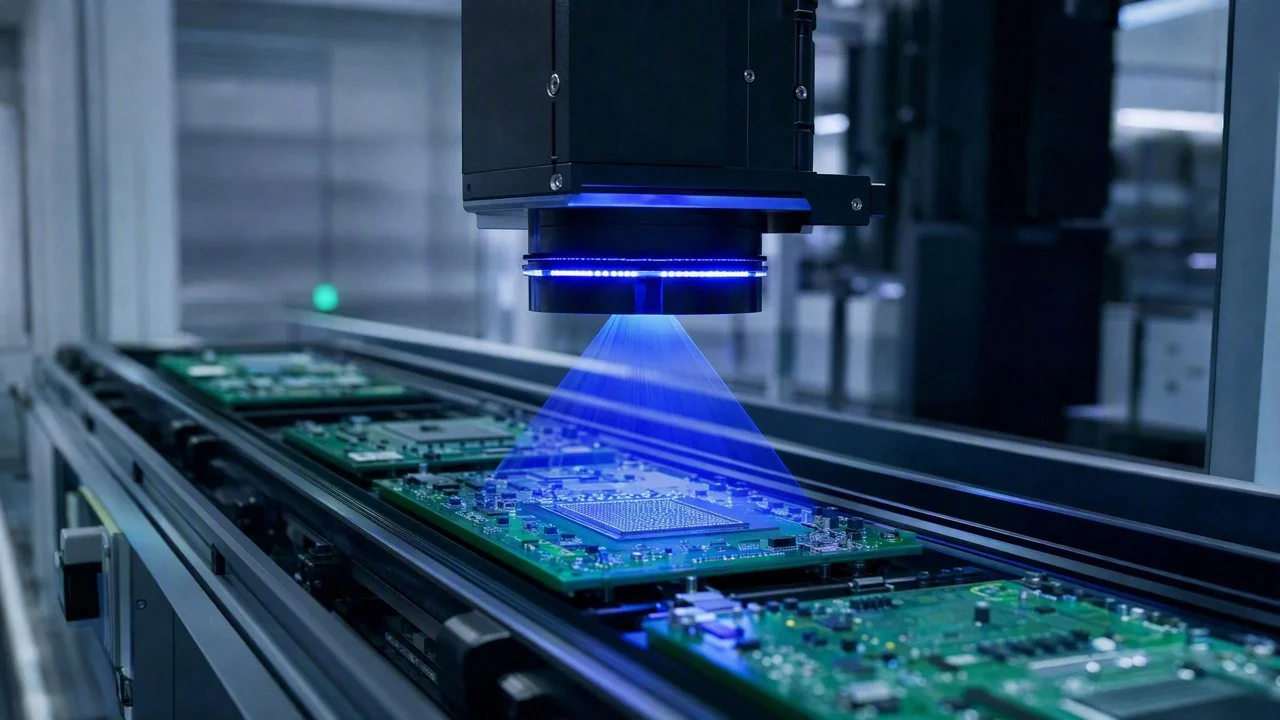
In PCBA manufacturing, DaoAI's 3D AI AOI equipment (proprietary 3D camera + 3D morphology reconstruction/point cloud, detecting hidden solder joints/coplanarity/micron-level morphology/voids and other 2D optical blind spot defects, with 2D-3D fusion) significantly reduces BGA void detection false positive rates by over 75% through deep learning and 3D data fusion, substantially easing the immense pressure of downstream manual re-inspection. In the complex landscape of electronics manufacturing, particularly on high-density, miniaturized PCBA production lines, the soldering quality of BGA (Ball Grid Array) packages directly impacts product reliability and long-term stability. BGA voids are common soldering defects; their presence can lead to insufficient solder joint strength, poor conductivity, or even short circuits, posing potential risks to electronic product performance. As electronic products trend towards miniaturization and high performance, BGA solder joint sizes continuously shrink, and density increases, presenting unprecedented challenges for inspection technology.
In the complex landscape of electronics manufacturing, particularly on high-density, miniaturized PCBA production lines, the soldering quality of BGA (Ball Grid Array) packages directly impacts product reliability and long-term stability. BGA voids are common soldering defects; their presence can lead to insufficient solder joint strength, poor conductivity, or even short circuits, posing potential risks to electronic product performance. As electronic products trend towards miniaturization and high performance, BGA solder joint sizes continuously shrink, and density increases, presenting unprecedented challenges for inspection technology.
Pain Points: Why This Hurdle is Difficult to Overcome
Traditional BGA void detection primarily relies on X-ray radiography, but it faces numerous challenges in inspecting complex multi-layer boards, stacked solder joints, and irregularly shaped packages. Firstly, traditional X-ray images are often 2D projections, making it difficult to accurately distinguish defects at different layers, leading to a high volume of false positives. A leading PCBA manufacturer reported that its BGA void detection false positive rate reached 20%—30%, meaning that for every 100 'defects' identified, 20—30 were actually good products, requiring significant human resources for secondary re-inspection. Secondly, manual re-inspection is not only inefficient, with an average throughput of only 50-80 PCBAs per hour, but also highly dependent on operator experience, susceptible to fatigue and subjective judgment, increasing the risk of missed defects. The annual re-inspection labor cost due to false positives amounted to millions of RMB. Finally, in the current trend of AI smart cameras simplifying manufacturing inspection processes, effectively combining X-ray images with intelligent analysis to reduce reliance on human experience is a critical technical challenge facing the industry.
The root cause of these false positives lies in the fact that BGA solder joint voids, when projected in a 2D X-ray image, have their shape, position, and depth information compressed. This makes them easily confused with factors such as solder joint geometry, pad obscuration, or even board layer structures. For example, a shallow but large void might exhibit similar grayscale characteristics in a 2D image to a deeper but smaller void, making it difficult for traditional algorithms based on thresholds or simple feature extraction to accurately differentiate them. Simultaneously, the extremely small spacing between high-density BGA pads, coupled with the resolution limitations of X-ray imaging, makes it challenging to precisely capture subtle voids. Furthermore, variations in solder paste composition and printing processes across different batches and suppliers lead to diverse void morphologies, further increasing the difficulty of identification for traditional algorithms.
Technical Principles
DaoAI's 3D AI AOI equipment brings a revolutionary breakthrough to BGA void detection through its proprietary 3D camera and advanced 3D morphology reconstruction technology. Its core principle involves precise 3D point cloud reconstruction of BGA solder joints using multi-angle structured light projection combined with high-precision image acquisition, obtaining complete spatial morphology data. This allows DaoAI's 3D AI AOI to not only see surface features of solder joints but also to penetrate 'appearances' and integrate with X-ray data for 2D-3D fusion analysis, directly quantifying 3D parameters of voids such as volume, depth, and position. Unlike traditional X-ray, which only provides 2D projection information, the 3D morphology data provided by DaoAI's 3D AI AOI completely resolves false judgments caused by insufficient 2D information, reducing the false positive rate to <5%.
At the algorithmic level, the DaoAI AI AOI software system is equipped with a visual foundation model that features APDT positive/few-shot learning capabilities, requiring only 1–20 good sample images for 0-code automatic programming in 5 minutes. For BGA void detection, the system uses deep learning to jointly train on a large number of 2D X-ray images and 3D morphology data, learning the true 3D characteristics of voids. This system intelligently identifies and filters out false positives caused by factors such as pad overlap and solder joint deformation, significantly enhancing detection accuracy and robustness. Compared to traditional rule-based AOI, DaoAI's 3D AI AOI no longer relies on manually set fixed thresholds or rules. Instead, it autonomously learns complex defect patterns through AI, possessing high sensitivity to micron-level morphological changes, effectively avoiding missed detections or false positives caused by improper parameter settings, thereby consistently maintaining a BGA void detection rate of over 99.5%.
Typical Application Scenarios
- **BGA Solder Void Detection:** DaoAI's 3D AI AOI precisely identifies bubbles and voids inside and at the bottom of BGA solder joints, quantifying their volume, area, and position. This avoids misjudgments caused by projection superposition in traditional X-ray 2D images, particularly suitable for automotive electronics and medical device PCBAs with extremely high reliability requirements.
- **BGA Coplanarity and Height Difference Detection:** Utilizing 3D morphology data, DaoAI 3D AI AOI accurately measures the coplanarity, height consistency, and alignment of BGA solder balls with pads, detecting micron-level morphological deviations imperceptible to the naked eye, ensuring soldering quality.
- **Hidden Solder Joint Defect Detection:** For solder joints obscured by component bodies or difficult to observe directly under complex packaging, DaoAI's 3D AI AOI, combined with 2D-3D fusion technology, effectively identifies hidden defects such as bridging, cold solder joints, and insufficient solder, extending beyond the blind spots of traditional optical inspection.
- **PCBA Micron-level Surface Defects:** Beyond BGAs, DaoAI's 3D AI AOI can also detect other micron-level defects on PCBA surfaces, such as scratches, foreign objects, solder splashes, and deformed component leads, providing more comprehensive quality control.
- **QFN/LGA Package Bottom Voids and Solder Climb:** For leadless packages like QFN (Quad Flat No-lead) and LGA (Land Grid Array), DaoAI's 3D AI AOI can penetrate the package bottom to detect defects such as solder voids and insufficient solder climb, areas that are difficult for traditional 2D AOI to cover effectively.
Case Study
A Tier-1 supplier specializing in high-end communication equipment PCBA manufacturing had long been plagued by high false positive rates in BGA void detection. Their original inspection process involved initial scanning by X-ray equipment, followed by sending all PCBAs marked as 'defective' to a manual re-inspection station. With a false positive rate as high as 25%, thousands of PCBAs required manual re-inspection daily, which not only tied up a significant number of skilled technicians but also limited production rhythm and extended delivery cycles. The customer introduced DaoAI's 3D AI AOI equipment to upgrade their core BGA component soldering process. In the initial phase, the DaoAI engineering team worked closely with the customer, leveraging the few-shot learning capability of the DaoAI AI AOI software system to quickly collect and annotate hundreds of 2D X-ray images and 3D morphology data of BGA voids. Model training and deployment were completed in just two weeks. After a month-long trial run, DaoAI's 3D AI AOI successfully reduced the BGA void false positive rate from 25% to <4%, cutting re-inspection volume by 84%. This meant that what previously required 10 operators for re-inspection could now be efficiently handled by just 2 operators, significantly reducing labor costs and shortening average re-inspection time from 8 hours/shift to 2 hours/shift. Concurrently, reduced false positives led to a substantial decrease in production line interruptions and rework, boosting overall line OEE by 12%.
By introducing DaoAI's 3D AI AOI, we not only solved the stubborn problem of BGA void false positives but also transformed the re-inspection stage from a production bottleneck into an efficient quality assurance point, truly realizing the value of intelligent manufacturing.
DaoAI Solution and Products
DaoAI addresses the challenges of BGA void detection in the PCBA industry with a comprehensive solution centered around its 3D AI AOI equipment. This equipment integrates DaoAI's proprietary high-precision 3D camera, achieving sub-micron depth resolution. Combined with point cloud data processing and 3D morphology reconstruction technology, it performs comprehensive stereoscopic inspection of BGA solder joints. For deployment, DaoAI's 3D AI AOI equipment supports 100% local private deployment, ensuring customer data security and smooth integration into existing production lines. The DaoAI AI AOI software system, acting as the brain, enables 0-code automatic programming for a good sample in 5 minutes through its powerful visual foundation model, greatly reducing changeover time. For new BGA package types, only 1-20 good samples are needed, and the system can quickly build a detection model through APDT positive/few-shot learning, enabling rapid line changes and flexible adaptation. Furthermore, the DaoAI World model, serving as a unified foundation, enables semantic understanding and cross-scenario generalization, allowing DaoAI's 3D AI AOI equipment to achieve quick switching and continuous learning between different PCBA products and BGA package types, further enhancing the level of intelligent inspection.
In practical applications, DaoAI's 3D AI AOI equipment not only solves the false positive problem of BGA voids but also detects other 2D optical blind spot defects, such as hidden solder joints, micron-level coplanarity deviations, solder balls, and voids, providing more comprehensive quality assurance for PCBA production. Its high precision and efficiency allow customers to free up valuable human resources from tedious re-inspection tasks, focusing on higher-value production management and process optimization. Through the deployment of DaoAI 3D AI AOI, the customer successfully reduced the BGA void false positive rate from 25% to <4%, cutting re-inspection volume by 84%, saving millions in re-inspection costs annually, and significantly improving overall production line efficiency.
FAQ
How does DaoAI's 3D AI AOI reduce false positive rates in BGA void detection?
DaoAI's 3D AI AOI equipment utilizes its proprietary 3D camera to acquire high-precision 3D morphological data, combined with 2D X-ray images for deep fusion analysis. This allows the system to obtain true 3D parameters of internal solder joint voids, such as volume and depth, rather than relying solely on 2D projections. Coupled with the visual foundation model and few-shot learning capabilities of the DaoAI AI AOI software system, it intelligently distinguishes real voids from false positives caused by pad overlap or solder joint deformation, significantly reducing the false positive rate to <4%.
What unique advantages does DaoAI's 3D AI AOI offer compared to traditional X-ray or 2D AOI?
Traditional X-ray only provides 2D projections, making it difficult to distinguish defects at different layers and prone to false positives. 2D AOI, moreover, cannot detect hidden defects at the bottom or inside BGAs. DaoAI's 3D AI AOI's core advantage lies in its proprietary 3D camera and 3D morphology reconstruction technology, which captures sub-micron precision 3D data. Combined with 2D-3D fusion, it effectively addresses the blind spots of traditional methods, not only precisely detecting BGA voids but also complex defects like coplanarity and hidden solder joints, reducing false positive rates by over 75%.
How long does it take to deploy DaoAI's 3D AI AOI, and does it support local deployment?
DaoAI's 3D AI AOI supports 100% local private deployment, ensuring data security. Deployment time typically depends on line integration complexity and model training requirements. Thanks to the 0-code automatic programming and APDT few-shot learning capabilities of the DaoAI AI AOI software system, for new BGA types, only 1-20 good samples are needed, and the system can complete model training in 5 minutes. The overall go-live period is significantly shorter than traditional solutions, usually completed and operational within weeks.
This article was generated by AI. Customer cases are simulated scenarios based on real product capabilities and figures are illustrative; see product pages for official benchmarks.