
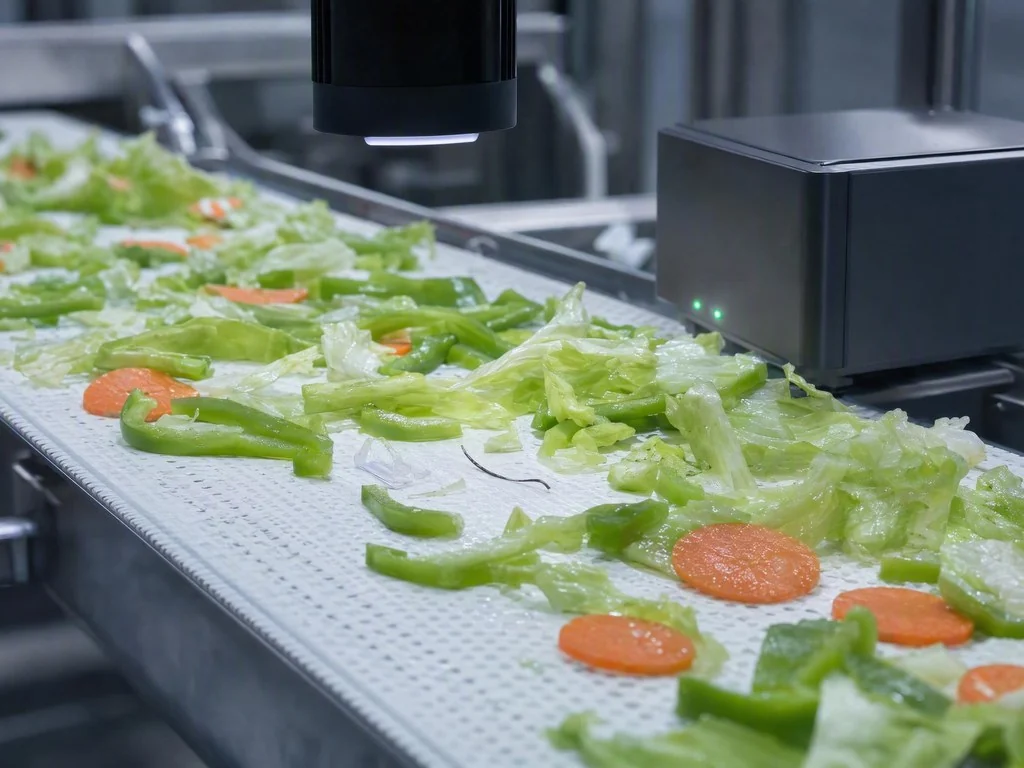
Quality control of fresh-cut vegetables is crucial in the fresh-cut vegetable processing industry, and foreign object detection is a key link. DaoAI's real-time edge detection solution brings new breakthroughs to this industry.
Industry background and user scenario: In the current food processing field, the fresh-cut vegetable processing industry is booming. With the accelerating pace of consumers' lives, the demand for convenient and fresh fresh-cut vegetables is increasing day by day. Fresh-cut vegetable processing factories are responsible for cutting, packaging and quickly pushing fresh vegetables to the market. These fresh-cut vegetables are mainly used for making salads and ready-to-eat foods, and their shelf life is usually calculated in hours. For processing factories, they not only need to ensure the freshness of products, but also ensure the quality and safety of products. Among them, foreign object detection is a very important task. Because once foreign objects are mixed into products and found and complained by consumers, it will have a serious impact on the brand image.
Pain points: Why is it difficult?
From the speed dimension, fresh-cut vegetables only have a short window of a few hours from cutting to leaving the factory. If the traditional detection method relies on cloud reasoning, there will be a round-trip delay in the data transmission process, which means that the production line needs to stop and wait for the detection results, thus seriously slowing down the production rhythm. For example, a production line that originally runs efficiently may frequently slow down because of waiting for cloud reasoning results, resulting in a significant reduction in production efficiency.
In terms of accuracy, small target foreign objects mixed in fresh-cut vegetables, such as hair, small insects, torn plastic packaging fragments, etc., often only occupy dozens of pixels in the picture. Due to the limitations of its algorithm and imaging ability, the traditional machine vision technology is difficult to accurately identify these tiny targets. Manual visual inspection is even more vulnerable to factors such as fatigue and inattention, resulting in frequent missed detections. According to statistics, the missed detection rate of traditional machine vision and manual visual inspection for such small target foreign objects may be as high as 20%–30%.
From the perspective of data security, food enterprises have extremely high requirements for data compliance and confidentiality. If the image data is transmitted to the cloud for processing, there is a risk of data leakage, which does not meet the enterprise's security standards. Moreover, once the data is leaked, it may cause a series of legal problems and reputation losses.
Technical principle
DaoAI has optimized a lightweight deep learning model for small target detection. The model is trained with a large number of sample data and can accurately identify various small target foreign objects. Its core algorithm uses an advanced deep learning architecture, which has stronger ability to extract and analyze target features. Compared with the traditional machine vision algorithm, it can better handle low-contrast and translucent foreign objects. Even if the foreign object only occupies dozens of pixels in the picture, it can be accurately detected.
In terms of hardware, DaoAI deploys the optimized model on the edge computing box of the production line. The edge computing box has powerful computing capabilities and can perform real-time reasoning locally. The image data does not need to be transmitted to the cloud and is directly processed on the edge computing box, which greatly shortens the reasoning delay. Compared with the traditional cloud reasoning method, the delay of edge reasoning can be controlled within 10ms, realizing real-time synchronous removal of the production line. At the same time, the lightweight model can run on low-power consumption devices, reducing the transformation cost and equipment floor space.
Typical application scenarios
- Vegetable cutting process: In the process of vegetable cutting, foreign objects such as hair may be mixed in. The difficulty of detection lies in that the color of hair is similar to that of vegetables, and it may be entangled with vegetables during the cutting process, making it difficult to distinguish. DaoAI's model can accurately identify hair through comprehensive analysis of features such as color and texture.
- Cleaning link: After cleaning, small insects may remain in the vegetables. These insects are usually small in size and may be translucent in water, which is difficult to find by traditional detection methods. Through data enhancement and difficult case mining, DaoAI's model has high sensitivity to low-contrast and translucent insects and can effectively detect these foreign objects.
- Packaging process: During the packaging process, torn plastic packaging fragments may be mixed into the vegetables. These fragments have irregular shapes and may be similar in color to vegetables, increasing the difficulty of detection. DaoAI's model can accurately identify plastic packaging fragments by analyzing features such as the shape and contour of the target.
- Sorting link: During the sorting process, some impurities may be mixed into the vegetables. These impurities come in a wide variety of types and sizes, and it is difficult for traditional detection methods to cover them all. DaoAI's model has strong generalization ability and can adapt to the detection of different types of impurities.
Implementation case
A medium-sized fresh-cut vegetable processing factory mainly produces salads and ready-to-eat fresh-cut vegetables, with a daily output of thousands of servings. Before introducing the DaoAI system, the factory used a combination of manual sampling inspection and traditional machine vision for foreign object detection. Manual sampling inspection had a high missed detection rate, and the traditional machine vision also had an unsatisfactory detection effect on small target foreign objects. During the implementation process, the DaoAI team first conducted a detailed investigation and analysis of the factory's production process, and then optimized and adjusted the model according to the actual situation. The edge computing box was deployed at a suitable position on the production line, and multiple tests and verifications were carried out to ensure the stability and accuracy of the system.
After the system was launched, the detection rate of millimeter-level small target foreign objects was stable at over 98%, which was significantly improved compared with the previous manual sampling inspection and traditional vision. The customer complaints caused by missed detections were greatly reduced.
DaoAI's solution and product
DaoAI's solution mainly includes an optimized lightweight deep learning model and an edge computing box for the production line. The model is specifically optimized for small target detection. Through data enhancement and difficult case mining, it strengthens the sensitivity to low-contrast and translucent foreign objects. For newly emerged foreign object forms, with the help of the APDT few-shot rapid reinforcement technology, it can complete the adaptation within a few hours, avoiding the trouble of retraining the entire model every time a new packaging material is changed. The edge computing box for the production line provides powerful local computing capabilities for the model, realizing real-time reasoning without the image leaving the factory and meeting the data compliance and confidentiality requirements of food enterprises.
Quantitative results
After the system was launched, significant quantitative results were achieved. The detection rate of millimeter-level small target foreign objects was stable at over 98%, which was a significant improvement compared with the previous detection rate of manual sampling inspection and traditional vision. The missed detection rate was reduced from the original 20% 30% to less than 2%, and the number of customer complaints caused by missed detections was greatly reduced. A single production line can achieve full inspection without additional manpower, improving the detection efficiency. At the same time, the edge deployment makes the replication and expansion of multiple production lines lighter and faster, reducing the enterprise's production expansion cost.
FAQ
How does DaoAI solve the problem of detecting small target foreign objects in fresh-cut vegetables?
DaoAI optimizes a lightweight deep learning model for small target detection and deploys it on the edge computing box of the production line to achieve local real-time reasoning. The image does not leave the factory, and the delay is low. At the same time, it strengthens the sensitivity to foreign objects and uses the APDT few-shot rapid reinforcement technology to quickly adapt to new forms, effectively solving the detection problem.
Why should the foreign object detection of fresh-cut vegetables be carried out at the edge?
The shelf life of fresh-cut products is short. The round-trip to the cloud will slow down the rhythm, and edge reasoning can achieve real-time synchronous removal. Moreover, keeping the images in the factory complies with regulations and ensures confidentiality. The lightweight model can run on low-power consumption devices, with low cost and small floor space. The few-shot adaptation is fast, achieving both speed and accuracy.
What are the effects after the DaoAI system is launched?
After the system is launched, the detection rate of millimeter-level small target foreign objects is stable at over 98%, which is significantly improved compared with manual sampling inspection and traditional vision. The customer complaints caused by missed detections are greatly reduced. A single production line can achieve full inspection, and the replication and expansion of production lines are lightweight and fast.
This article was generated by AI. Customer cases are simulated scenarios based on real product capabilities and figures are illustrative; see product pages for official benchmarks.