
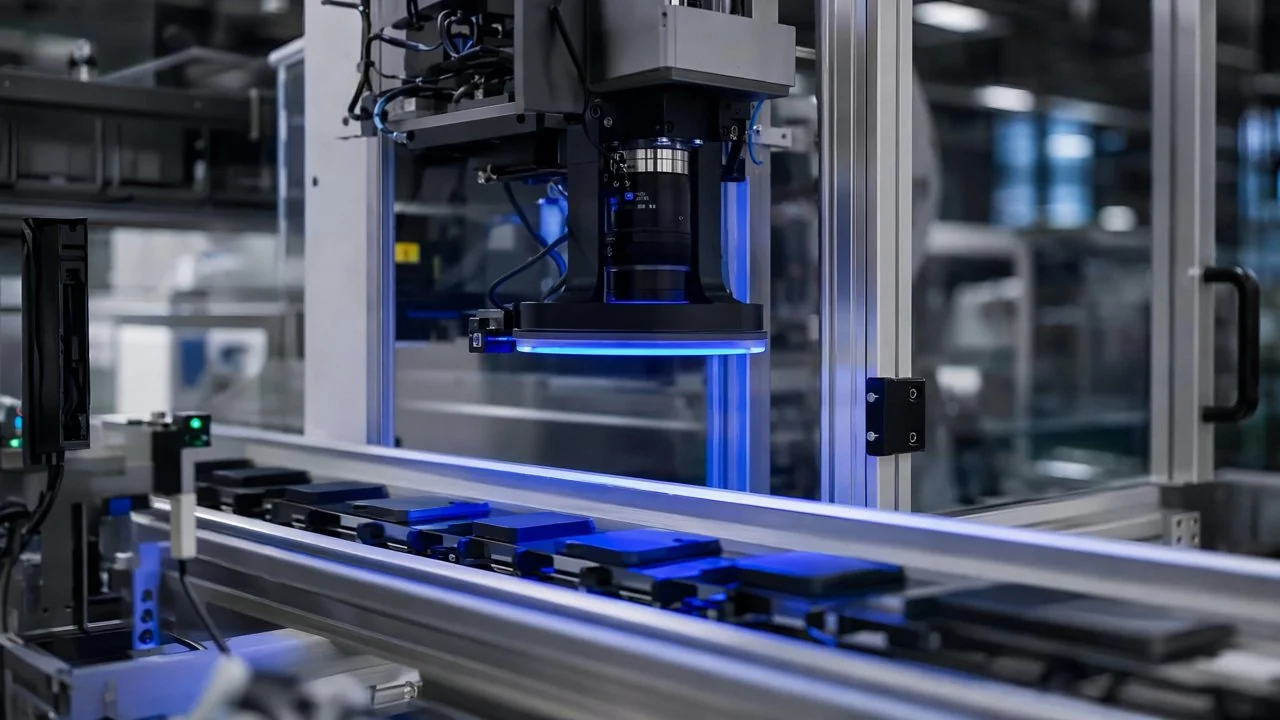
The label printing industry is facing severe challenges due to a high number of SKUs. WeLinkirt (DaoAI) brings new opportunities for enterprises with advanced technologies and solutions.
In today's manufacturing and consumer goods industries, label printing is a crucial link. Labels not only carry basic product information such as barcodes, specification parameters, warning icons, and multi-language texts but also relate to product compliance and brand image. With the diversification and personalization of market demand, the number of product SKUs has witnessed an explosive growth. For example, in industries such as hardware tools, electronic devices, and food and beverage, enterprises need to print labels for a large number of different types of products, with thousands or even tens of thousands of SKUs. At the same time, the order batch sizes are getting smaller, and the number of urgent orders is increasing. This business model of high SKUs, small batches, and urgent orders poses a huge challenge to label printing inspection.
Pain Points: Why It's Difficult
From the perspective of production capacity, the traditional label printing inspection change-over process is extremely time-consuming. When the number of SKUs reaches thousands, reconfiguring the inspection system is required for each SKU change. Usually, the change-over time can easily reach one or two hours. This means that a large amount of production line time is consumed in switching SKUs rather than actual production. Take a production line that needs to process 10 different SKU orders per day as an example. If each SKU change-over takes 1.5 hours, then 15 hours of production time will be wasted on change-overs every day, seriously affecting the production capacity.
In terms of inspection accuracy, there are various types of label printing defects, including missing printing, incorrect printing, color registration deviation, unreadable barcodes, and blurred text. Any defect that flows out may lead to customer sorting errors or compliance issues. Enterprises require both a high defect detection rate and a low false rejection rate. If the false rejection rate is too high, a large number of good products will be treated as waste, directly eroding the already thin profit margins of small-batch orders. For example, if the profit margin of a small-batch order is 10%, and the false rejection rate reaches 5%, the actual profit will be reduced to 5%, and it may even lead to losses.
The root cause of the difficulty for traditional inspection methods to handle these challenges lies in their lack of flexibility and efficiency. Traditional inspection systems are often based on fixed templates and rules for inspection, with poor adaptability to different SKUs. When there are a large number of SKUs, separate inspection templates and rules need to be customized for each SKU, which not only increases the configuration difficulty and time cost of the inspection system but also easily leads to misjudgments and missed detections in practical applications.
Technical Principle
WeLinkirt (DaoAI) adopts advanced golden sample management technology and ACI (AI-AOI) general appearance inspection algorithm. Golden sample management means collecting 20-50 golden samples for each SKU. Through the analysis and learning of these golden samples, an inspection model for the SKU is established. The model library is archived according to SKUs, and the corresponding golden sample benchmark can be directly retrieved during change-over. This method greatly reduces the modeling cost and change-over time.
The ACI general appearance inspection algorithm uses deep learning technology to comprehensively analyze and verify characters, barcodes, color registration, and icons on labels. The algorithm can automatically identify various features on the label and compare them with the golden sample benchmark to accurately detect defects. Compared with traditional inspection methods, the ACI algorithm has higher flexibility and accuracy, can adapt to the inspection needs of different SKUs, and can complete the detection of multiple defects in the same process, improving the inspection efficiency.
Typical Application Scenarios
- Missing printing detection: By comparing the images of the golden sample and the label to be inspected, the ACI algorithm can quickly identify whether there is missing printing on the label. The difficulty lies in that some minor missing printings may be difficult to detect, requiring the algorithm to have high resolution and sensitivity.
- Incorrect printing detection: The algorithm will identify and compare the text, barcodes, and other information on the label to determine whether there is incorrect printing. The forms of incorrect printing may be diverse, such as character errors and barcode encoding errors, which requires the algorithm to accurately identify various character and barcode encoding rules.
- Color registration deviation detection: Using image analysis technology, the algorithm can detect whether there is a deviation in the color registration between different colors on the label. The degree of color registration deviation may be small, and the algorithm needs to be able to accurately measure the position and deviation of colors.
- Unreadable barcode detection: The algorithm will decode and verify the barcode to determine whether it can be read normally. The quality of the barcode may be affected by factors such as printing quality and contamination, and the algorithm needs to have strong anti-interference ability.
- Blurred text detection: By analyzing the clarity and edge features of the text, the algorithm can determine whether the text is blurred. The degree of text blurring may vary, and the algorithm needs to be able to accurately identify different degrees of blurring.
Implementation Case
A hardware tool factory is a large-scale enterprise that mainly prints self-adhesive labels for a large number of tools and hardware parts. The factory has thousands of SKUs, and most of the orders are small-batch and urgent. Before introducing the solution of WeLinkirt (DaoAI), the factory's label printing inspection faced many problems. At the factory, the change-over time was as long as 1-2 hours, the defect detection rate was only 90%, and the false rejection rate was as high as 5%. The production efficiency of the production line was low, a large amount of time was wasted on change-overs, and the enterprise's profit was seriously affected due to the high false rejection rate.
The solution of WeLinkirt (DaoAI) has brought significant improvements to the factory. The production line can still switch quickly under thousands of SKUs and frequent urgent orders, and the comprehensive production capacity and quality have been improved simultaneously.
During the implementation process, the technical team of WeLinkirt (DaoAI) first conducted a detailed investigation and analysis of the factory's label printing process and inspection requirements. Then, 20-50 golden samples were collected for each SKU, and the corresponding inspection models were established. After the model establishment was completed, multiple tests and optimizations were carried out to ensure the accuracy and stability of the inspection system. Finally, the factory successfully launched the label printing inspection solution of WeLinkirt (DaoAI).
WeLinkirt Solution and Product
WeLinkirt (DaoAI)'s solution mainly includes a golden sample management system and an ACI general appearance inspection platform. The golden sample management system is responsible for the collection, storage, and management of golden samples, as well as the establishment and maintenance of inspection models. The ACI general appearance inspection platform is based on deep-learning algorithms to perform real-time inspection and analysis of labels. The platform has a high degree of flexibility and scalability and can be customized according to the needs of different enterprises.
WeLinkirt (DaoAI)'s product has the following characteristics: First, it has an efficient change-over ability, and the change-over time for each SKU can be controlled within 30 minutes; second, it has a high defect detection rate of up to 99.5%; third, it has a low false rejection rate of less than 0.3%. In addition, the product also provides a user-friendly interface and comprehensive data analysis functions, which are convenient for enterprises to carry out production management and quality control.
Quantitative Results
By introducing WeLinkirt (DaoAI)'s solution, the hardware tool factory has achieved significant quantitative results. The change-over time has been shortened from the original 1-2 hours to less than 30 minutes, greatly improving the production efficiency of the production line. The defect detection rate has been increased from 90% to 99.5%, effectively intercepting label defects such as incorrect printing and missing printing, and improving the product quality. The false rejection rate has been reduced from 5% to less than 0.3%, ensuring the output of good products in small-batch orders and increasing the enterprise's profit. Overall, the production capacity and quality of the production line have been improved simultaneously.
FAQ
What are the main challenges in label printing?
The main challenge in label printing lies in the high number of SKUs. When there are thousands of SKUs and the order batches are small, long change-over time will affect the production capacity. At the same time, high precision is required for labels, with a high detection rate and a low false rejection rate. WeLinkirt reduces the modeling cost per SKU to 20-50 golden samples, bringing the change-over time back to the minute-level and effectively addressing these challenges.
What solution does WeLinkirt have for high-SKU label printing inspection?
WeLinkirt adopts golden sample management. For each SKU, 20-50 golden samples are used to build an inspection model, and the model library is archived according to SKUs. Combined with ACI general appearance inspection, the change-over can be completed in 30 minutes, which can improve production capacity and quality and meet the inspection needs in high-SKU scenarios.
What effects does the implementation of WeLinkirt's solution have?
After the implementation of the solution, the production line can switch quickly under thousands of SKUs and frequent urgent orders, and the change-over time is stable within 30 minutes. The defect detection rate reaches 99.5%, and the false rejection rate is less than 0.3%. The comprehensive production capacity and quality are improved simultaneously, bringing significant benefits to the enterprise.
This article was generated by AI. Customer cases are simulated scenarios based on real product capabilities and figures are illustrative; see product pages for official benchmarks.