
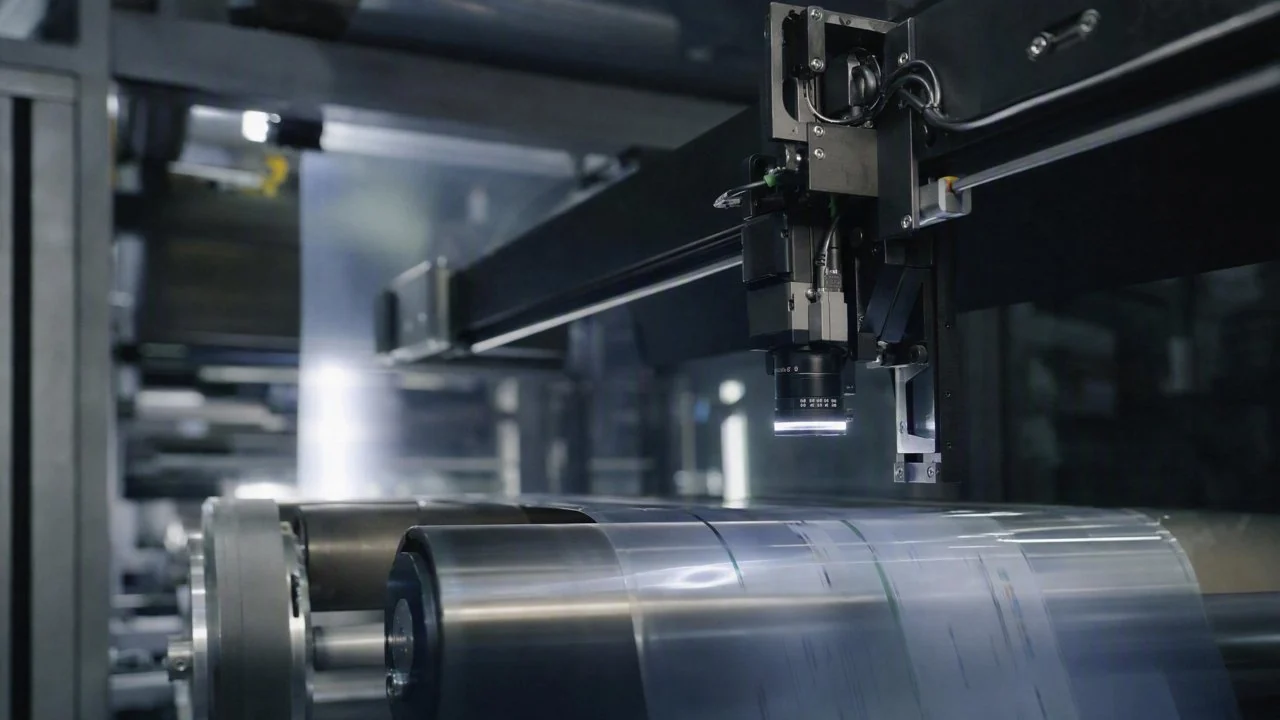
WeLinkirt uses advanced technical solutions to solve the problem of false alarms in the detection of the printing film/label coil industry, achieving high-efficiency and accurate production.
Scenario: Printing films and label coils are widely used in the product packaging of many industries such as food, daily chemicals, and pharmaceuticals. The quality of these coils directly affects the appearance and brand image of products. Therefore, it is crucial to conduct strict quality inspections during the production process. Printing film/label coil manufacturers usually have multiple production lines and machines, processing a variety of different substrates and printed patterns. Due to factors such as mechanical structure and operating parameters, different machines have natural differences in tension control, overprint accuracy, and ink color uniformity. At the same time, different materials also vary in physical and chemical properties, which further increases the complexity of the production process.
Pain Points: Why is it Difficult?
From a quantitative perspective, the false alarm rate of traditional detection systems remains high. In some enterprises, the false alarm rate even exceeds 30%. This means that a large proportion of detection alarms are unnecessary. For example, a certain enterprise can receive up to 500 detection alarms per day, of which about 150 are false alarms. High false alarms not only waste a lot of manpower and time for screening but also cause operators to become numb to alarm signals. According to statistics, due to the interference of false alarms, the timely disposal rate of real defects has decreased by about 20%. In addition, the number of production line shutdowns for re-verification due to false alarms has increased significantly, with an average of 5 shutdowns per day, and each shutdown for re-verification takes about 15 minutes, seriously affecting the production rhythm.
The root cause of this difficult-to - solve situation is that the old detection systems lack the ability to distinguish the characteristics of different machines and materials. They use a unified defect criterion and cannot adapt to the normal variations of different machines and materials. For example, normal slight color differences and periodic changes in background patterns, which belong to the normal process fluctuations of qualified products, are regarded as defects and alarmed in the old systems. Moreover, the quality characteristics of coils produced by different machines vary, and the same criterion is not applicable to different machines, making the false alarm problem even more serious.
Technical Principle
WeLinkirt's DaoAI is based on the DaoAI World model. Through advanced algorithms and a large amount of data learning, it establishes a baseline model of normal variations for each machine and each material. This model includes various parameters such as acceptable color difference ranges, background pattern periods, and overprint tolerances. During the detection process, the system uses the normal baseline of the corresponding machine-material as a reference and only issues an alarm when the detected features deviate from the baseline.
Compared with traditional methods, traditional methods use a one-size-fits-all unified detection standard and cannot adapt to the diversity in production. In contrast, WeLinkirt's method is personalized and intelligent. Traditional methods misjudge normal process fluctuations as defects, resulting in a large number of false alarms, while WeLinkirt's solution can accurately separate normal process fluctuations from false alarms, greatly improving the detection accuracy. For example, when identifying slight color differences, traditional methods may alarm as long as there is a color difference, while WeLinkirt's system will judge according to the normal color difference range of the material and machine, and only alarm when it exceeds the range.
Typical Application Scenarios
- Color difference detection: During the printing process, slight color differences may occur due to factors such as ink mixing and printing speed. WeLinkirt's system first learns the normal color difference range of the material and machine, and then compares the actual color difference with the normal range during detection. The difficulty lies in that there may be slight color differences in different batches of materials, and the system needs to be able to dynamically adjust the normal color difference range.
- Overprint accuracy detection: Inaccurate overprinting will affect the overall aesthetics and information accuracy of the label. The system monitors the overprinting of printed patterns in real-time by learning the overprint tolerance of the machine. The difficulty is that the overprint accuracy of the machine will change with the running time and environmental factors, and the system needs to be able to capture these changes in a timely manner.
- Background pattern period detection: The periodic change of the background pattern is part of the product design, but the old system may misjudge the normal periodic change as a defect. WeLinkirt's system learns the normal period range of the background pattern and only alarms for abnormal periodic changes. The difficulty is that the period of the background pattern may be affected by the printing process and material characteristics, and the system needs to have strong adaptability.
- Ink color uniformity detection: Uneven ink color will affect the visual effect of the product. The system establishes a normal distribution model of ink color for the machine and material, and judges whether the ink color is within the normal range during detection. The difficulty is that the judgment of ink color is interfered by many factors such as lighting and material reflectivity, and the system needs to have accurate calibration and judgment capabilities.
Implementation Case
There is a medium-sized printing film/label coil manufacturer with 5 production lines and 10 machines of different models, processing various types of substrates and printed patterns. Before introducing WeLinkirt's solution, the enterprise faced a serious false alarm problem in detection. At the enterprise, the false alarm rate was as high as 35%, the timely disposal rate of real defects was only 60%, and the number of shutdowns for re-verification due to false alarms reached 8 times a day, seriously affecting production efficiency and product quality.
During the implementation process, WeLinkirt's technical team first conducted detailed data collection and analysis for each machine and material of the enterprise, and established the corresponding baseline models of normal variations. Then, the detection system was upgraded and optimized to ensure that the system could accurately detect according to the baseline models. After a period of debugging and optimization, the system was officially launched.
WeLinkirt's solution has transformed the enterprise's detection system from 'blind alarming' to 'accurate identification', effectively improving production efficiency.
WeLinkirt's Solution and Product
WeLinkirt's DaoAI solution is based on the DaoAI World model. By deeply learning the normal variations of machines and materials, it provides an accurate judgment basis for the enterprise's detection system. This solution can achieve 100% full-width online detection, ensuring that no edge or full-width area is missed, and it can adapt to the production mode of multi-machine switching. The system also has the ability of real-time monitoring and dynamic adjustment, and can adjust the detection standards in a timely manner according to the changes in the production process to ensure the accuracy and reliability of detection.
Quantitative Results
After the implementation of the solution, in the case of mixed-line production of multiple machines and materials, the overall false alarm rate of the enterprise decreased by 28%, from the original 35% to 25.2%. The timely disposal rate of real defects increased to 80%, and the number of shutdowns for re-verification due to false alarms decreased to 2 times per day. The production rhythm and quality inspection efficiency were significantly improved. This shows that WeLinkirt's solution can effectively solve the false alarm problem in the detection of printing film/label coils and bring real benefits to the enterprise.
FAQ
What is the reason for the high false alarm rate in the detection of printing film/label coils?
The high false alarm rate is not because the system is too sensitive, but because it cannot distinguish between normal variations and real defects. There are natural differences in tension, overprinting, and ink color among different machines, and different materials also have different characteristics. The old system uses the same criterion and misjudges normal situations as defects, resulting in a large number of false alarms.
How does WeLinkirt solve the false alarm problem in the detection of printing film/label coils?
WeLinkirt is based on the DaoAI World model. It learns the baseline of normal variations for each machine and each material, including parameters such as color difference range and background pattern period. During detection, it uses the baseline as a reference and separates normal process fluctuations from false alarms to reduce false alarms.
What are the effects after the implementation of WeLinkirt's solution?
After the implementation of the solution, the overall false alarm rate of the enterprise in the mixed-line production of multiple machines and materials is reduced. For example, in the case, it is reduced by 28%. It achieves full-width online detection, improves the disposal rate of real defects, significantly reduces the shutdowns for re-verification due to false alarms, and simultaneously improves the production rhythm and quality inspection efficiency.
Full solution for this scenario: the full inspection solution for Chemical / materials · False-Alarm Reduction for Printed Film / Label Coils
This article was generated by AI. Customer cases are simulated scenarios based on real product capabilities and figures are illustrative; see product pages for official benchmarks.