
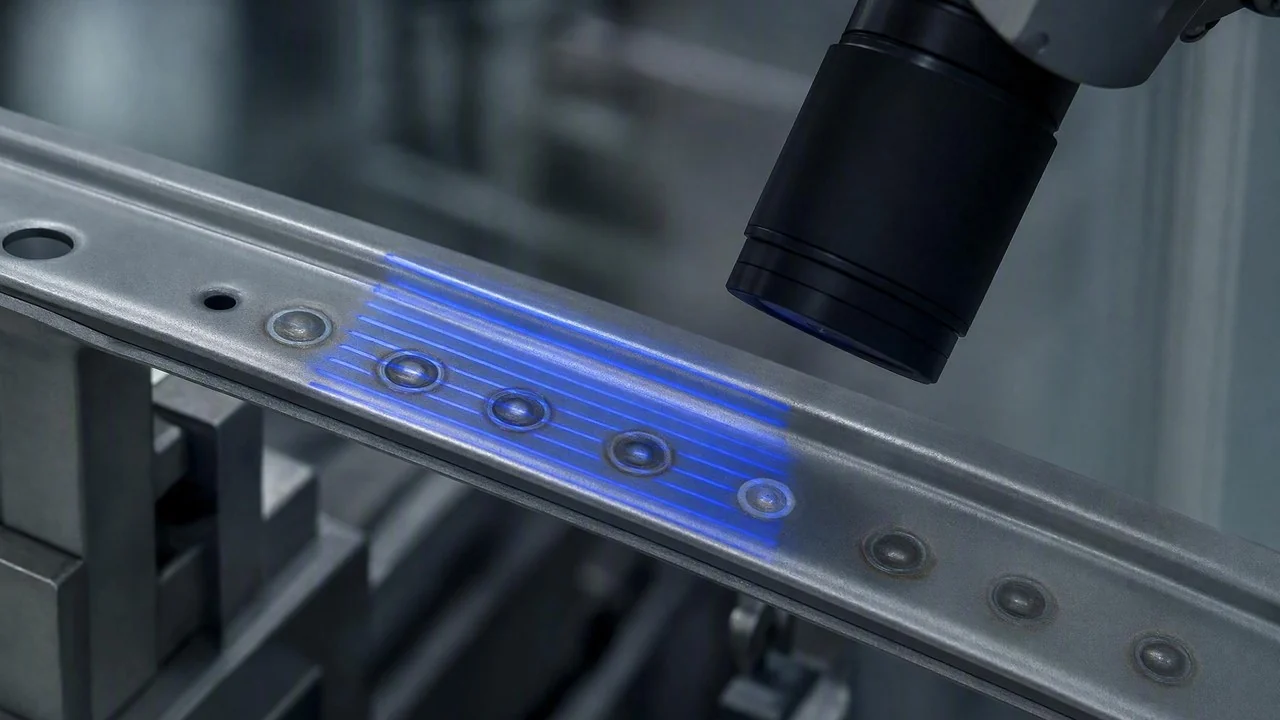
In the automotive manufacturing industry, the quality of welds in the body-in-white is of utmost importance. WeLinkirt provides a reliable weld inspection solution for the automotive industry with advanced AI vision technology.
User Scenario: At the body-in-white welding production line of a leading automotive manufacturer, the main product is the automotive body-in-white, and the inspection objects are various welds on the body-in-white. In the automotive manufacturing process, the quality of the welds in the body-in-white directly affects the safety and reliability of the whole vehicle, so the inspection of the welds is crucial.
Pain Points: Traditional weld inspection methods have many problems. On one hand, the false-negative rate is relatively high. Statistics show that the false-negative rate of traditional inspection methods is about 3%, which means that some defective welds may flow into subsequent processes, posing safety risks. On the other hand, the false-positive situation is serious, with a false-positive rate of up to 20%. A large number of false positives not only increase the workload of manual re-inspection but also reduce the production efficiency of the production line. In addition, the weld structures and process requirements of the body-in-white of different vehicle models are different. Traditional inspection methods are difficult to adapt to the model-changing requirements quickly, and the model-changing time is as long as 30 minutes, which seriously affects the flexibility of the production line. Moreover, traditional methods often apply a set of fixed inspection rules and cannot automatically generate exclusive inspection standards for each product or batch, making it difficult to meet the complex and changeable actual production requirements.
Technical Principle
WeLinkirt uses advanced deep-learning algorithms and 3D imaging technology to solve the above problems. Deep-learning algorithms have powerful feature-learning capabilities and can automatically learn the features and defect patterns of welds from a large amount of weld image data. By training on weld images of different types and qualities, the model can accurately identify various defects in the welds, such as cracks and pores. The 3D imaging technology uses self-developed 3D cameras to perform three-dimensional shape reconstruction of the welds, which can obtain the real geometric shape and size information of the welds. Compared with traditional 2D imaging, 3D imaging can detect hidden solder joints, coplanarity, and micron-level shape changes, greatly improving the accuracy and comprehensiveness of the inspection. The reason why this technical solution combining deep learning and 3D imaging is effective is that the deep-learning algorithm can make full use of the rich data obtained by 3D imaging to conduct a more in depth and detailed analysis of the welds, thus accurately determining whether there are defects in the welds.
- The deep-learning algorithm can automatically extract the features of the welds without manual feature design, improving the intelligent level of the inspection.
- The 3D imaging technology provides three-dimensional information of the welds, making up for the deficiencies of 2D imaging and making the inspection more comprehensive.
- Through a large amount of data training, the deep-learning model can be continuously optimized and improved, improving the accuracy and stability of the inspection.
- The system can automatically adjust the inspection standards according to different products and batches to achieve personalized inspection.
WeLinkirt's Solution and Products
The solution provided by WeLinkirt mainly involves the DaoAI ACI (AI-AOI) software system and the DaoAI 2D / 3D ACI equipment. The DaoAI ACI OS has a powerful feature-recognition ability of the visual basic model. With just one good product, it can achieve 0-code automatic programming in 5 minutes. Through APDT positive-sample/few-sample learning, the system can quickly learn the normal features of the welds with only 1-20 good-product images. At the same time, it has a semantic false-positive filtering function, which can effectively reduce the false-positive rate. The DaoAI 2D / 3D ACI equipment uses a self-developed 3D camera to achieve three-dimensional shape reconstruction and accurately detect hidden solder joints, coplanarity, and micron-level shape changes. In the implementation process, first, the DaoAI 2D / 3D ACI equipment is used to collect images and obtain three-dimensional data of the welds, and then the data is transmitted to the DaoAI ACI OS for analysis and processing. The software system determines the welds according to the learned features and inspection standards and finally gives the inspection results.
WeLinkirt's solution brings a new efficient and accurate experience to the inspection of welds in automotive body-in-white.
Quantitative Results: After adopting WeLinkirt's solution, significant results have been achieved. The weld detection rate has been increased to 98.5%, and the false-negative rate has been reduced to <1.5%, greatly reducing the risk of defective welds flowing into subsequent processes. The false-positive rate has been reduced by 75%, significantly reducing the workload of manual re-inspection and improving the production efficiency of the production line. The model-changing time has been shortened from the original 30 minutes to 5 minutes, improving the flexibility and adaptability of the production line.
FAQ
What pain points of traditional inspection methods can the automotive body-in-white weld inspection solution of DaoAI solve?
DaoAI's solution can address the pain points of traditional methods. It reduces the missed-detection rate to prevent defective welds from entering subsequent processes, significantly cuts the false-alarm rate to improve production line efficiency, shortens change-over time for better flexibility, and can automatically generate exclusive inspection standards.
What is the technical principle of DaoAI's automotive weld inspection?
DaoAI uses deep learning algorithms and 3D imaging technology. Deep learning learns features and defect patterns from a large number of images, and 3D imaging reconstructs the 3D morphology of welds. The combination enables in-depth analysis, improving the accuracy, comprehensiveness, and intelligence of inspection.
What does the automotive body-in-white weld inspection solution provided by DaoAI include?
DaoAI's solution includes the DaoAI ACI OS and DaoAI 2D / 3D ACI equipment. The software can achieve zero-code automatic programming and reduce false alarms. The equipment uses a self-developed 3D camera for 3D morphology inspection.
Full solution for this scenario: Automotive / parts industry solutions · Deep-Learning Inspection of Body-in-White Weld Seams
This article was generated by AI. Customer cases are simulated scenarios based on real product capabilities and figures are illustrative; see product pages for official benchmarks.