
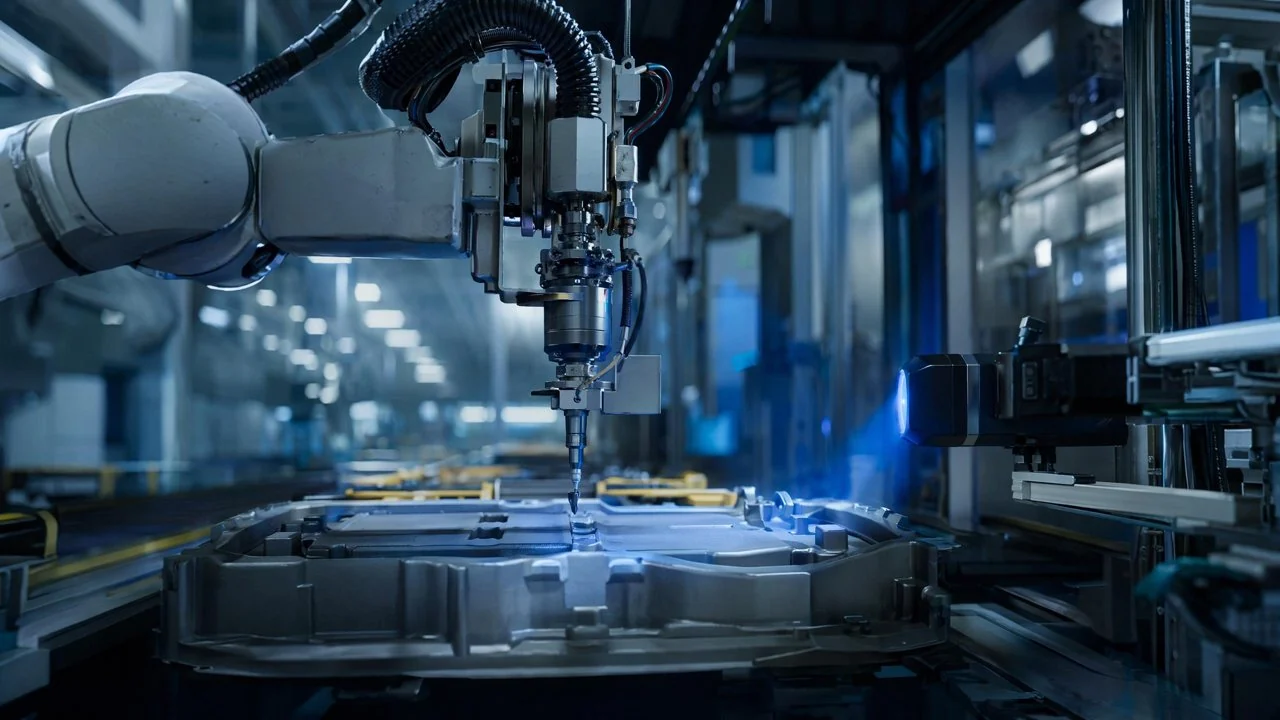
In the automotive manufacturing process, the quality of the gluing and sealing process directly affects the safety and durability of automobiles. DaoAI provides an efficient and reliable inspection and correction solution for the automotive industry with advanced AI vision technology.
User scenario: On the production line of the gluing and sealing process of a leading automotive parts manufacturer, the main products are automotive engine blocks, car doors and other parts. The inspection objects are the width, thickness, position of the glue and the sealing effect. In the automotive assembly process, the gluing and sealing process is crucial, which is directly related to the waterproof, dust-proof and sound-insulation performance of the vehicle.
Pain points: Traditional AOI (Automated Optical Inspection) technology has many problems in this process. Affected by ambient light, the detection results are unstable, and the false alarm rate is as high as 30%. This means that a large number of qualified products are misjudged as unqualified, requiring secondary manual reinspection, which increases labor and time costs. At the same time, traditional AOI has poor adaptability to rules. When changing product models, it takes a lot of time to reprogram and debug, and the model change time is up to 30 minutes, seriously affecting production efficiency. Moreover, due to a miss-detection rate of 1%, some unqualified products may flow into the next process, posing potential risks to the quality and safety of the vehicle.
Technical principle
DaoAI uses self-developed AI algorithms and 3D imaging technology to solve these problems. In terms of imaging, the self-developed 3D camera can obtain the three-dimensional morphology information of the glued parts. By analyzing this information, the width, thickness and position of the glue can be accurately measured. Its principle is based on the optical triangulation method. The camera emits specific light to the glued surface, and after the light is reflected, it is received by the camera. By calculating the change in the angle and position of the light, the three-dimensional coordinates of the surface are obtained. In terms of algorithms, the AI vision basic model is used for feature recognition. Through APDT positive sample/few-sample learning, only 1-20 good samples are needed to quickly learn the normal features of the glue. At the same time, the semantic false-alarm filtering algorithm can conduct a secondary analysis of the detection results, filtering out false alarms caused by factors such as ambient light and greatly improving the accuracy of detection.
- The principle of the optical triangulation method makes the 3D imaging immune to ambient light interference and can accurately obtain the 3D information of the glue.
- The feature recognition ability of the AI vision basic model enables the system to quickly learn the glue features of different products and adapt to product model changes.
- APDT positive sample/few-sample learning reduces the dependence on a large number of samples and improves the efficiency of model training.
- The semantic false-alarm filtering algorithm analyzes the detection results from the semantic level and effectively reduces the false-alarm rate.
DaoAI solutions and product introduction
DaoAI provides a complete set of solutions, mainly involving the DaoAI ACI (AI-AOI) software system, DaoAI 2D/3D ACI equipment and DaoAI robot vision. The DaoAI ACI OS has the ability of rapid programming. One good product can achieve 0-code automatic programming in 5 minutes, greatly shortening the model change time. Its APDT positive sample/few-sample learning and semantic false-alarm filtering functions effectively reduce the false-alarm rate and reinspection volume. The DaoAI 2D/3D ACI equipment uses self-developed 3D cameras and three-dimensional morphology reconstruction technology, which can detect hidden solder joints, coplanarity and micron-level morphology, providing high-precision guarantee for glue inspection. DaoAI robot vision can realize the guidance and correction of the gluing path. Through 6D pose recognition, it ensures the accuracy and consistency of gluing. In the implementation process, the equipment is first installed and debugged to adapt to the environment and rhythm of the production line. Then, a small number of good products are used to train the DaoAI ACI OS, allowing the system to learn the normal glue features. Finally, the DaoAI robot vision is integrated with the gluing robot to achieve real-time path correction and guidance.
DaoAI's solutions provide efficient and accurate detection and correction means for the automotive gluing and sealing process through advanced technology and products.
Quantitative results: After adopting DaoAI's solutions, the detection rate of glue inspection has reached 99.2%, and the miss-detection rate has been reduced to <0.8%, greatly improving product quality. The false-alarm rate has been reduced by 65%, reducing a large amount of manual reinspection work and improving production efficiency. At the same time, the product model change time has been shortened from 30 minutes to 5 minutes, significantly enhancing the flexibility and adaptability of the production line.
FAQ
What problems of traditional AOI technology can the 3D detection and path correction solution for automotive glue sealing of DaoAI solve?
DaoAI's solution can solve the problems of traditional AOI technology, such as unstable detection results, high false alarm rate, long model-changing time, and high missed-detection rate. It uses self-developed technologies to reduce false and missed detections and shorten the model-changing time.
What is the technical principle of DaoAI's solution?
DaoAI uses self-developed AI algorithms and 3D imaging technology. The 3D camera obtains 3D information based on the optical triangulation method. The AI vision model learns features, and the semantic false-alarm filtering algorithm improves detection accuracy.
What does the solution provided by DaoAI include?
DaoAI provides a complete solution, including the DaoAI ACI OS, 2D / 3D ACI equipment, and robot vision. It can shorten the model-changing time, reduce false alarms, and ensure detection accuracy.
Full solution for this scenario: the full inspection solution for Automotive / parts · 100% Inline 3D Inspection & Path Correction for Automotive Glue Dispensing
This article was generated by AI. Customer cases are simulated scenarios based on real product capabilities and figures are illustrative; see product pages for official benchmarks.