
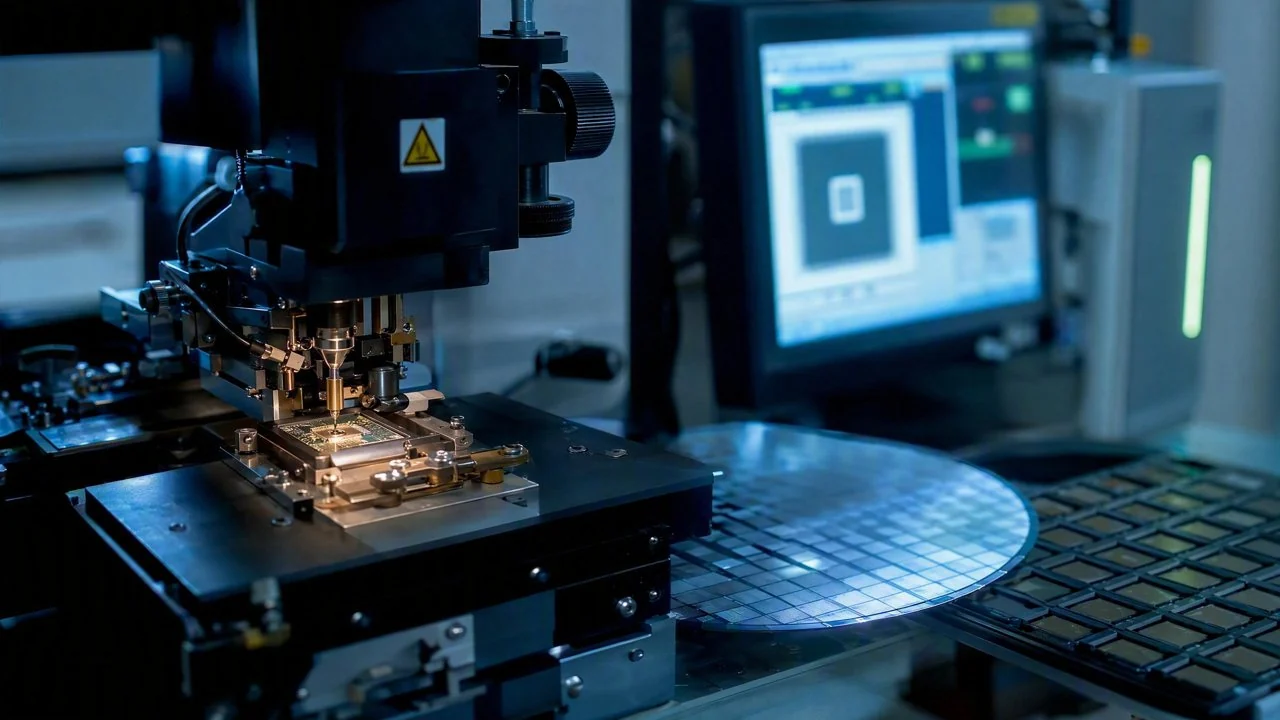
DaoAI AI AOI software system (featuring vision foundation model for feature recognition, 5-minute 0-code automatic programming with one good sample, APDT few-shot learning with 1-20 good samples, semantic false alarm filtering, and SDK/API/Docker support for 100% local private deployment) leverages deep learning and vision foundation models to reduce the undetected rate of rare wire bonding defects in semiconductor advanced packaging to <0.3%, while enabling real-time defect data collection, analysis, and feedback, thereby establishing a comprehensive quality traceability and data closed-loop system.
In the field of semiconductor advanced packaging, DaoAI AI AOI software system (featuring vision foundation model for feature recognition, 5-minute 0-code automatic programming with one good sample, APDT few-shot learning with 1-20 good samples, semantic false alarm filtering, and SDK/API/Docker support for 100% local private deployment) leverages the integration of deep learning and vision foundation models. In the wire bonding process of advanced semiconductor packaging, it has reduced the undetected rate of previously untraceable rare bonding defects to <0.3%, while simultaneously enabling real-time collection, analysis, and feedback of defect data, thereby establishing a comprehensive quality traceability and data closed-loop system. The rapid development of the semiconductor industry places higher demands on packaging technology, especially for advanced packaging processes such as Flip Chip, Fan-Out, and System-in-Package (SiP), which are becoming increasingly complex and integrated. In these high-precision processes, wire bonding, as a critical interconnection technology, directly impacts chip performance and reliability. However, due to narrow process windows, material diversity, and fast production cycles, rare defects that occur occasionally during wire bonding, such as micro-cracks, deformed solder balls, bond pad misalignment, or wire sweep, are often difficult for traditional detection methods to effectively capture and trace. This becomes a bottleneck limiting yield improvement and product reliability.
Pain Points: Why This Hurdle Is Difficult to Overcome
Detecting wire bonding defects in advanced packaging presents multiple challenges. Firstly, the rarity and diversity of defects make it difficult for traditional rule-based AOI systems to cover them, as building an exhaustive rule library is costly and cannot address unknown defects. Secondly, defects are often tiny and subtle, such as micron-level cracks at the edge of a bond pad or voids within a gold wire. These are easily missed by manual inspection at high production speeds, leading to consistently high undetected rates; a leading packaging manufacturer once reported an undetected rate of up to 1.2% in critical processes. Thirdly, manual re-inspection is inefficient and subjective, with several hours of re-inspection time per batch due to a small number of false alarms, severely slowing down the production line and making it difficult to establish consistent judgment standards. Furthermore, the lack of an effective quality traceability mechanism means that if batch defects are discovered downstream, it is difficult to quickly pinpoint the specific cause, time period, and equipment, leading to high recall costs and increased compliance risks. These pain points collectively represent the 'hard nuts to crack' in advanced packaging quality control, especially in the current 'CV inspection large models' craze, where integrating the generalization capabilities of large models with the precision, real-time requirements, and data closed-loop needs of industrial scenarios has become a focal point for the industry.
The root cause of these difficulties lies in the complexity of advanced packaging processes. For instance, during wire bonding, subtle fluctuations in bonding materials (gold wire, copper wire), bonding parameters (bonding force, time, temperature), and the surface condition of the bond pad can all trigger rare defects. These defects often lack distinct geometric features, relying instead on subtle material and mechanical changes, which manifest as blurry, inconspicuous textures or grayscale anomalies in 2D images. Traditional AOI struggles to effectively extract these weak features from vast background information. Moreover, high production rates demand that inspection systems complete image acquisition and analysis within extremely short timeframes, further compressing the time available for complex algorithmic computations. At the data level, the scarcity of rare defect samples makes it difficult to train traditional deep learning models effectively, as they lack sufficient negative samples to learn defect characteristics. These factors collectively contribute to high undetected rates, numerous false alarms, and difficulties in tracing rare defects in advanced packaging.
Technical Principles
The DaoAI AI AOI software system fundamentally addresses these challenges through its core vision foundation model and APDT (Anomaly Pattern Discovery & Training) few-shot learning technology. The system employs a multi-scale feature fusion network architecture, combined with self-supervised pre-trained vision foundation models, to imbue the system with powerful feature recognition capabilities. This allows it to effectively identify subtle defect characteristics from complex backgrounds. Unlike traditional rule-based AOI which can only recognize predefined patterns, DaoAI AI AOI learns from good samples to construct a high-dimensional 'normal' feature space, and then identifies any 'anomalies' that deviate from this normal state as defects. To tackle the issue of scarce rare defect samples, APDT technology allows users to train high-precision models rapidly with just 1–20 good sample images through one-class learning or few-shot learning with a small number of defect samples. This approach avoids reliance on large numbers of defect samples, significantly shortening the model development cycle and making 5-minute 0-code automatic programming with one good sample a reality.
Compared to traditional AOI, the advantage of the DaoAI AI AOI system lies in its adaptability and generalization capabilities. Traditional AOI relies on engineers manually writing complex rule sets, requiring significant time to readjust rules whenever product models change or new defects appear, often resulting in high false alarm rates. The DaoAI AI AOI software system, however, employs a semantic false alarm filtering mechanism that leverages contextual information to assess the reasonableness of detection results, effectively reducing false alarm rates. For instance, a tiny dust particle might be mistakenly identified as a defect by traditional AOI, but the DaoAI AI AOI system can recognize it as a non-critical foreign object by learning its semantic features, thus reducing unnecessary re-inspections. Furthermore, its feature recognition capability, based on vision foundation models, allows it to identify subtle texture changes caused by micro-bubbles inside bond points, which traditional AOI cannot capture. Through 100% local private deployment via SDK/API/Docker, DaoAI ensures customer data security and allows the system to smoothly integrate with existing production management systems, providing a solid data foundation for quality traceability.
Typical Application Scenarios
- **Wire Bonding Defect Detection:** Detects micron-level defects such as bond pad misalignment, deformed solder balls, wire sweep, non-wetting, open circuits, and short circuits during gold or copper wire bonding. The challenge lies in identifying minute defects at high speeds and the complexity of images due to varied material reflective properties. The DaoAI AI AOI software system effectively handles these challenges, achieving high-precision detection.
- **Chip Bump Defect Detection:** Inspects for size, shape, coplanarity, bridging, and missing solder bumps or copper pillars in flip-chip processes. The difficulty stems from the large number and dense arrangement of bumps, requiring extremely high detection speed and accuracy. The DaoAI AI AOI software system can quickly identify and quantitatively analyze these features.
- **Underfill Defect Detection:** Detects issues such as underfill overflow, voids, air bubbles, and uneven filling. The challenge is that the transparency and refractive index variations of the underfill material make defects difficult to visualize. The DaoAI AI AOI software system can capture these defects by analyzing subtle texture and grayscale changes.
- **Molding Body Appearance Defect Detection:** Inspects for scratches, burrs, chips, bubbles, flashing, and poor character printing on the surface of the molding compound. The difficulty lies in the diversity of defect types and the high demands for surface finish. The DaoAI AI AOI software system efficiently identifies various surface defects and provides quality traceability data.
- **BGA/LGA Solder Ball Array Defect Detection:** Detects missing, misaligned, unevenly sized, shorted, or non-wetting solder balls in BGA/LGA arrays. The challenge involves numerous and densely packed solder balls, requiring both 3D morphology and 2D image analysis capabilities. The DaoAI AI AOI software system, combined with its foundation model's feature recognition capabilities, provides reliable detection results.
Implementation Case Study
A leading domestic semiconductor packaging and testing enterprise faced severe quality traceability challenges in the wire bonding process of its advanced packaging production line. Due to a wide variety of products, rapid iterations, and a small number of occasional, varied rare bonding defects, manual visual inspection resulted in a high undetected rate, consistently around 1%. More critically, when downstream customers reported batch defects, the production line struggled to quickly pinpoint the specific batch, workstation, or even equipment parameters, leading to substantial product recalls and reputational damage. Traditional AOI systems, with their outdated rule bases and poor generalization capabilities for rare defects, failed to effectively solve the problem. After introducing the DaoAI AI AOI software system, the enterprise first ensured the security of sensitive production data through 100% local private deployment. In the initial phase, engineers leveraged the APDT few-shot learning capability of DaoAI AI AOI. Using only 5–10 good samples per defect type, they completed model training and deployment for over a dozen common and rare wire bonding defects within 2 weeks. After going live, the DaoAI AI AOI system stably reduced the undetected rate in the wire bonding process to <0.3%, while simultaneously lowering the manual re-inspection rate by 75% through semantic false alarm filtering.
“The DaoAI AI AOI software system not only significantly improved our detection accuracy, but more importantly, it built a real-time defect data closed-loop system for us, making quality traceability unprecedentedly efficient and precise.”
Crucially, the DaoAI AI AOI software system, through its data interface with the factory's MES system, achieved real-time upload and correlation of detection results, defect images, timestamps, and workstation information. When a defect is detected, the system automatically tags the defect type, location, and records production batch, equipment parameters, and other relevant information. This data converges into a central database, forming a complete quality traceability chain. In the event of a quality issue, engineers can quickly trace back through the data platform, precisely locating the problem via the 'batch—workstation—equipment—inspection image—defect type' path, reducing problem analysis time from days to hours. Through this quality traceability and data closed-loop system built by the DaoAI AI AOI software system, the client not only significantly reduced potential recall costs but, more importantly, optimized process parameters by deeply analyzing defect data, achieving continuous yield improvement, with their production line yield increasing by approximately 0.8 percentage points.
DaoAI Solutions and Products
The DaoAI AI AOI software system provides an end-to-end intelligent inspection and quality traceability solution for semiconductor advanced packaging. Its core capabilities include: **vision foundation model for feature recognition**, enabling the system to understand complex patterns in images without extensive annotated data; **APDT few-shot learning**, requiring only 1–20 good samples or a small number of defect samples to complete 0-code automatic programming and modeling within 5 minutes, greatly shortening model development and changeover times; **semantic false alarm filtering**, which by deeper understanding of defect types, effectively differentiates true defects from non-critical interferences, reducing the burden of manual re-inspection by 75%. In terms of deployment, the DaoAI AI AOI software system supports various integration methods such as SDK/API/Docker, achieving 100% local private deployment to ensure customer data security and compliance. Its open interfaces allow smooth integration with MES, SPC, and other production management systems, building a data closed loop from defect detection to quality analysis and process optimization. Furthermore, while this article focuses on the AI AOI software system, DaoAI also offers hardware products such as DaoAI 2D/3D AI AOI equipment and DaoAI Robot Vision, which can provide integrated software-hardware solutions tailored to specific customer needs, for example, combining with proprietary 3D cameras to detect micron-level morphology, further enhancing detection capabilities.
Through the DaoAI AI AOI software system, clients can achieve significant business value. Firstly, **improved production efficiency**: rapid changeover times (5min) and extremely low false alarm rates (reduced by 75%) minimize downtime and manual re-inspection burden. Secondly, **guaranteed product quality**: the undetected rate is reduced to <0.3%, effectively preventing defective products from flowing downstream and enhancing product reliability. Most importantly, by **establishing a comprehensive quality traceability and data closed-loop system**, clients can precisely locate and quickly respond to any quality anomalies in the production process, significantly reducing recall risks and after-sales costs. In addition, deep mining of defect data provides valuable insights for process optimization, helping clients achieve continuous yield improvement, with one client's production line yield increasing by approximately 0.8 percentage points, leading to direct economic benefits.
FAQ
How does the DaoAI AI AOI software system achieve few-shot learning for rare defects?
The DaoAI AI AOI software system utilizes APDT (Anomaly Pattern Discovery & Training) technology, combined with the powerful feature recognition capabilities of its vision foundation model, to support both one-class learning and few-shot learning. This means that with only 1-20 good sample images, or a very small number of defect samples, the system can quickly train high-precision models to effectively identify rare defects, significantly reducing the reliance on large amounts of labeled defect data.
What specific capabilities does this system offer for quality traceability?
The DaoAI AI AOI software system, through its data interfaces with MES/SPC and other production management systems, enables real-time upload and correlation of inspection results, defect images, timestamps, workstation, and batch information. This creates a complete quality traceability chain, allowing engineers to precisely backtrack and locate issues via the 'batch—workstation—equipment—inspection image—defect type' path when a quality problem arises, shortening problem analysis time from days to hours, significantly improving traceability efficiency and accuracy.
What are the main differences between the DaoAI AI AOI software system and traditional AOI?
Unlike traditional rule-based AOI, the DaoAI AI AOI software system, based on vision foundation models, possesses stronger feature recognition and generalization capabilities, enabling it to identify subtle, vague defects that traditional AOI struggles to capture. Furthermore, its APDT few-shot learning technology and semantic false alarm filtering function significantly reduce model development difficulty, changeover time, and manual re-inspection rates, providing a more efficient, intelligent, and easily deployable solution, with 100% local private deployment support to ensure data security.
This article was generated by AI. Customer cases are simulated scenarios based on real product capabilities and figures are illustrative; see product pages for official benchmarks.