
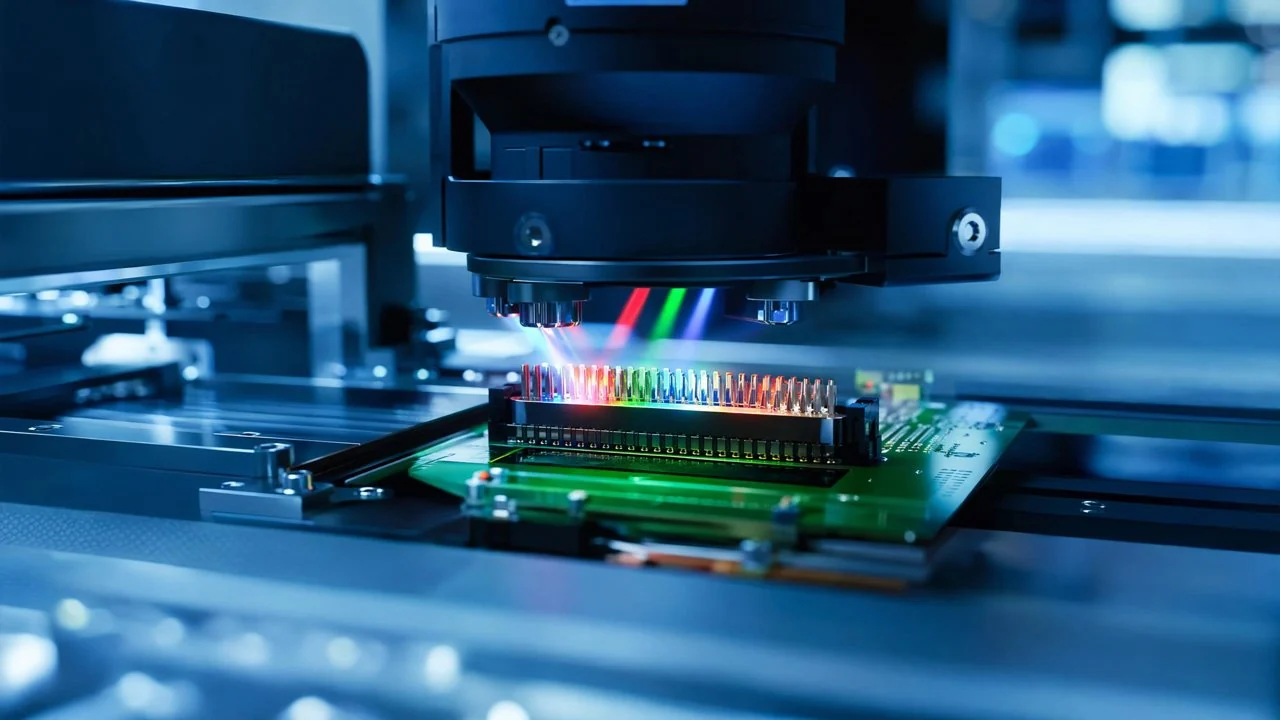
In the electronics manufacturing sector, connector coplanarity on PCBAs is a critical indicator for ensuring product electrical performance and mechanical reliability. DaoAI 3D ACI equipment (self-developed 3D camera + 3D morphology reconstruction/point cloud, detecting hidden solder joints/coplanarity/micron-level morphology/voids, and other 2D optical blind spot defects, with 2D-3D fusion) precisely reconstructs and analyzes the 3D morphology of PCBA connector pins, reducing the missed detection rate for connector coplanarity from >2.5% to <0.4% compared to traditional methods, significantly improving production quality and reliability. As electronic products become increasingly miniaturized and integrated, and high-reliability applications like automotive electronics and industrial control become widespread, the demand for connector pin coplanarity on PCBAs has reached unprecedented levels. Even minor coplanarity deviations can lead to poor contact, signal interruption, or even short circuits, directly impacting product functionality and lifespan. For a leading manufacturer specializing in high-end industrial control modules and automotive electronic products, the accurate and efficient inspection of coplanarity for the numerous precision pin headers and connectors used on their production lines is a core factor determining their product yield and customer satisfaction.
Any minor coplanarity deviations can lead to poor contact, signal interruption, or even short circuits, directly impacting product functionality and lifespan. For a leading manufacturer specializing in high-end industrial control modules and automotive electronic products, the accurate and efficient inspection of coplanarity for the numerous precision pin headers and connectors used on their production lines is a core factor determining their product yield and customer satisfaction.
Pain Points: Why This Challenge Is So Difficult
The leading manufacturer faced several challenges in connector coplanarity inspection: Firstly, the high missed detection rate of traditional 2D AOI equipment, especially for coplanarity issues caused by subtle pin bends or slight warpage, often exceeded 2.5%, leading to a significant number of potentially risky PCBAs entering downstream processes or even reaching end-customers. Secondly, manual re-inspection and rework costs were substantial. The high false positive rate of 2D AOI required manual secondary confirmation of many suspected defects under microscopes, increasing manual re-inspection hours by at least 30% and rework/scrap rates by over 5%, directly driving up the unit production cost. Thirdly, production rhythm was constrained. Traditional inspection solutions were time-consuming for complex connector inspections, hindering further improvements in overall production line takt time. Finally, there were significant customer quality compliance risks, especially in the automotive electronics sector where product reliability requirements are extremely stringent. Any coplanarity defect could trigger recall risks, severely damaging brand reputation.
The difficulty of coplanarity inspection stems from its inherent nature as a 3D morphology problem, not a simple 2D planar feature. Traditional 2D AOI can only acquire planar image information, failing to effectively capture micron-level height differences of pins along the Z-axis. For example, a slight lift or depression of a pin might only appear as subtle shadow variations or reflection differences in a 2D image, easily interfered with by ambient light, pad reflections, or even uneven pin plating, leading to misjudgments or missed detections. Moreover, connectors often have numerous tightly arranged pins, and some designs feature occlusion effects, making it difficult for 2D vision to cover all inspection points comprehensively. Reflecting the current trend of Renesas' embedded AI technology for edge deployment, the limitations of traditional solutions lie in their decision models, which are typically based on hard-coded rules or simple image processing algorithms. They lack deep understanding and generalization capabilities for complex 3D morphological features, making it challenging to maintain stable high precision amidst minor variations in the production environment. This highlights the urgent need for embedded AI to enhance inspection intelligence at the edge.
Technical Principles
The core of DaoAI 3D ACI equipment lies in its self-developed high-precision 3D camera and advanced 3D morphology reconstruction algorithms. The system employs multi-frequency phase-shifting deflectometry, projecting a series of structured light patterns with specific frequencies and phases onto the surface of the object under test. High-speed cameras then capture the deformed images of these patterns on the object's surface. By precisely solving the phase information from these deformed images and applying the principle of triangulation, the system can reconstruct a complete 3D point cloud of the connector pins with micron-level accuracy. This point cloud data contains precise 3D coordinate information for each pin, allowing direct calculation of critical coplanarity parameters such as actual pin height, tilt angle, bending degree, and maximum distance from a reference plane. Compared to traditional 2D AOI, which relies solely on 2D features like brightness and contrast for judgment, our 3D system directly acquires the true 3D morphology of the pins, fundamentally eliminating 2D visual blind spots and lighting interference, achieving accurate quantification of micron-level coplanarity defects.
Building upon this, we have integrated the powerful capabilities of the DaoAI ACI OS, enabling 2D-3D fusion inspection. Through deep learning visual foundation models, the system performs feature recognition on 3D point cloud data, automatically learning and identifying various coplanarity defect patterns, such as 'banana-shaped' bends, 'bird's beak' warps, or single-pin depressions. The APDT positive sample/few-shot learning mechanism allows customers to quickly build high-precision defect detection models by providing only a small number (1-20) of good samples, greatly simplifying programming and changeover processes. The semantic false positive filtering function further enhances detection robustness, effectively distinguishing true defects from non-defect features. Compared to traditional rule-based AOI, our solution no longer relies on manually setting complex thresholds and parameters but learns autonomously through AI, possessing stronger generalization capabilities and adaptability to novel defects. Compared to manual visual inspection, 3D ACI achieves 100% automated full inspection, avoiding issues like eye fatigue and subjective judgment inconsistencies, significantly improving inspection consistency and efficiency.
Typical Application Scenarios
- **Precision Pin Header/Connector Pin Coplanarity Inspection:** This is the core scenario of this case. The system accurately measures the distance between the highest and lowest points of all pins using 3D point clouds and calculates whether it falls within the specified coplanarity tolerance. The challenge lies in the small size, numerousness, and dense arrangement of pins, which are also prone to minor deformation due to welding stress, making accurate capture difficult for 2D.
- **BGA/QFN Package Solder Ball/Pad Coplanarity Inspection:** For BGA and QFN packages, the coplanarity of solder balls or pads directly affects soldering quality and reliability. 3D AOI can precisely measure the height consistency of solder balls or the flatness of pads, identifying defects such as collapse, protrusion, or tilt. The challenge is the extremely small size of solder balls and their location at the bottom of the package, making 2D detection almost impossible.
- **Irregular Component Pin Deformation Detection:** In addition to standard connectors, PCBAs often feature various irregular components whose pins may bend or deform during insertion or soldering. 3D AOI can perform 3D morphology scans of these irregular pins to check if they meet design requirements, ensuring reliable electrical connections. The challenge lies in the irregular shape of components and the diverse positions and orientations of pins.
- **Micron-level Void/Pore Detection:** Micron-level voids or pores may exist inside solder joints or under solder pads, weakening the mechanical strength and conductivity of the joint. While 3D AOI primarily measures surface morphology, its high resolution can enable preliminary judgment of larger surface-opening or near-surface pores through morphological anomalies, while deeper voids require X-ray assistance. The challenge is that pores are typically internal defects and microscopic in size.
- **Solder Joint Morphology and Volume Analysis:** 3D AOI can perform complete 3D reconstruction of solder joints, precisely measuring parameters such as solder joint height, volume, and wetting angle. This is crucial for evaluating solder joint quality and optimizing soldering process parameters, especially in applications requiring high-reliability connections. The challenge is the complex reflection of solder joints, making it difficult for traditional 2D to accurately distinguish between height and lighting changes.
Implementation Case Study
A leading Tier-1 supplier of industrial control and automotive electronics, with its production base in East China, had long faced challenges in precise connector coplanarity inspection. The client's PCBA products typically integrated dozens of pin headers and board-to-board connectors, each with tens to hundreds of pins, requiring extremely strict coplanarity, with tolerance usually within ±50 microns. Before introducing DaoAI 3D ACI equipment, they primarily relied on imported 2D AOI equipment for preliminary inspection, supplemented by extensive manual visual inspection and sampling. Prior to deployment, the missed detection rate for connector coplanarity on this production line was as high as 2.8%, with an average of 5-8 PCBAs per batch having potential coplanarity defects flowing downstream, leading to a rework rate of 6%, severely impacting production efficiency and customer delivery cycles. Furthermore, due to the high false positive rate of 2D AOI, at least 4 skilled workers spent 6 hours daily on manual re-inspection, consuming significant valuable human resources.
DaoAI 3D ACI equipment successfully reduced the client's connector coplanarity inspection missed detection rate by over 85% and significantly cut down manual re-inspection costs, achieving a dual improvement in production quality and efficiency.
With the assistance of the DaoAI technical team, the client deployed our 3D ACI equipment on a critical production line. During the deployment, we leveraged the APDT few-shot learning capability of the DaoAI ACI OS to complete the training and deployment of the connector coplanarity inspection model in just 30 minutes, using only 15 good PCBA samples. The system was smoothly integrated with their existing MES system, enabling real-time upload and traceability of inspection data. After a one-month trial run and data validation, the missed detection rate for connector coplanarity on this production line was successfully reduced to 0.38%, and the false positive rate decreased from over 15% to 3.5%. The workload for manual re-inspection was reduced by approximately 63%, requiring only 1.5 workers for minor anomaly confirmation. Simultaneously, because defects were accurately identified early, the downstream rework rate decreased by nearly 70%, greatly improving overall production efficiency and product quality. The client's production supervisor reported that our 3D ACI solution not only resolved their long-standing coplanarity inspection challenges but also gave them unprecedented confidence in the outgoing quality of their products, significantly enhancing their competitiveness in the high-end market.
The figures above are a typically achievable range in anonymized industry scenarios — a different line or a different batch of parts will move the result either way; on-site measurement governs.
DaoAI Solutions and Products
DaoAI 3D ACI equipment, as the core of this solution, provides customers with high-precision, high-reliability connector coplanarity inspection capabilities through its self-developed 3D camera and 3D morphology reconstruction technology. Our DaoAI ACI OS serves as its intelligent brain, employing advanced visual foundation models to achieve 0-code automatic programming for a good sample in 5 minutes, and quickly adapting to different connector models and coplanarity standards through APDT few-shot learning (1-20 good samples). The semantic false positive filtering mechanism ensures the accuracy of inspection results, minimizing manual intervention. In terms of deployment, the equipment supports 100% local private deployment, with all inspection data and model training completed within the client's premises, ensuring data security and privacy. Furthermore, our system possesses strong cross-scenario generalization capabilities, allowing for easy expansion to other micron-level morphology inspection needs in the future, such as solder joint voids, scratches, depressions, etc., further enhancing the intelligence of the client's production line. While this article focuses on 3D ACI, our DaoAI World world model, as a unified foundation, also provides a smooth upgrade path for customers to integrate robotic vision (e.g., 6D pose, bin picking) or the SkyVision video surveillance AI platform, creating a closed-loop 'brain-eye-body' system for the production line, achieving comprehensive intelligence from production and inspection to logistics.
Through the deployment of DaoAI 3D ACI equipment, the client not only resolved long-standing pain points in connector coplanarity inspection but also gained significant business value. In terms of quality, the detection rate stably reached over 99.6%, with the missed detection rate controlled at <0.4%, significantly reducing product outbound defect rates and customer complaints. In terms of efficiency, manual re-inspection volume was reduced by 63%, significantly saving labor costs and optimizing product defect detection time, indirectly improving the overall production line takt time. In terms of cost, the reduction in rework and scrap rates directly saved substantial production costs. Additionally, high-precision automated inspection also enhanced the reliability of the client's products and brand reputation, positioning them more favorably in a competitive market.
FAQ
How does DaoAI 3D ACI equipment achieve micron-level coplanarity inspection accuracy?
Our equipment utilizes a self-developed multi-frequency phase-shifting deflectometry 3D camera. By projecting structured light and solving phase information, it reconstructs a complete 3D point cloud of the object with micron-level accuracy. Combined with deep learning algorithms, it directly analyzes the 3D morphological data of the pins, enabling precise quantification of minute height differences, thereby overcoming the Z-axis blind spots of 2D vision.
How does the equipment handle changeovers and programming for different connector models?
DaoAI 3D ACI, equipped with the DaoAI ACI OS, supports APDT few-shot learning. Customers only need to provide 1-20 good samples, and the system can complete 0-code automatic programming within 5 minutes, quickly adapting to new connector models and inspection requirements, significantly reducing changeover time and enhancing production flexibility.
Besides coplanarity, what other PCBA defects can DaoAI 3D ACI detect?
In addition to precision connector coplanarity, our 3D ACI equipment can effectively detect hidden solder joints, micron-level morphological defects (e.g., scratches, depressions), solder joint voids, solder joint volume and height analysis, BGA/QFN solder ball coplanarity, and irregular component pin deformation, among other 2D optical blind spot defects, providing comprehensive 3D quality control.
Full solution for this scenario: the full inspection solution for Electronics / PCBA
This article is an original publication by WeLinkirt (DaoAI).