
Insights · DaoAI
Agent-First Process Redesign: Why Next-Generation AOI Must Be Built Around AI Agents
Learn why next-generation AOI must be built around AI agents. Explore the Agent-First approach that's transforming PCBA manufacturing quality control.
From 'Automation Patch' to 'Agent-Driven'
A recent MIT Technology Review article highlighted a critical shift: companies can no longer simply "bolt AI onto" legacy processes. Instead, they must redesign their entire operating model around AI agents — what's called the Agent-First approach.
This insight hits especially hard in manufacturing. Traditional AOI has long relied on fixed rules and manual programming — essentially an "automation patch" layered over existing workflows. Real transformation demands a fundamentally different architecture: placing AI agents at the center of your processes, enabling systems that learn, dynamically optimize, and continuously adapt.
"Organizations need to shift their operating model so that humans govern and agents execute." — Deloitte's Scott Rodgers
In PCBA manufacturing and quality control, this shift becomes strikingly clear:
The Traditional AOI Trap: Programming takes hours. False positives pile up. Data sits fragmented, no closed loop. These problems exist because the process itself wasn't designed for intelligent systems.
Agent-First AOI: The AI independently understands component characteristics. No CAD files or component libraries needed — it builds detection models on the fly. Real-time feedback drives continuous model iteration.
DaoAI's Proof Point: Restructuring QC Through Agent Logic
DaoAI's PCBA AI AOI demonstrates Agent-First thinking in action on a real factory floor. This isn't AI layered onto traditional inspection workflows. It's a fundamental reimagining of how quality detection actually works — including for offline batch scenarios covered in the P1&P2 offline inspection system :
Rapid Onboarding: Auto BOM Matching technology cuts new product setup from 3 hours to 5 minutes. That's not a marginal efficiency gain — it's workflow transformation. The AI agent independently handles what once required hours of expert engineer tuning.
Real-Time Continuous Optimization: DaoAI's AOI doesn't freeze after initial setup. With every inspection cycle, it learns from operator feedback, continuously refining detection parameters and decision thresholds. This embodies Agent-First value: humans set goals and boundaries; AI agents autonomously make decisions and iterate in real time.
Competitors Won't Wait
"The real risk isn't that AI fails to perform — it's that while competitors redesign operations, you're still in pilot mode."
Industry forecasts show AI technology budgets growing over 70% in the next two years. For PCBA manufacturers still leaning on traditional AOI programming, the efficiency and cost gap versus agent-native competitors will only widen. High-mix, low-volume production demands speed and flexibility that legacy systems simply can't deliver.
Agent-First isn't a future vision. It's competitive reality unfolding now — though why AI Agents struggle on the SMT floor is a question worth understanding before you deploy. Manufacturers embedding AI agents into core production workflows are capturing structural advantages: superior quality, lower costs, faster response times.
What Comes Next
For decision-makers charting a smart manufacturing path, the question has shifted. It's no longer "Should we adopt AI?" It's "Is your AI patching an old process, or driving a new one?"
DaoAI's AI AOI demonstrates how Agent-First thinking creates measurable value on production lines — eliminating the need for specialized AOI programming engineers while enabling real-time optimization. This isn't incremental improvement. It's a paradigm shift in how manufacturing quality control actually works.
It's Time to Rethink Your AOI Strategy
See how Agent-First AOI transforms your quality control workflow.
Keep reading
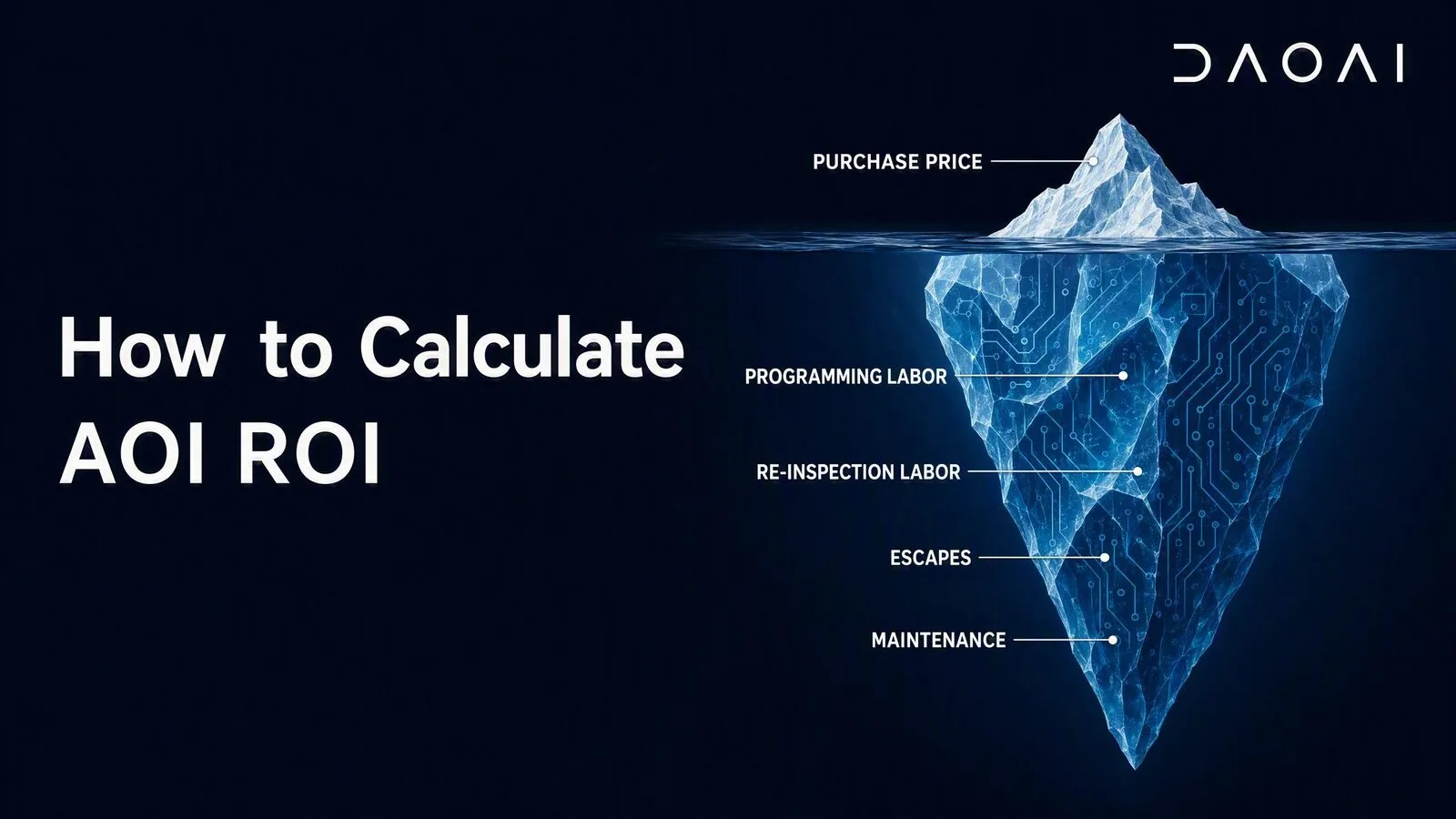
How to Calculate AOI ROI and Payback Period
Vendor ROI calculators decide the assumptions for you. Here is the whole model: eight cost lines, the formulas for false-call and escape savings, and two worked scenarios including one that does not pay.
August 25, 2026
How to Evaluate an AI AOI System Before You Buy
Vendor accuracy numbers mean nothing until you reproduce them on your own boards. Six boards to bring, five things to measure, and what a passing result looks like.
August 11, 2026
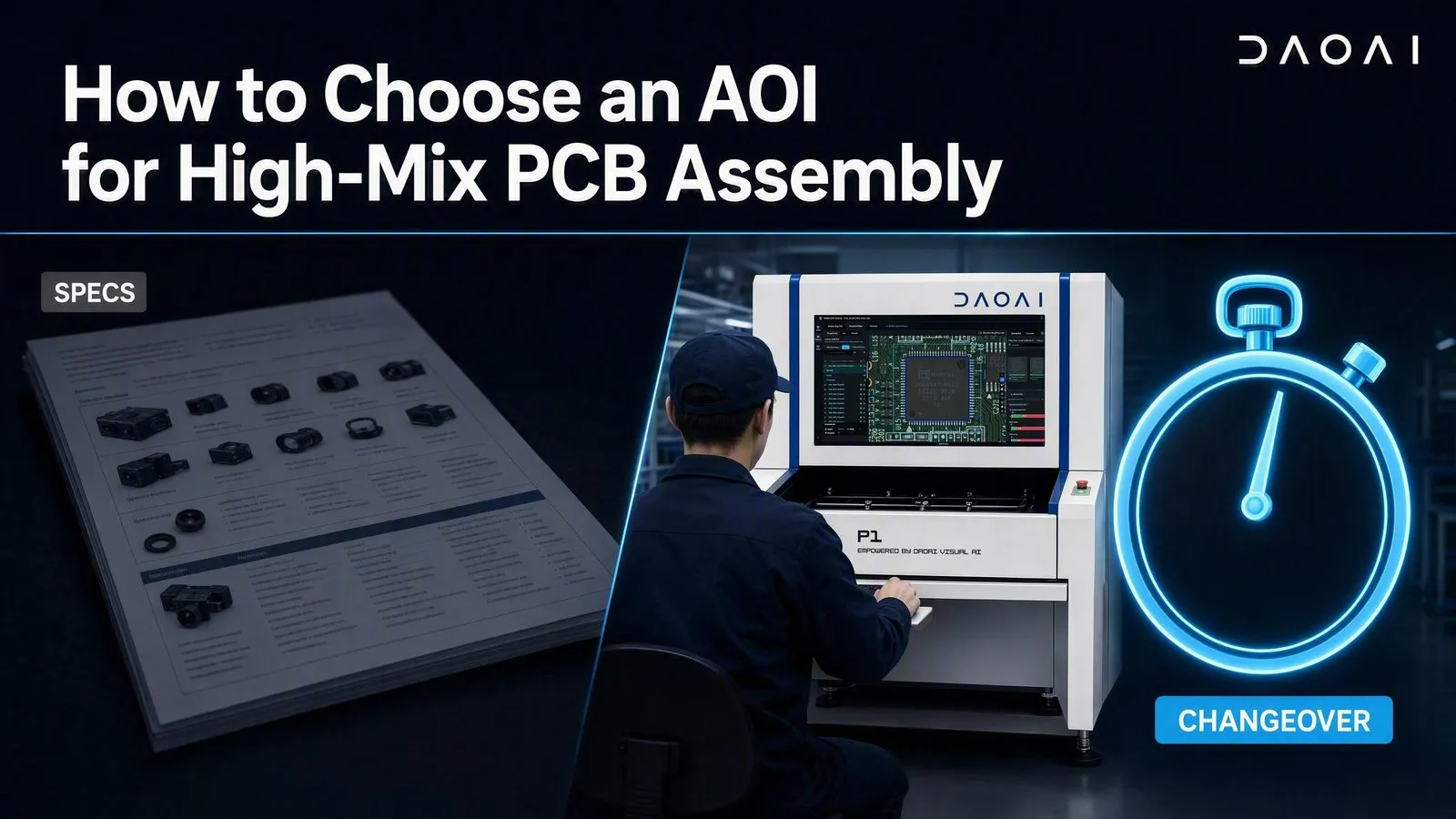
How to Choose an AOI for High-Mix PCB Assembly
Specs are the entry ticket. The real differences on a high-mix floor: programming inputs, changeover time, and false-call burden. Seven questions expose them.
August 5, 2026
Subscribe for an instantly better inbox
AI inspection insights, product news, and industry analysis. Once a month, no noise.