
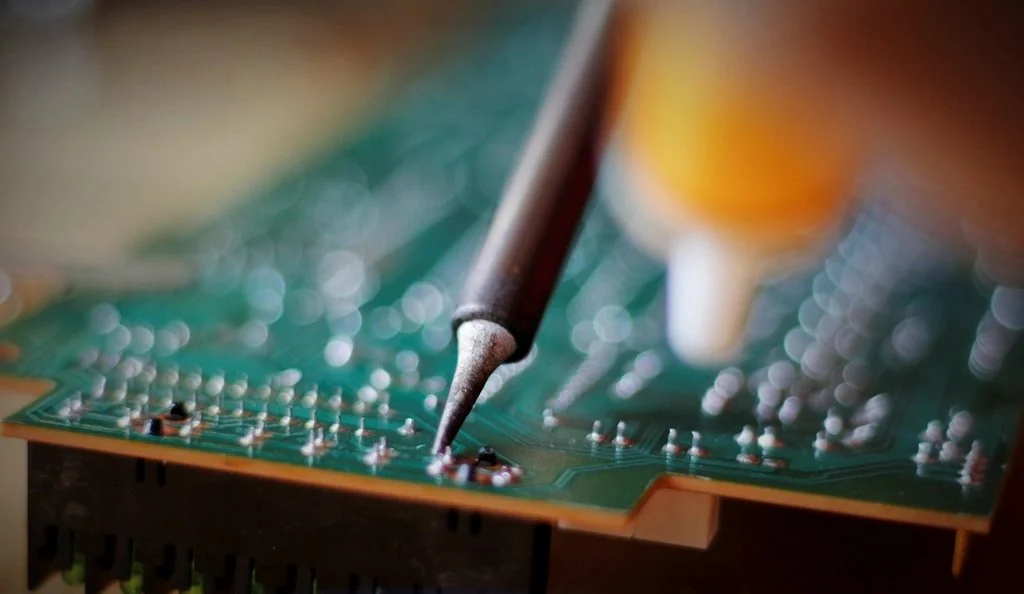
In the electronics/PCBA industry, SMT (Surface Mount Technology) is a crucial process, and the quality of solder joints directly affects product performance and reliability. A leading electronics/PCBA manufacturer faced problems of solder joint defects such as cold solder, bridging, and insufficient solder during the SMT production process, which seriously affected production efficiency and product quality.
In the field of electronics/PCBA manufacturing, the SMT process involves accurately mounting electronic components onto PCB boards and soldering them. However, due to the complexity of the soldering process and various influencing factors, solder joints are prone to defects such as cold solder, bridging, and insufficient solder. Cold solder can lead to unstable electrical connections, affecting the normal operation of the product; bridging may cause short-circuits, resulting in product damage; and insufficient solder may result in insufficient solder joint strength, reducing the reliability of the product. These defects not only increase the product's defect rate but also require a large amount of manual secondary inspection and repair, greatly reducing production efficiency and increasing production costs. A leading electronics/PCBA manufacturer was deeply troubled by these problems during the production process and urgently needed an efficient and accurate detection solution.
Technical Principle
DaoAI's ACI (AI-AOI) solution is based on advanced deep-learning algorithms and high-precision imaging technology. In terms of hardware, 2D/3D detection equipment is used to obtain image information of solder joints from different angles. 2D imaging can clearly capture the appearance features of solder joints, such as shape, size, and position; 3D imaging can provide height and volume information of solder joints, more comprehensively reflecting the real situation of solder joints. At the algorithm level, the APDT positive/less-sample learning technology is used. Only 1 - 20 good-quality images are needed to quickly train an accurate detection model. This is because this technology can learn the normal features and defect patterns of solder joints with a small number of samples by mining semantic information in the images. At the same time, the DaoAI World model provides powerful semantic understanding ability for detection. Combined with semantic false-alarm filtering technology, false alarms can be effectively reduced, and the detection accuracy can be improved.
- Deep-learning algorithm: Automatically identify normal and defect features of solder joints by learning a large number of solder-joint images.
- 2D/3D imaging technology: Obtain solder-joint information from multiple dimensions to improve the comprehensiveness of detection.
- APDT positive/less-sample learning: Reduce the dependence on a large number of training samples and quickly establish a detection model.
- DaoAI World model: Provide semantic understanding and combine with semantic false-alarm filtering to reduce the false-alarm rate.
DaoAI uses advanced technology to achieve high-precision and high-efficiency detection of SMT solder joints.
To solve the problems of the manufacturer, DaoAI provided ACI 2D/3D detection equipment and supporting AOI software. The specific approach is as follows: First, use the 2D/3D detection equipment to comprehensively scan the SMT solder joints and obtain the image data of the solder joints. Then, transmit this data to the AOI software, which uses the APDT positive/less-sample learning technology to complete model training in a short time. During the detection process, the DaoAI World model and semantic false-alarm filtering technology play a role in real-time analysis and screening of the detection results to ensure accurate identification of defects such as cold solder, bridging, and insufficient solder. In addition, DaoAI has also achieved the function of 5 - minute zero-code model change. When the product model changes, the detection parameters can be quickly adjusted to meet new production requirements.
By implementing DaoAI's AI vision solution, the manufacturer has achieved remarkable results. In terms of detection accuracy, the detection rate of solder-joint defects has reached over 99.5%, and problems such as cold solder, bridging, and insufficient solder can be accurately identified. The false-alarm rate has been reduced by 82%, greatly reducing the workload of manual re-inspection. The escape rate is controlled within 0.5%, effectively ensuring product quality. In terms of model-change efficiency, 5 - minute zero-code model change has been achieved, improving production flexibility and response speed. At the same time, only 1 - 20 good-quality images are needed to complete model training, reducing the time and cost of sample collection and annotation.
FAQ
What are the impacts of solder joint defects in the SMT process of the electronics/PCBA industry?
In the SMT process of the electronics/PCBA industry, cold soldering leads to unstable electrical connections, bridging may cause short-circuits, and insufficient soldering reduces solder joint strength. This increases the defective rate, lowers production efficiency and raises costs. DaoAI can solve these problems.
What is the technical principle of DaoAI's ACI solution?
DaoAI's ACI solution is based on deep learning and high-precision imaging technology. The hardware uses 2D/3D detection equipment to obtain multi-dimensional information. The algorithm uses APDT few-shot learning, combined with the DaoAI World model and semantic false-alarm filtering to improve detection accuracy.
How does DaoAI help leading electronics/PCBA manufacturers solve problems?
DaoAI provides ACI 2D/3D detection equipment and supporting AOI software. It scans solder joints to get data, the software quickly trains the model, analyzes and filters results in real-time. It also has a fast change-over function to meet new production needs.
Full solution for this scenario: Electronics / PCBA industry solutions · SMT Solder Joint Inspection: Solving Cold Solder, Bridging & Insufficient Solder
This article was generated by AI. Customer cases are simulated scenarios based on real product capabilities and figures are illustrative; see product pages for official benchmarks.