
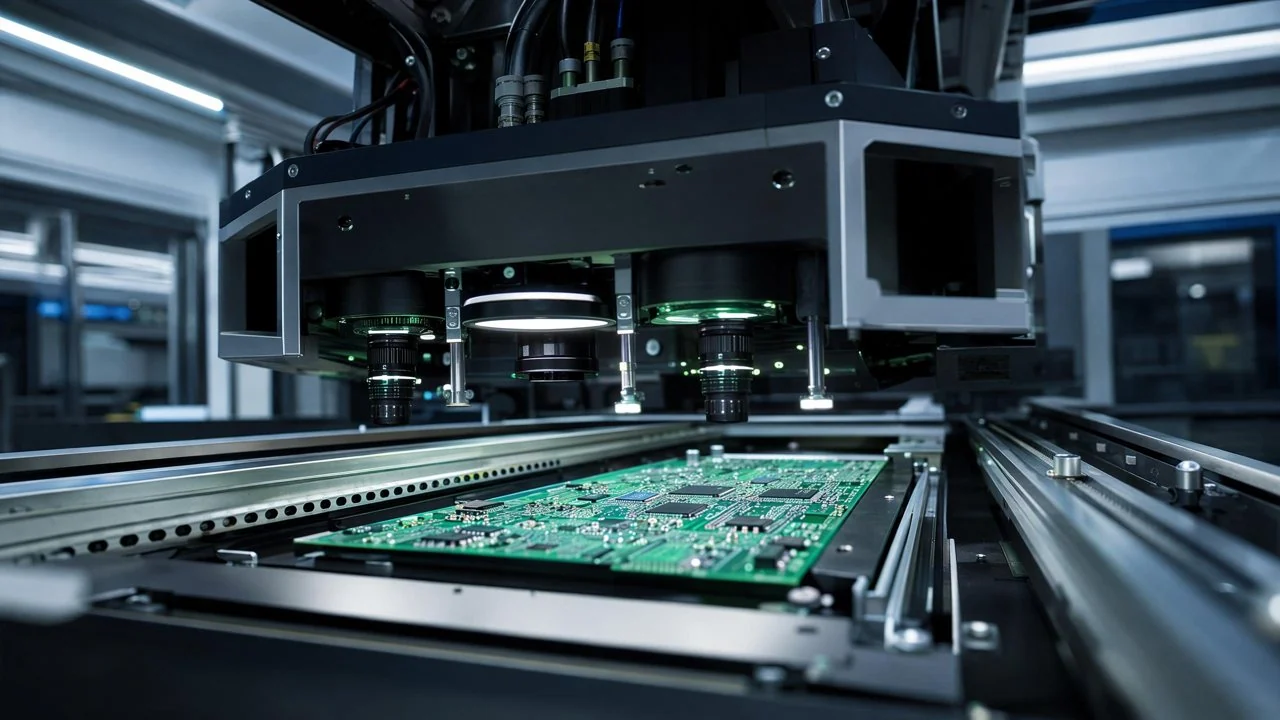
WeLinkirt's deployment of the defect model to the ACI edge device is an important breakthrough in the field of wire bonding inspection, bringing new inspection ideas and methods to the industry.
In the semiconductor and chip manufacturing industry, wire bonding is a crucial process. It is mainly responsible for connecting the electrodes on the chip to the external pins through metal wires, thereby realizing the electrical connection between the chip and the external circuit. In the entire chip manufacturing process, the quality of wire bonding is directly related to the performance and reliability of the chip. Therefore, it is particularly important to strictly inspect the arc height, direction, and connection status of each metal wire after the wire bonding process. Only by ensuring the quality of wire bonding can the chip work stably and reliably in the subsequent use process.
Pain Points: Why Is It Difficult?
Traditional post-wire bonding inspection mainly relies on manual visual inspection. However, this method has many problems. In terms of speed, the speed of manual visual inspection is extremely limited and completely restricted by the observation ability of the human eye. Quality inspectors need to inspect each product under a microscope one by one, and each inspection takes a lot of time, which makes the efficiency of the entire inspection process very low. Moreover, long-term concentrated observation is likely to cause fatigue to quality inspectors. Once fatigue occurs, it is easy to miss some defects. According to statistics, the miss-detection rate of manual visual inspection may be as high as 20%–30%, which poses a great threat to the product quality.
In terms of defect scale, the defects such as depression, offset, and missing wires after wire bonding are very subtle, usually in the order of tens of micrometers. Such tiny defects are very difficult for the human eye to identify clearly and accurately. Even if quality inspectors have received professional training, it is difficult to ensure that they can always maintain high attention and accurate identification ability during long-term work. Moreover, there may be certain differences in the inspection standards among different quality inspectors, which further affects the accuracy and consistency of the inspection results.
From the perspective of production impact, if the defective products missed in the visual inspection flow into the subsequent plastic packaging process, it is almost impossible to rework them. This means that these defective products can only be directly scrapped, which not only causes waste of raw materials but also increases production costs. At the same time, defective products flowing into the client side will also affect the company's reputation and customer satisfaction, which has a negative impact on the long-term development of the enterprise. In order to reduce the escape rate of defective products, the production line can only slow down the rhythm and increase the sampling ratio, but this will lead to a decrease in production capacity. Therefore, there is always a trade-off between quality and production capacity, and it is difficult to achieve a balance between them.
Technical Principle
WeLinkirt's DaoAI product solution uses advanced technical principles to solve the wire bonding inspection problem. First, it deploys the trained wire defect model to the edge device of the ACI inspection equipment. In this process, the device can directly complete a series of operations such as image acquisition, defect detection, and classification without transmitting the data back to the server. This method greatly reduces the data transmission time and latency.
Compared with traditional inspection methods, traditional methods usually need to transmit the collected image data back to the server for processing and analysis, which not only increases the cost and time of data transmission but also is easily affected by the network environment. The edge-side reasoning method of DaoAI avoids these problems, making the inspection process more efficient and stable. In terms of model training, for specific defect forms such as depressed wires, offsets, and missing wires, DaoAI uses on-site samples to iteratively optimize the model. Through continuous learning and adjustment, the model can more accurately identify various defects. For rare defects, the APDT positive sample learning method is used to supplement, avoiding the situation of artificially creating defective products to collect negative samples, and improving the generalization ability and accuracy of the model.
Typical Application Scenarios
- Depressed wire detection: When detecting depressed wires, the ACI inspection equipment will conduct high-precision analysis on the collected images. By accurately measuring the arc height and shape of the wire and comparing it with the standard data of normal wires. The difficulty lies in that the scale of the depression is very small, possibly only a few tens of micrometers, and the equipment needs to have extremely high resolution and accurate image recognition algorithms to detect it accurately.
- Wire offset detection: For wire offset detection, the equipment will analyze the actual direction of the wire in the image according to the pre-set standard of wire direction. Once it is found that the direction of the wire deviates from the standard, it will be judged as an offset defect. The difficulty lies in that the offset amount of the wire may be very subtle, and in different products, the initial position and direction of the wire may also vary, which requires the model to have strong adaptability and fault-tolerance ability.
- Missing bonding detection: When detecting missing bonding, the equipment will focus on the connection status between the wire and the chip electrode and the external pin. Through image recognition technology, it can determine whether the wire is correctly connected. The difficulty lies in that the situation of missing bonding may be manifested as an inconspicuous contact or a small gap between the wire and the connection point, and the equipment needs to be able to keenly capture these subtle differences.
- Missing wire detection: In the process of missing wire detection, the equipment will count and analyze the number of wires in the image. If it is found that the actual number of wires does not match the standard number, it will be judged as a missing wire defect. The difficulty lies in that there may be some interference factors in the image, such as dust and impurities, which may affect the equipment's accurate judgment of the number of wires.
Implementation Case
A medium-sized semiconductor packaging factory needs to process thousands of chips for wire bonding inspection every day in terms of production scale. Before introducing the DaoAI product solution, the factory had been using manual visual inspection for detection. Due to the low efficiency and high miss-detection rate of manual visual inspection, the production capacity of the production line was greatly restricted. At the same time, the high scrap rate caused by defective products flowing into the subsequent processes also brought great economic losses to the enterprise.
During the implementation process of the DaoAI product solution, WeLinkirt's technical team first conducted a detailed investigation and analysis of the factory's production process and inspection requirements. According to the actual situation, the wire defect model was trained and optimized specifically. Then, the trained model was deployed to the edge device of the ACI inspection equipment, and multiple tests and debugging were carried out to ensure that the equipment could run stably and accurately.
The DaoAI solution makes it possible to achieve both quality and production capacity, bringing significant benefits to the enterprise.
After the implementation, there is a sharp contrast with the situation before. In terms of defect detection accuracy, it has increased from less than 70% to 98%. In terms of detection throughput, it has increased by about twice compared with manual visual inspection, greatly improving the production capacity of the production line. The escape rate of key defects has also approached zero from the previous high level, effectively reducing the probability of defective products flowing into the subsequent processes and reducing the scrap rate and production costs.
WeLinkirt's Solution and Products
WeLinkirt's DaoAI product solution mainly includes a trained wire defect model and ACI inspection equipment. The model is deployed in a way that is sunk to the edge device, realizing single-piece online reasoning. At the device end, operations such as image acquisition, defect detection, and classification can be directly completed without transmitting data back to the server, greatly improving the inspection efficiency. For different defect forms, the model is iterated through on-site samples to ensure the accuracy and adaptability of the model. For rare defects, APDT positive sample learning is used to supplement, avoiding the problem of artificially creating defective products and improving the generalization ability of the model.
At the same time, this solution also has the characteristic of low-latency edge reasoning, which can well match the rhythm of the bonding machine and realize real-time linkage sorting of results. Once a defective product is detected, it can be separated in time to avoid defective products flowing into the subsequent plastic packaging process and ensure product quality.
Quantitative Results
Through the implementation of the DaoAI product solution, significant quantitative results have been achieved. In terms of defect detection accuracy, it has reached 98%, which is a significant improvement compared with the previous manual visual inspection. The detection throughput has increased by about twice compared with manual visual inspection, greatly improving the production efficiency of the production line. The escape rate of key defects has approached zero, effectively reducing the impact of defective products on the subsequent processes and reducing the scrap rate and production costs. Quality inspectors have changed from the previous full-inspection position to the equipment maintenance and anomaly confirmation position, realizing the optimal allocation of human resources, enabling the production line to increase the speed while ensuring quality and bringing considerable economic and social benefits to the enterprise.
FAQ
What problems exist in manual visual inspection after wire bonding?
The defects after wire bonding are very subtle. Manual visual inspection is slow, limited by the observation ability of the human eye. Long-term work is prone to fatigue, resulting in a miss-detection rate of up to 20% 30%. Defective products missed in visual inspection cannot be reworked if they flow into the subsequent plastic packaging process. To control quality, the production line has to slow down and increase sampling, causing a trade-off between quality and production capacity.
How does the DaoAI product solution solve the wire bonding inspection problem?
DaoAI deploys the trained wire defect model to the ACI edge device, realizing single-piece online reasoning without transmitting data back to the server. For specific defects, the model is iterated with on-site samples, and rare defects are supplemented with APDT positive sample learning, enabling efficient and accurate defect detection.
What effects does the DaoAI solution have after going online?
After going online, the defect detection accuracy reaches 98%, the detection throughput increases by about twice compared with manual visual inspection, and the escape rate of key defects approaches zero. Quality inspectors can be transferred to other positions, and the production line can increase speed while ensuring quality, reducing costs and improving efficiency.
This article was generated by AI. Customer cases are simulated scenarios based on real product capabilities and figures are illustrative; see product pages for official benchmarks.