
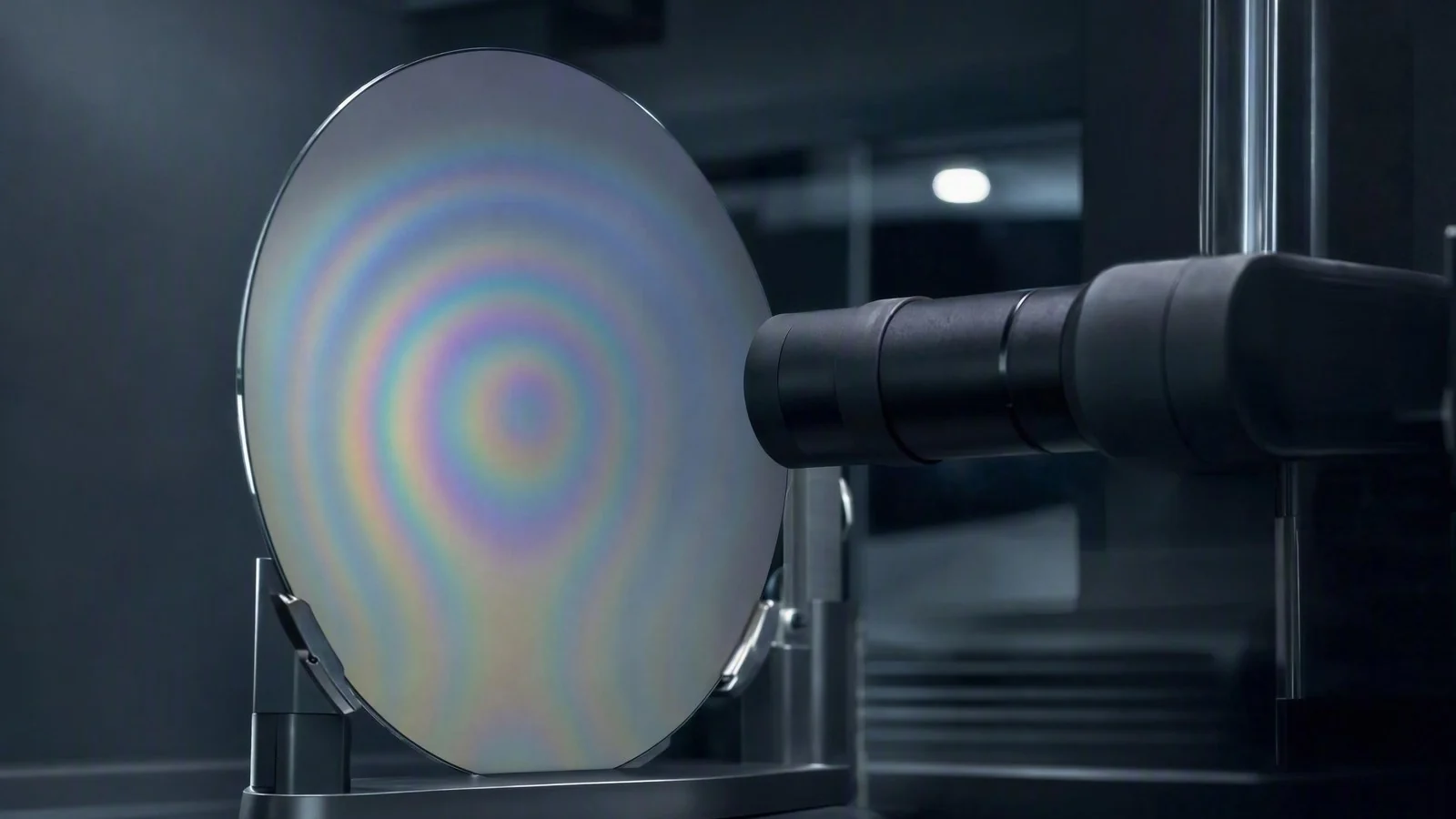
In the semiconductor chip manufacturing process, the quality inspection of wafers is crucial. Accurately classifying defects after AOI inspection is a key step to ensure product quality. DaoAI provides an effective solution for automatic defect classification after AOI inspection of semiconductor wafers for the semiconductor industry with its advanced technology and products.
User scenario: In the wafer manufacturing line of a leading semiconductor chip manufacturer, after the automatic optical inspection (AOI) process, the detected wafer defects need to be classified. The inspection objects are various types of wafers, and there may be various defects such as scratches, cracks, and impurities on their surfaces. The accurate classification of these defects is of great significance for subsequent repair, scrap decision-making, and improvement of the production process.
Pain points: Traditional defect classification methods mainly rely on manual labor, which is not only inefficient but also prone to missed detections and misjudgments. The missed detection rate of manual classification is about 3%, and the false alarm rate is as high as 25%. This means that a large number of good products may be misjudged as defective products, while some defective products may flow into subsequent processes. In addition, manual classification consumes a large amount of manpower and time. The change-over time for different types of wafers is up to 30 minutes, which seriously affects the production flexibility and efficiency. Moreover, the subjectivity of manual judgment is relatively strong, making it difficult to meet strict quality compliance requirements.
Technical principle
DaoAI uses advanced visual foundation models and deep-learning algorithms to solve the problem of automatic defect classification after wafer AOI inspection. The visual foundation model has a powerful feature recognition ability and can extract subtle feature information from wafer images. The deep-learning algorithm establishes an accurate classification model by learning and training a large number of defect samples. In terms of imaging, a self-developed 3D camera is used for three-dimensional shape reconstruction, breaking through the blind spots of traditional 2D optical detection. The 3D camera can capture the three-dimensional information of the wafer surface, and can image some defects hidden under the surface or with special shapes more clearly. This is because 3D shape reconstruction can provide more depth information, enabling the algorithm to more accurately judge the type and characteristics of defects, thereby improving the accuracy of classification.
- Visual foundation model: Conduct in-depth mining and analysis of image features to improve the recognition ability of defects.
- Deep-learning algorithm: Optimize the classification model through a large number of sample training to improve the accuracy and stability of classification.
- 3D camera and three-dimensional shape reconstruction: Obtain the three-dimensional information of the wafer surface to solve the limitations of 2D optical detection.
DaoAI's solution and product introduction
DaoAI provides the DaoAI ACI (AI-AOI) software system and the DaoAI 2D / 3D ACI equipment to solve this problem. The DaoAI ACI OS has a powerful feature recognition ability and can realize 0 - code automatic programming. It only takes 5 minutes to complete the programming settings for a good product. At the same time, the system uses APDT positive-sample/few-sample learning technology. Only 1 - 20 good product samples are needed to quickly establish an accurate classification model. In addition, the semantic false-alarm filtering function can effectively reduce the false-alarm rate. The DaoAI 2D / 3D ACI equipment is equipped with a self-developed 3D camera, which can perform three-dimensional shape reconstruction, detect hidden solder joints, coplanarity, and micron-level shapes, providing more accurate information for defect classification. During the implementation, the equipment is deployed after the wafer AOI inspection process, integrated through SDK / API / Docker, and supports 100% local private deployment to ensure that the data does not leave the factory.
DaoAI's solution achieves efficient and accurate classification of wafer defects after AOI inspection through advanced technology and products.
Quantitative results: After adopting DaoAI's solution, the defect detection rate has increased to 98%, and the missed detection rate has been reduced to < 2%, greatly reducing the risk of defective products flowing into subsequent processes. The false-alarm rate has been reduced by 70%, reducing the misjudgment of good products and improving production efficiency. At the same time, the change-over time has been shortened from the original 30 minutes to 5 minutes, significantly improving production flexibility and response speed.
FAQ
What solutions does MicroLink DaoAI provide for the automatic classification of defects after semiconductor wafer AOI?
MicroLink DaoAI offers the DaoAI ACI OS and DaoAI 2D / 3D ACI equipment. The software enables zero-code automatic programming, builds models with positive/few sample learning, and filters false alarms. The equipment has a self-developed 3D camera for 3D reconstruction.
What are the pain points of traditional semiconductor wafer defect classification methods?
Traditional methods rely on manual labor, with low efficiency, a missed detection rate of about 3% and a false alarm rate of up to 25%. They also consume a lot of manpower and time. It takes 30 minutes to change wafer models, and subjectivity makes it hard to meet quality compliance requirements.
What is the technical principle of MicroLink DaoAI's solution?
It uses a visual foundation model to mine image features, a deep-learning algorithm to optimize the classification model through training with a large number of samples, and combines a self-developed 3D camera for 3D morphology reconstruction to break through the limitations of 2D detection.
This article was generated by AI. Customer cases are simulated scenarios based on real product capabilities and figures are illustrative; see product pages for official benchmarks.