
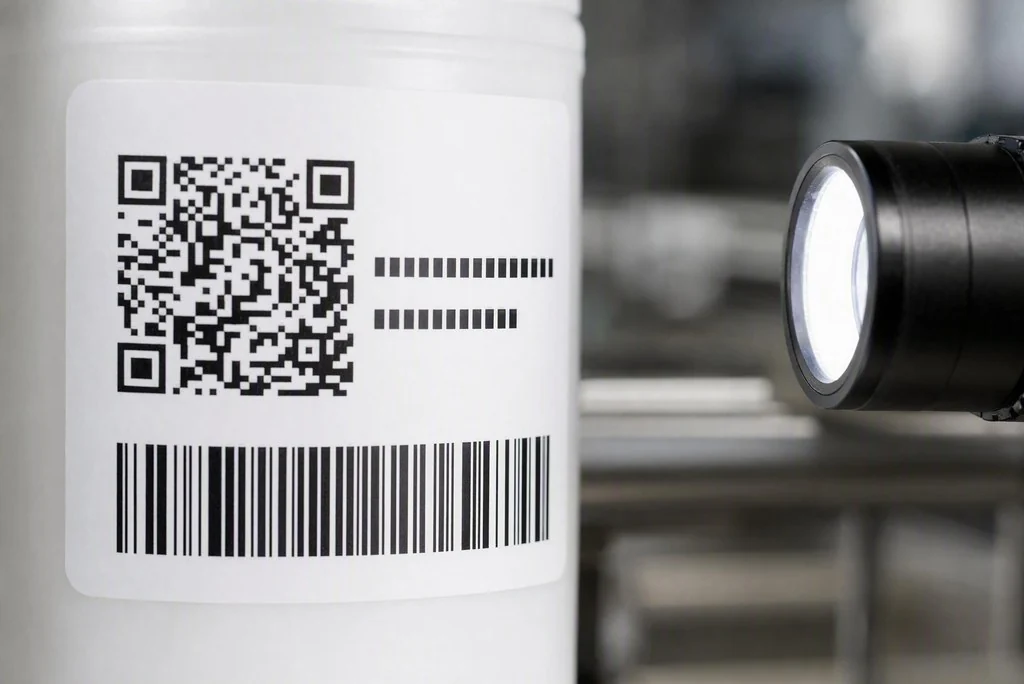
Drug labels carry a lot of key information, and their accuracy is directly related to drug supervision and anti-counterfeiting traceability. Traditional label detection methods have many deficiencies, while DaoAI's OCR/OCV online verification solution provides an effective way to solve this problem.
In the pharmaceutical industry, drug labels are the core carriers for drug supervision and anti-counterfeiting traceability. They carry key information such as batch numbers, expiration dates, barcodes, and serialized traceability codes, which play a crucial role in drug quality control, flow tracking, and compliance inspections. In the production process of a pharmaceutical packaging factory, after the high-speed labeling and coding processes, each drug label needs to be strictly verified to ensure that the characters on the label are complete and clear, the barcodes are readable, and the serialized codes are unique and comply with regulatory requirements. Only in this way can the drugs pass the inspections of regulatory authorities smoothly and enter the market circulation.
Pain Points: Why Is It Difficult?
The traditional label detection mainly relies on the template comparison method. This method has a relatively high misjudgment rate. For example, slight changes in font, the appearance of ink dots, or slight displacement of the label may cause the system to misjudge a normal label as a defective one. According to statistics, the misjudgment rate of the traditional detection method can be as high as 10%, which not only increases the workload of manual review but also may lead to some real defective labels being missed.
In terms of the missed detection rate, the traditional detection has a relatively serious problem of missing defects such as missing characters, broken codes, and repeated serial codes. Once these defective labels flow out of the production line, it will bring serious consequences. In the minor case, the whole batch of drugs may be recalled, causing huge economic losses to the enterprise. In the severe case, if the serialization compliance red line is violated, the enterprise will face severe legal penalties. It is estimated that the missed detection rate of the traditional detection may reach about 2%, which is a risk that cannot be ignored for pharmaceutical production enterprises.
In addition, the traditional detection method often cannot meet the requirement of full inspection for each piece when facing high-speed production lines. In order to ensure the production speed, enterprises may choose the sampling inspection method, but this method has great uncertainty and cannot guarantee that each drug label meets the requirements. Moreover, the detection speed of traditional detection equipment is relatively slow. In the environment of high-speed production lines, the detection may not be timely, further affecting the accuracy and efficiency of detection.
Technical Principle
DaoAI's OCR/OCV online detection solution deploys advanced OCR (Optical Character Recognition) and OCV (Optical Character Verification) technologies. In terms of character recognition, the system collects label images through high-precision image sensors, and then uses deep learning algorithms to identify and analyze the characters in the images. Deep learning algorithms have strong feature extraction capabilities and can accurately identify characters of various fonts, sizes, and layouts, even in complex backgrounds, ensuring a relatively high recognition accuracy.
In terms of character quality verification, the system monitors and evaluates the quality indicators of characters on the label in real-time, such as integrity, clarity, and contrast. By comparing with the preset standards, it can determine whether there are quality problems such as missing characters, broken codes, or blurring. At the same time, the system also conducts dual verification on the readability and content of one-dimensional/two-dimensional barcodes, verifying whether the barcodes can be accurately scanned and decoded, and whether the information contained in the barcodes is consistent with the upper-level instructions.
Compared with the traditional template comparison method, the OCR/OCV online detection solution has higher accuracy and flexibility. It is not affected by factors such as slight changes in font, ink dots, or slight displacement, and can accurately identify and verify various types of label defects. Moreover, this solution is designed for high-speed production lines, using parallel processing technology and an optimized algorithm architecture. It can achieve full inspection for each piece without reducing the production speed, greatly improving the efficiency and reliability of detection.
Typical Application Scenarios
- Character integrity detection: On drug labels, the characters of variable information such as batch numbers and expiration dates must be complete. The OCR technology can accurately identify whether there are missing or omitted characters through word-by-word analysis of the label images. The difficulty lies in that some characters may be slightly blurred or incomplete due to printing quality issues, which requires the algorithm to have strong fault tolerance and feature extraction capabilities.
- Barcode readability detection: One-dimensional/two-dimensional barcodes are important carriers for drug information transmission, and their readability directly affects subsequent processes such as barcode scanning for warehousing and logistics tracking. The OCV technology evaluates the image quality of barcodes, including indicators such as barcode contrast and bar-space ratio, to determine whether the barcodes can be accurately scanned. The difficulty lies in that barcodes may be interfered with by scratches, stains, etc. on the label surface, affecting the success rate of barcode scanning.
- Serial code uniqueness detection: Serialized traceability codes are the key to drug anti-counterfeiting traceability, and each serial code must be unique. The system verifies the uniqueness of serial codes through real-time comparison and database query. The difficulty lies in that as the production volume of drugs increases, the number of serial codes will increase sharply, requiring an efficient algorithm and database management system to ensure the speed and accuracy of the query.
- Character quality verification: In addition to the integrity of characters, the printing quality of characters is also crucial. The OCV technology verifies the clarity and stroke thickness of characters to ensure that the characters are clearly readable. The difficulty lies in that different printing equipment and printing processes may lead to differences in character quality, requiring the system to be able to adapt to various situations for accurate judgment.
- Format compliance detection: Serial codes and barcodes have specific format requirements, and the system verifies their formats to ensure compliance with regulations and industry standards. The difficulty lies in that the format rules may change with the update of regulations, requiring the system to be able to update and adjust the verification rules in a timely manner.
Implementation Case
A medium-sized pharmaceutical packaging factory has a relatively fast production line and needs to process a large number of drug packages every day. Before adopting DaoAI's OCR/OCV online verification solution, the factory had been using the traditional template comparison detection method. Due to the high misjudgment rate and missed detection rate, the workload of manual review was huge, and there were often cases of recalling whole batches of drugs, bringing relatively large economic losses to the enterprise.
When implementing DaoAI's solution, DaoAI's technical team first conducted a detailed investigation and analysis of the factory's production line to understand the production process and label characteristics. Then, according to the actual situation, a customized deployment of the system was carried out, including the installation and debugging of equipment and the optimization and configuration of algorithms. The entire implementation process was smooth and orderly, and did not have a significant impact on the normal operation of the production line.
“DaoAI's OCR/OCV online verification solution has significantly improved the accuracy of our label detection, achieving zero outflow of defective labels and truly solving our pain points.” - A person in charge of a pharmaceutical packaging factory
Before the implementation, the misjudgment rate of the traditional detection method was 10%, the missed detection rate was 2%, and the workload of manual review accounted for 30% of the total workload. After the implementation, the comprehensive verification accuracy of labels reached 99.8%, the outflow of defective labels was zero, the production line maintained full-speed operation, and the workload of manual review was significantly reduced to 5%. At the same time, the serialized traceability chain was completely closed, smoothly meeting the regulatory requirements for serialization and anti-counterfeiting compliance.
DaoAI's Solution and Product
DaoAI's OCR/OCV online verification solution is a set of solutions specially designed for high-speed production lines. It integrates advanced hardware equipment and intelligent algorithms, and can perform real-time and accurate detection and verification of drug labels. This solution has a high degree of flexibility and scalability, and can be customized according to the production needs and label characteristics of different enterprises.
In terms of hardware, the solution uses high-precision image sensors and high-speed processing chips, which can quickly and clearly collect label images and perform real-time processing. In terms of software, the system integrates deep learning algorithms and rule engines, which can achieve multiple functions such as character recognition, quality verification, barcode verification, and serial code verification, and can optimize and adjust the algorithms according to the actual situation.
Quantitative Results
By implementing DaoAI's OCR/OCV online verification solution, the enterprise has achieved significant results in multiple aspects. In terms of detection accuracy, the comprehensive verification accuracy of labels has increased from about 90% of the traditional method to 99.8%, greatly improving the quality and reliability of labels. In terms of the missed detection rate, it has decreased from 2% to almost zero, effectively avoiding the risk of defective labels flowing out of the production line. In terms of the workload of manual review, it has been significantly reduced from 30% to 5%, reducing labor costs and improving production efficiency. At the same time, the production line can maintain full-speed operation, the serialized traceability chain is completely closed, meeting the regulatory requirements for serialization and anti-counterfeiting compliance, and providing strong support for the sustainable development of the enterprise.
FAQ
Why can't there be any errors in drug label verification?
Drug labels carry key information and are the core carriers for supervision and anti-counterfeiting traceability. Problems such as printing wrong batch numbers or missing expiration date digits can cause the entire batch of drugs to be stopped. Traditional detection is prone to misjudgment, and the consequences of defective labels flowing out are serious, which may lead to the recall of the whole batch or violation of regulatory red lines. Therefore, the verification must be accurate.
What are the characteristics of DaoAI's OCR/OCV online verification solution?
This solution is designed for high-speed production lines and can perform full inspection for each piece without reducing the speed. It can simultaneously complete character recognition and quality verification, and verify barcodes and serialized codes. Using advanced algorithms and hardware, it is not affected by factors such as fonts and ink dots, and can remove defective labels in real-time, improving the accuracy and efficiency of detection.
What are the effects after the implementation of this solution?
After the system is launched, the comprehensive verification accuracy of labels reaches 99.8%, achieving zero outflow of defective labels. The production line runs at full speed, the serialized traceability chain is complete, meeting the regulatory compliance requirements. At the same time, the workload of manual review is significantly reduced from 30% to 5%, reducing labor costs.
This article was generated by AI. Customer cases are simulated scenarios based on real product capabilities and figures are illustrative; see product pages for official benchmarks.