
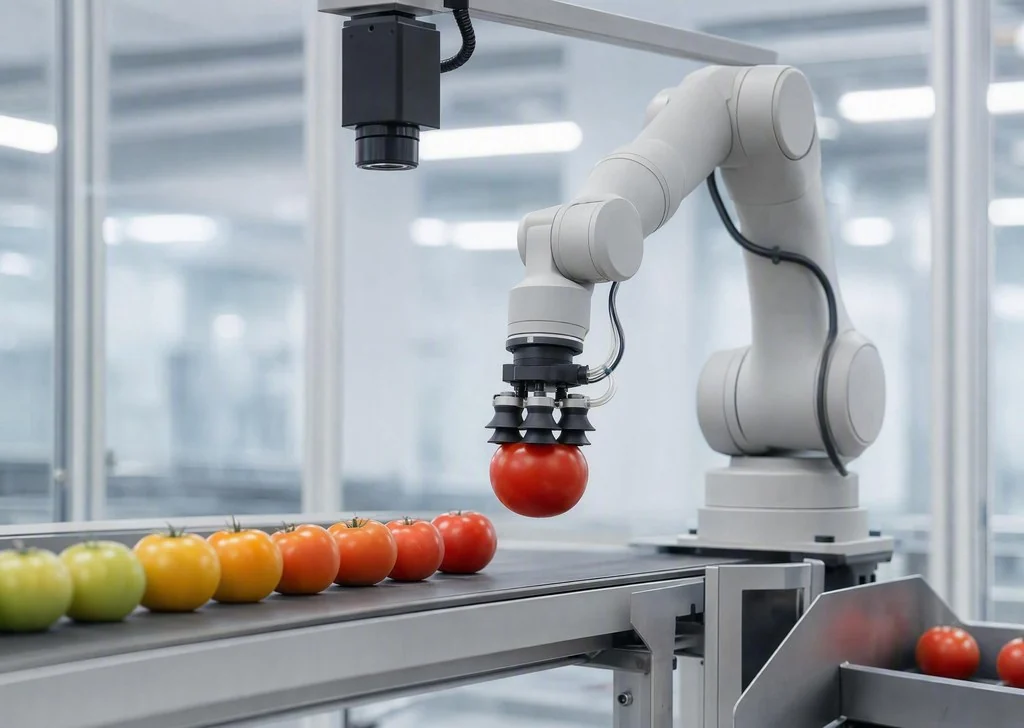
In the field of agricultural product sorting, maturity classification and precision sorting have always been crucial. DaoAI's robotic vision sorting system brings new solutions to this field with advanced technologies.
Industry Background and User Scenario: The post-harvest grading and boxing of agricultural products are important steps in the agricultural product circulation process, which are directly related to the selling price and shelf-life of agricultural products. A certain agricultural product sorting center mainly deals with the grading and boxing of various fruits and vegetables, and its business volume increases significantly during the peak season. Under the traditional sorting mode, the center relies on a large number of manual operations, which is not only inefficient but also prone to various problems. With the continuous improvement of consumers' requirements for the quality of agricultural products and the intensification of market competition, the center urgently needs a more efficient and accurate sorting solution to enhance the market competitiveness of its products.
Pain Points: Why Is It Difficult?
In terms of standard consistency, for a long time, the maturity classification of this agricultural product sorting center has relied on manual visual inspection. Although skilled workers have certain experience, their standards may fluctuate due to various factors. For example, after working for a period of time, workers will feel fatigued, and at this time, their standards for judging maturity may deviate, resulting in inconsistent classification. Statistics show that during the peak season when workers are fatigued, the situation of inconsistent classification will increase by about 30%. In addition, lighting conditions will also have an impact on manual visual inspection. Different lighting intensities and angles will cause errors in workers' judgment of the color and color distribution of fruits and vegetables. Moreover, each worker has their own subjective judgment criteria, and even the same worker may have different judgment criteria in different emotional states.
The labor problem is also a major pain point. During the peak season, the business volume of this sorting center increases sharply, and the demand for workers also rises significantly. However, due to the high labor intensity and relatively poor working environment of the sorting work, it has become very difficult to recruit workers. At the same time, even if enough workers are recruited, training new workers takes a lot of time and energy, and new workers can hardly reach the working level of skilled workers in the short term. This makes the labor pressure during the peak season very high, seriously affecting the sorting efficiency.
The problem of mechanical damage cannot be ignored either. Fruits and vegetables are delicate in texture, and they are easily damaged mechanically during the process of repeated manual sorting and improper grasping. It is estimated that the mechanical damage rate of fruits and vegetables caused by manual sorting is as high as 20%. These damages not only affect the appearance of fruits and vegetables, making them less attractive, and reducing consumers' willingness to buy, but also affect the storage resistance of fruits and vegetables, shortening their shelf-life, thus bringing economic losses to enterprises.
Technical Principles
The robotic vision sorting system deployed by DaoAI mainly consists of a vision end and a robotic arm. At the vision end, an advanced deep-learning model is used. Through learning and training on a large number of fruit and vegetable samples, this model can accurately identify information such as the color, color distribution, surface features, and shape of fruits and vegetables. It can evaluate the maturity of fruits and vegetables based on this information and classify them into different grades. Compared with the traditional manual visual inspection method, the deep-learning model has higher accuracy and consistency and is not affected by fatigue, lighting, and subjective factors.
The robotic vision guides the robotic arm to complete the tasks of positioning, flexible grasping, and sorting and boxing according to grades. After obtaining the position information of fruits and vegetables through the vision system, the robotic arm can accurately locate the position of fruits and vegetables. At the same time, in order to avoid damage to fruits and vegetables, the system uses a flexible end-effector. This actuator can accurately control the grasping force according to the characteristics of different fruits and vegetables, achieving flexible grasping. This method greatly reduces the probability of mechanical damage and improves the quality of fruits and vegetables. Compared with the traditional rigid grasping method, flexible grasping is more gentle and can better protect fruits and vegetables.
Typical Application Scenarios
- Maturity classification: Analyze the color and color distribution of fruits and vegetables through the deep-learning model to judge their maturity. The difficulty lies in the differences in the color and color distribution of different varieties and batches of fruits and vegetables, which requires the model to have strong adaptability.
- Surface defect detection: The vision system can detect defects such as flaws and spots on the surface of fruits and vegetables. The difficulty is that some subtle defects may be difficult to identify accurately, which requires high-resolution imaging equipment and advanced algorithms.
- Shape detection: Judge whether the shape of fruits and vegetables meets the standard. The difficulty is that the shapes of fruits and vegetables are diverse, and the model needs to accurately distinguish between normal and abnormal shapes.
- Size classification: Classify fruits and vegetables according to their size. The difficulty lies in accurately measuring the size of fruits and vegetables, especially for those with irregular shapes.
Implementation Case
This agricultural product sorting center is large-scale, and the daily processing volume of fruits and vegetables can reach several tons during the peak season. Before introducing the DaoAI robotic vision sorting system, the center's classification consistency was poor, and the artificial standard drift led to about 25% of the products being inaccurately classified. During the peak season, there was a shortage of labor, and a large number of temporary workers were needed. Moreover, the manual sorting efficiency was low, and only a certain amount of fruits and vegetables could be processed every day. At the same time, the mechanical damage rate of fruits and vegetables was relatively high, reaching about 20%. During the process of launching the DaoAI system, the technical team first conducted a detailed investigation and analysis of the center's business process and formulated a personalized solution. Then the installation, debugging, and training of the system were carried out. After a period of trial operation and optimization, the system was officially put into use.
Skilled workers get tired, but the model doesn't. For the first time, the standard of maturity has been firmly established.
DaoAI's Solutions and Products
DaoAI's robotic vision sorting system of WeLinkirt provides a comprehensive solution for the pain points in agricultural product sorting. The system uses the APDT few-shot rapid modeling technology, which can quickly adapt to different varieties and batches of agricultural products. Only dozens of samples are needed to complete the adaptation of new categories, without the need to collect large-scale data again for each agricultural product. This greatly shortens the deployment time of the system and improves its flexibility.
In terms of hardware, the system uses high-precision vision sensors and advanced robotic arms. The vision sensors can provide clear and accurate image information, providing reliable data support for the analysis of the deep-learning model. The robotic arm has high-precision positioning and motion control capabilities, which can accurately complete the tasks of grasping and sorting. At the same time, the application of the flexible end-effector further reduces the mechanical damage rate of fruits and vegetables and improves the product quality.
Quantitative Results
After the system was put into use, significant results were achieved. In terms of maturity classification, the classification consistency was significantly improved, the artificial standard drift was basically eliminated, and the classification accuracy increased from about 75% to over 95%. In terms of labor, the robots took over the repetitive sorting and boxing work, greatly alleviating the labor pressure during the peak season. According to statistics, the number of workers required during the peak season was reduced by about 30%, and multiple sorting positions were released. In terms of mechanical damage, the flexible grasping reduced the mechanical damage rate of fruits and vegetables to below 5%, and the appearance and storage resistance of the products were significantly improved. The overall sorting efficiency was increased by about 40%, and the quality control level was also greatly improved.
FAQ
What problems did the agricultural product sorting center have in previous classification?
Previously, the classification in the agricultural product sorting center relied on manual visual inspection. The standards of skilled workers fluctuated due to fatigue, lighting, and subjective differences. There was also a shortage of labor during the peak season, and it was difficult to recruit workers. In addition, since fruits and vegetables are delicate, manual sorting and grasping easily caused mechanical damage, with a damage rate of up to 20%, affecting the appearance and storage resistance. DaoAI can solve these problems.
How does the DaoAI robotic vision sorting system adapt to new categories?
DaoAI uses the APDT few-shot rapid modeling. For the appearance differences of different varieties and batches, only dozens of samples are needed for the system to quickly adapt to new categories. There is no need to collect large-scale data again for each agricultural product, which shortens the deployment time and improves flexibility.
What effects has the DaoAI system achieved after being put into use?
After being put into use, the consistency of maturity classification has been significantly improved, with a classification accuracy of over 95%, and artificial standard drift has been basically eliminated. The labor pressure during the peak season has been alleviated, and the number of workers has been reduced by about 30%. The mechanical damage rate of fruits and vegetables has dropped below 5%, the sorting efficiency has increased by about 40%, and the quality control level has been improved.
Full solution for this scenario: the full inspection solution for Food / agriculture · Produce Ripeness Grading & Sorting
This article was generated by AI. Customer cases are simulated scenarios based on real product capabilities and figures are illustrative; see product pages for official benchmarks.