
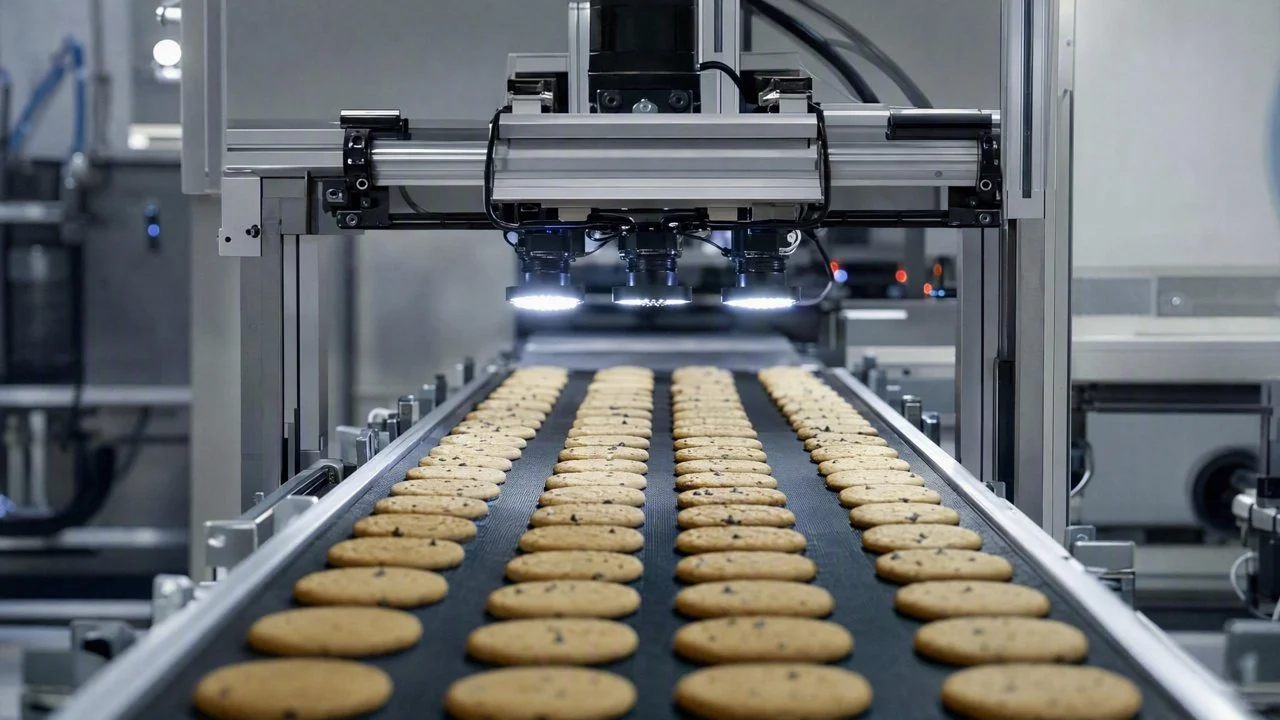
In the field of fresh food processing, efficient and accurate foreign object removal and quality grading are crucial for ensuring product quality and corporate benefits. However, traditional color sorters are difficult to meet this requirement in practical applications. The emergence of DaoAI from WeLinkirt brings a new solution to this industry dilemma.
Scene: The fresh food processing industry is an important part of the food industry chain, mainly supplying ready-to - eat vegetables and frozen fruit and vegetable raw materials to supermarkets and catering channels. These products are directly facing consumers, with extremely high requirements for quality and safety. A fresh food processing factory processes over a hundred tons of products daily. It needs to improve production efficiency and reduce losses while ensuring product quality to meet market demand. However, traditional production methods and technologies have obvious deficiencies in foreign object removal and quality grading, restricting the development of enterprises.
Pain Points: Why Is It Difficult?
Traditional photoelectric color sorters have low accuracy in foreign object recognition, with serious misdetection and missed-detection problems. They rely on fixed color thresholds for judgment and can hardly accurately identify foreign objects that are similar in color to the raw materials, such as dark-colored insects, translucent plastics, and stones of the same color. According to statistics, the detection rate of traditional color sorters for such similar-colored foreign objects is only about 88%. A large number of foreign objects will pass through with the qualified raw materials into subsequent processing steps, seriously affecting product quality and food safety.
To avoid missed detection, traditional color sorters usually tighten the color thresholds, which leads to a large number of qualified raw materials being wrongly removed. Normal fruits and vegetables with natural spots or slight color differences are often regarded as foreign objects and removed, resulting in high loss of good products. The mis-removal rate reaches 4-6%. With a processing capacity of 6.5 tons per hour in the factory, it means that hundreds of kilograms of qualified raw materials are wasted every hour, which undoubtedly increases the production cost of the enterprise.
Another problem with traditional color sorters is the trade-off between the foreign object detection rate and the mis-removal rate. To increase the detection rate, the threshold needs to be tightened, which increases the mis-removal rate; while reducing the mis-removal rate will lead to a decrease in the detection rate. This contradictory relationship makes it difficult for traditional color sorters to effectively control the loss of good products while ensuring product quality, failing to meet the enterprise's demand for efficient production.
Technical Principle
The ACI (AI-AOI) visual inspection system deployed by DaoAI from WeLinkirt uses a deep-learning model, which is fundamentally different from the traditional rule-based color sorting method. Traditional color sorters only judge based on color thresholds, while the deep-learning model comprehensively considers multiple factors such as texture, shape, edge, and context. For example, for a dark-colored area, a traditional color sorter may directly judge it as a foreign object, but the deep-learning model can analyze its texture, shape and other features to determine whether it is a moldy foreign object or a natural dark-colored spot of the variety.
The system uses high-speed line-scan imaging technology to quickly and accurately capture the image information of raw materials. The imaging device is combined with the deep-learning defect/foreign object model to analyze and process the images in real-time. The model is trained with a large amount of data and can learn the characteristic differences between different types of foreign objects and raw materials, thus achieving accurate identification and judgment. At the same time, the system is connected to the original air-blowing removal mechanism. When a foreign object is detected, it can timely control the air-blowing mechanism to remove the foreign object.
Typical Application Scenarios
- Insect detection: Insects usually have similar colors to the raw materials and irregular shapes, making detection difficult. Traditional color sorters can hardly find insects hidden in the raw materials. The ACI system can analyze the unique texture and shape features of insects through the deep-learning model and accurately identify them. For example, for dark-colored insects, the model can distinguish them from the raw materials according to their slender shapes and special textures, thus achieving precise detection.
- Plastic debris detection: Translucent plastic debris is similar in color to the raw materials, and traditional color sorters tend to let it pass as qualified raw materials. The ACI system uses high-speed line-scan imaging technology to obtain clear images of plastic debris. The deep-learning model can accurately judge whether it is a foreign object by analyzing its edge and shape features. Even if the color of the plastic debris is almost the same as that of the raw materials, the model can identify it through its irregular edges and unique shapes.
- Stone detection: Stones of the same color as the raw materials are difficult to identify for traditional color sorters. The deep-learning model of the ACI system can comprehensively consider the performance of factors such as the density and hardness of stones in the image and their context relationship with the surrounding raw materials to accurately detect stones. For example, the texture and shape of stones in the image are significantly different from those of fruits and vegetables, and the model can make judgments based on these features.
- Fruit and vegetable damage detection: Traditional color sorters are prone to misjudge fruits and vegetables with natural spots or slight color differences as foreign objects. The deep-learning model of the ACI system can distinguish these natural differences from real damage. The model can judge whether the spots and color differences belong to the characteristics of the variety itself by learning the normal characteristics of different varieties of fruits and vegetables, thus avoiding mis-removal of qualified raw materials.
Implementation Case
This fresh food processing factory is large-scale and supplies a large amount of ready-to - eat vegetables and frozen fruit and vegetable raw materials to supermarkets and catering channels every day. Before introducing the solution of DaoAI from WeLinkirt, the factory used traditional photoelectric color sorters and faced problems such as low foreign object detection rate, high mis-removal rate, and large loss of good products. During the implementation process, the WeLinkirt team evaluated and transformed the factory's original production line, deployed the ACI visual inspection system, and debugged and optimized the system to ensure its smooth connection with the original air-blowing removal mechanism.
By introducing the solution of DaoAI from WeLinkirt, the fresh food processing factory has realized the integration of foreign object removal and quality grading, significantly improving production line efficiency and product quality.
WeLinkirt's Solution and Products
WeLinkirt's DaoAI solution is mainly composed of ACI high-speed line-scan imaging and a deep-learning defect/foreign object model. The high-speed line-scan imaging technology can quickly and accurately obtain the image information of raw materials, providing data support for the deep-learning model. The deep-learning model can analyze and process the images to achieve accurate identification and judgment of foreign objects and raw materials. At the same time, the solution also has a quality grading model that can synchronously output information such as the size, color, and damage level of raw materials, realizing one-time completion of foreign object removal and grading.
In addition, the APDT few-shot learning ability of DaoAI is a major feature. For sporadic and rare types of foreign objects, the system can quickly adapt to new batches of raw materials with only dozens of samples, without the need to re-label a large amount of data. The labeling volume is reduced by about 80%. The judgment results are archived, supporting tracing back of foreign object types and removal details by batch, which is convenient for enterprises to monitor and manage the production process.
Quantitative Results
After the system was put into operation, the foreign object detection rate of the fresh food processing factory increased from about 88% of the original color sorter to over 97%, and the mis-removal rate decreased from 4-6% to below 1%. This means that hundreds of kilograms of qualified raw materials are saved every hour, greatly reducing the enterprise's production cost. The production line runs stably at a throughput of 6.5 tons per hour. Quality grading and foreign object removal are combined into a single work station, reducing manual re-inspection positions, and the overall yield of good products has significantly increased. From these quantitative indicators, it can be seen that WeLinkirt's DaoAI solution has brought significant economic and social benefits to the enterprise.
FAQ
What problems do traditional color sorters have in fresh food processing?
Traditional photoelectric color sorters rely on fixed color thresholds and have difficulty identifying foreign objects with similar colors, such as dark-colored insects and translucent plastics. To avoid missed detection, they tighten the thresholds, resulting in a large number of qualified raw materials with natural spots or slight color differences being wrongly removed. The loss of good products is high, and there is a trade-off between the detection rate and the mis-removal rate, making it difficult to balance both.
What are the advantages of DaoAI's solution?
DaoAI deploys an ACI system. The deep-learning model comprehensively considers multiple factors such as texture and shape to distinguish foreign objects from the natural differences of raw materials. Its APDT few-shot learning ability can quickly adapt to new raw materials. The foreign object detection rate exceeds 97%, and the mis-removal rate is below 1%, which can significantly improve the overall yield of good products and reduce costs.
How does DaoAI's Foreign Object Removal and Quality Grading solution improve production line efficiency?
The solution combines high-speed line-scan imaging and a deep-learning model and is connected to the air-blowing removal mechanism. Quality grading and foreign object removal are completed at one time. It reduces manual re-inspection positions, and the production line runs stably at a throughput of 6.5 tons per hour, improving the overall production efficiency.
This article was generated by AI. Customer cases are simulated scenarios based on real product capabilities and figures are illustrative; see product pages for official benchmarks.