
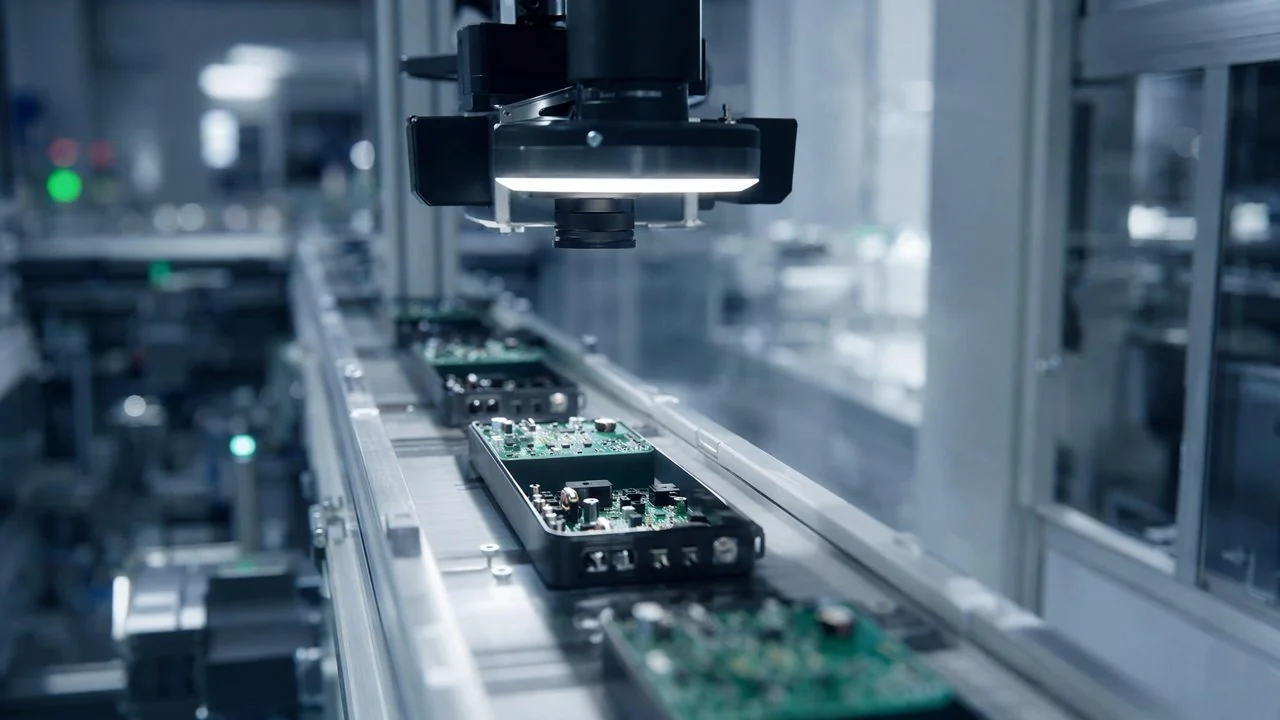
The assembly inspection in the consumer electronics industry faces many challenges. DaoAI brings a new solution to this field with transfer learning technology.
Scene: In the consumer electronics industry, the production rhythm of multi-variety and small-batch has become the norm. Many consumer electronics factories assemble finished products and modules for multiple well-known brands. Due to the rapid change of market demand and the acceleration of product replacement, the life cycle of a single-model product is often less than three months. This means that the production line needs to undergo dozens of model changes a year. In the assembly process, there are dozens of elements involved, such as screws, buckles, cables, shielding covers, foam, and labels. Any missing or misassembled element may magnify the risk of batch returns at the client end, bringing huge economic losses to enterprises.
Pain Points: Why is it Difficult?
Firstly, in terms of sample acquisition, there are almost no real defect samples for new products before mass production ramps up. Traditional supervised visual inspection methods require hundreds of defect images for effective model training. However, in actual production, the time for new products to go online is tight, and there is simply not enough time to collect sufficient samples. This leads to insufficient model training and difficulty in accurately identifying defects. Secondly, the diversity of defect types is also a problem. There are many different types of defects, such as a missing screw, an un-seated buckle, a reversed cable plug, a misaligned shielding cover, and a mis-pasted foam. These need to be uniformly recognized and classified in a single system. The large differences in features among different types of defects increase the difficulty of detection. Finally, the production rhythm and the limitations of manual inspection are also key factors. The production rhythm of the production line is compact, and manual visual inspection needs to check a large number of products in a short time. Facing numerous assembly elements, the situations of missed detection and misjudgment have long existed. Moreover, every time a new product is launched, quality inspectors need to be retrained, which not only increases labor costs but also makes it difficult to ensure the accuracy and consistency of detection.
Further analyzing the root causes, the rapid development of the consumer electronics industry has made product replacement more frequent. Enterprises need to push new products to the market as soon as possible to seize market share, which has compressed the sample collection time. At the same time, the continuous innovation and complication of product design have increased the number of assembly elements and the variety of defect types. And the manual inspection method itself is subjective and prone to fatigue, which cannot meet the high-intensity and high-precision detection requirements.
Technical Principle
DaoAI uses transfer learning as the core technology. The principle of transfer learning is to use the previously accumulated assembly inspection models of the same platform and the same process family as the base. These historical models have learned some general features and rules through a large amount of data training. When there is a new product to be inspected, there is no need to train the model from scratch. Only a small number of samples of the new model need to be supplemented to fine-tune the base model so that it can adapt to the new product. Combined with the ACI (AI-AOI) general appearance inspection framework, the system can complete the work of positioning, comparison, and classification in a single process. In the positioning stage, the system will quickly and accurately find the positions of each assembly element in the product. In the comparison stage, the actual assembly situation is compared with the standard template. In the classification stage, different types of defects are classified according to the comparison results.
Compared with traditional methods, traditional supervised visual inspection methods require a large number of defect samples for training, and almost have to start from scratch when facing new products. This not only consumes a lot of time and manpower, but also the accuracy and generalization ability of the model are poor when the samples are insufficient. However, DaoAI's transfer learning method uses the knowledge of historical models, which greatly reduces the number of labeled samples required for new products by about 40%, while ensuring that the detection accuracy does not decrease. This is because the historical models have learned some general features, which have certain similarities among different products. By fine-tuning, they can quickly adapt to new products.
Typical Application Scenarios
- Screw assembly inspection: Screws are common assembly elements in consumer electronic products. During inspection, the system first locates the position of the screws and then compares the number and tightening degree of the screws. The difficulty lies in the fact that the screws are small in size and may be affected by the surrounding ambient light, resulting in inaccurate image recognition. Moreover, some screws may be blocked by other components, increasing the difficulty of detection.
- Buckle assembly inspection: Whether the buckle is assembled in place directly affects the structural stability of the product. The system will judge whether there is an un-seated situation by comparing the shape and position of the buckle. The difficulty is that the shape and position of the buckle change more complexly, and the buckle designs of different products are also different, which requires the system to have strong adaptability and recognition ability.
- Cable plug-in inspection: A reversed cable plug is one of the common assembly defects. The system will detect it by recognizing the shape of the cable interface and the direction of the circuit. The difficulty lies in the fact that the circuit of the cable is more complex, and there may be bending and folding during the assembly process, increasing the difficulty of recognition.
- Shielding cover installation inspection: The misalignment of the shielding cover will affect the electromagnetic shielding performance of the product. The system will judge whether it is installed correctly by positioning the edge and position of the shielding cover. The difficulty is that the material and surface texture of the shielding cover may affect the image collection and recognition, and there may be slight displacement during the assembly process.
- Foam pasting inspection: A mis-pasted foam will affect the sealing performance of the product. The system will detect it by comparing the position and shape of the foam. The difficulty is that the foam material is soft and easy to deform, and there may be bubbles during the pasting process, affecting the accuracy of detection.
Implementation Case
A medium-sized consumer electronics factory mainly assembles finished products and modules for multiple well-known brands. The production line scale is relatively large, and it needs to undergo dozens of model changes a year. Before introducing the DaoAI solution, the factory relied on manual visual inspection for assembly defect detection. The missed-detection rate was as high as 15%, and the misjudgment rate reached 10%. It took 2-3 weeks for new products to reach the detection standard from introduction, and due to the need to frequently train quality inspectors, the labor cost was relatively high. During the implementation process of the DaoAI solution, the historical models were first sorted out and optimized, and then a small number of samples were supplemented according to the characteristics of the new products for fine-tuning. After a period of debugging and optimization, the system was officially launched. After the launch, the cycle from the introduction of new products to reaching the detection standard was significantly compressed, shortening to less than one week. The missed-detection rate dropped below 8%, and the misjudgment rate dropped below 3%.
Model change no longer starts from scratch. Historical models become the starting point for new products, not a burden.
WeLinkirt's Solution and Product
WeLinkirt's solution takes transfer learning as the core and combines the ACI general appearance inspection framework to form a complete assembly defect detection system. The system can uniformly cover 28 types of assembly defects, including missing parts, misassembly, reverse plugging, misalignment, and mis-pasting. The system is connected to the production line MES, and the detected defects can be automatically archived according to the model and category. These data can feed back to process improvement and provide strong support for the enterprise's production management. The product is characterized by simple operation, high detection efficiency, and strong accuracy, and can adapt to the multi-variety and small-batch production model of the consumer electronics industry.
Quantitative Results: By using the DaoAI solution, the number of labeled samples required for new products is reduced by about 40%, which greatly saves the time and cost of sample collection and labeling. The detection rate of missing parts and misassembly is stable at over 92%, and the escape rate of key safety parts is close to zero, effectively reducing the quality risk of products. At the same time, the connection with the production line MES system enables defect data to be promptly fed back to the production department, which helps continuous process improvement, improves production efficiency, and the assembly consistency of products.
FAQ
What problems does the consumer electronics assembly process face?
In the consumer electronics industry, there are multiple varieties and small batches, and the production line changes models frequently. There are many assembly elements. Missing or misassembled parts can lead to batch returns. In the past, manual visual inspection was prone to missed detection and misjudgment, and new products required retraining of quality inspectors. In addition, there are problems of sample scarcity and diverse defect types. There are few defect samples before mass production of new products, making it difficult for traditional methods to train. Multiple types of defects need to be uniformly recognized and classified.
How does DaoAI solve the consumer electronics assembly problems?
DaoAI takes transfer learning as the core, re-uses historical models. New products only need to supplement a small number of samples for fine-tuning and going online. Combined with the ACI framework, it can uniformly cover 28 types of assembly defects, complete positioning, comparison, and classification in a single process, and the detection rate of missing and misassembled parts exceeds 92%.
What are the effects after the implementation of the DaoAI solution?
After implementation, the cycle for new products to reach the detection standard is compressed, from the original 2-3 weeks to less than one week. The work of quality inspectors has changed from piece-by-piece visual inspection to review and abnormal handling. High-cost defects are stably intercepted, the risk of batch returns at the client end is reduced, and the production line maintains assembly consistency during model changes.
Full solution for this scenario: Consumer / general industry solutions · Assembly Missing-Part & Misassembly Detection
This article was generated by AI. Customer cases are simulated scenarios based on real product capabilities and figures are illustrative; see product pages for official benchmarks.