
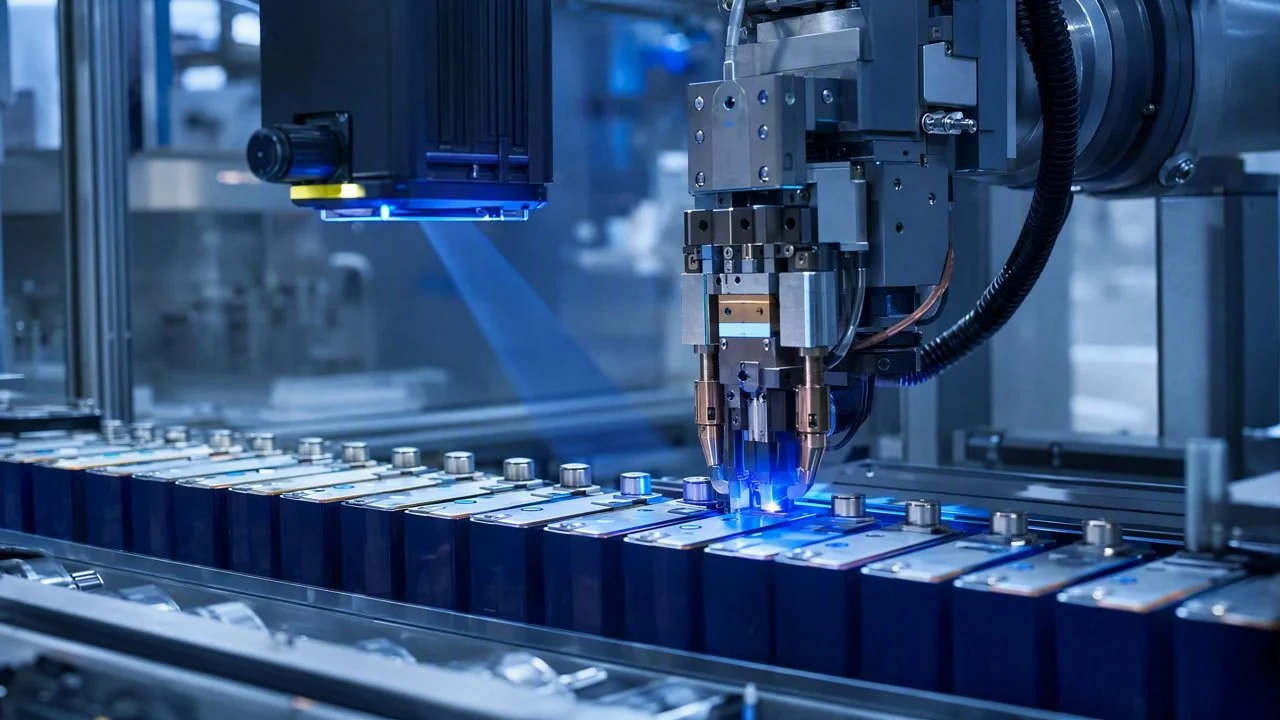
Cylindrical battery cells are an important part of new energy batteries, and their quality directly affects the performance and safety of the batteries. As a key component of cylindrical battery cells, the appearance defect detection of nickel-plated steel shells is crucial. DaoAI provides an efficient and accurate solution for the appearance inspection of nickel-plated steel shells of cylindrical battery cells with its advanced multi-light source computational imaging technology.
In the current booming new energy battery industry, cylindrical battery cells are widely used in electric vehicles, power tools, energy storage equipment and other fields due to their high energy density and compact structure. The nickel-plated steel shell of the cylindrical battery cell is an important component for protecting the internal structure of the cell and preventing battery leakage. Its appearance quality is directly related to the performance and safety of the battery. Therefore, a comprehensive and accurate appearance inspection of the nickel-plated steel shell of the cylindrical battery cell is a key link to ensure the battery quality. However, due to the high reflectivity and strong curvature of the nickel-plated steel shell surface, traditional visual inspection methods face many challenges in practical applications.
Pain Points: Why Is It Difficult?
From a quantitative perspective, the traditional single-light source visual solution has serious limitations in the appearance inspection of the nickel-plated steel shell of the cylindrical battery cell. In terms of inspection accuracy, its judgment accuracy is often lower than 80%, which means that a large number of defects may be missed or misjudged. In terms of defect detection rate, the defect detection rate of the traditional method is less than 90%. Especially in the high-light area of the shell, the defect signal is easily submerged by glare, resulting in frequent missed detections. In addition, in terms of inspection efficiency, the traditional method requires manual re-inspection, which is not only inefficient but also difficult to ensure the consistency of the inspection results.
So, why is the appearance inspection of the nickel-plated steel shell of the cylindrical battery cell so difficult? The root cause lies in the surface characteristics of the nickel-plated steel shell. On the one hand, the nickel-plated steel shell surface has strong mirror reflection. When light shines on the shell surface, it will produce strong reflected light, making the defect signal masked. On the other hand, the curvature of the cylindrical battery cell makes the illumination angle change continuously with the position, which further increases the difficulty of detecting the defect signal. Under different illumination angles, the manifestation of the defect may change, resulting in the traditional single-light source visual solution being unable to accurately identify the defect. In addition, due to the influence of subjective factors, manual re-inspection is difficult to ensure the consistency of the inspection results, and it is easy to miss and misjudge.
Technical Principle
The multi-light source computational imaging solution adopted by DaoAI is an innovative detection technology based on advanced algorithms and hardware mechanisms. This solution collects images through controllable illumination from multiple directions and angles, and uses the response differences of defects under different illumination to separate the surface defect signal from the mirror-reflection background. Specifically, the multi-light source computational imaging system will collect multiple images of the nickel-plated steel shell of the cylindrical battery cell under different illumination conditions, and then analyze and process these images through algorithms to extract the feature information of the defects.
Compared with the traditional single-light source visual solution, the multi-light source computational imaging solution has obvious advantages. The traditional solution can only detect under a single illumination condition, and cannot effectively separate the defect signal from the mirror reflection, resulting in low detection accuracy and defect detection rate. The multi-light source computational imaging solution can comprehensively capture the feature information of the defects through illumination from multiple directions and angles, improving the accuracy and reliability of the detection. In addition, this solution also cooperates with the ACI (AI-AOI) model to classify defects such as scratches, pits, stains, etc., and uses APDT positive sample learning to adapt to the surface states of different shell batches, achieving full-circumferential coverage detection of the curved surface.
Typical Application Scenarios
- Scratch detection: Scratches are one of the common appearance defects of the nickel-plated steel shell of the cylindrical battery cell. When detecting scratches, the difficulty lies in that the width and depth of the scratches may be small, and the reflection characteristics of the scratches will change under different illumination conditions. The multi-light source computational imaging solution can clearly capture the edges and contours of the scratches through illumination from multiple angles, and use the ACI model to accurately classify and identify the scratches.
- Pit detection: Pits are usually caused by collisions or extrusions during the production process. The difficulty in detecting pits lies in their irregular shapes and sizes, and they are easily masked by glare in the high-light area. The multi-light source computational imaging solution adjusts the illumination angle to make the pits present different features in different images, thereby separating the pit signal from the reflection background. It also uses APDT positive sample learning to adapt to the reflection states of different batches of shells, improving the detection accuracy of pits.
- Stain detection: Stains may affect the heat dissipation and insulation performance of the battery. The colors and textures of stains vary, and the contrast and clarity of stains will also change under different illumination. The multi-light source computational imaging solution collects images from multiple angles and uses algorithms to analyze the color, texture and other features of the stains to accurately identify the location and size of the stains.
- Indentation detection: Indentations are usually produced by molds or external forces during the production process. The depth and width of the indentations may be small, and on the curved shell, the features of the indentations are easily affected by the curvature and reflection. The multi-light source computational imaging solution enhances the contrast of the indentations through illumination from multiple directions and uses the ACI model to classify and detect the indentations.
Implementation Case
A large-scale battery production enterprise has multiple cylindrical battery cell production lines, with a daily output of tens of thousands of pieces. The enterprise previously used the traditional single-light source visual solution for the appearance inspection of the nickel-plated steel shell of the cylindrical battery cell and encountered many problems in actual production. The inspection accuracy was low, and missed detections occurred frequently. Especially in the high-light area and on both sides of the curved surface of the shell, the missed-detection rate was as high as over 20%. Manual re-inspection was not only inefficient but also difficult to ensure the consistency of the inspection results, resulting in a large number of qualified products being mis-discarded, causing unnecessary losses.
It's not about making the light brighter, but making the defects visible in the light.
To solve these problems, the enterprise introduced DaoAI's multi-light source computational imaging solution. During the implementation process, DaoAI's technical team conducted a comprehensive evaluation and debugging of the production line to ensure that the solution could match the enterprise's production process. After a period of trial operation and optimization, the solution was officially launched. After the launch, the inspection effect was significantly improved. The judgment accuracy increased from less than 80% to over 98%, and the defect detection rate increased from less than 90% to over 99%. The missed-detection rate on both sides of the curved surface significantly decreased, from over 20% to less than 1%. Misjudgments were effectively controlled, and the mis-discard rate of qualified products decreased significantly. The appearance inspection changed from manual-dependent to stable online automatic judgment.
DaoAI's Solution and Products
DaoAI's multi-light source computational imaging solution is mainly composed of a multi-light source imaging system, an ACI model and an APDT positive sample learning module. The multi-light source imaging system collects images through controllable illumination from multiple directions and angles, providing rich information for subsequent defect detection. The ACI model analyzes and processes the collected images to classify and identify surface defects such as scratches, pits, stains, indentations, etc. The APDT positive sample learning module can be adaptively adjusted according to the surface states of different shell batches, improving the accuracy and reliability of the detection.
This solution has the ability to detect the entire curved surface in a full-circumferential manner, and can comprehensively detect the entire surface of the nickel-plated steel shell of the cylindrical battery cell. At the same time, the solution is also efficient and stable, and can achieve rapid and accurate defect detection without sacrificing the production rhythm. In addition, DaoAI also provides professional technical support and after-sales service to ensure that customers can use the solution smoothly.
Quantitative Results
By introducing DaoAI's multi-light source computational imaging solution, significant quantitative results have been achieved in the appearance inspection of the nickel-plated steel shell of the cylindrical battery cell. The judgment accuracy has reached over 98%, an increase of over 20% compared with the traditional solution, greatly reducing the misjudgment situation. The defect detection rate has reached over 99%, an increase of over 10% compared with the traditional solution, effectively reducing the missed-detection rate. At the same time, misjudgments have been effectively controlled, and the mis-discard rate of qualified products has decreased by over 90%, saving a large amount of production costs for the enterprise. The appearance inspection has changed from manual-dependent to stable online automatic judgment, improving the inspection efficiency and consistency, and providing a strong guarantee for the enterprise's production quality.
FAQ
What are the difficulties in the appearance inspection of the nickel-plated steel shell of the cylindrical battery cell?
The surface of the nickel-plated steel shell of the cylindrical battery cell has strong mirror reflection, and the curvature of the cylinder makes the illumination angle change continuously with the position. The defect signal is often submerged by glare. The traditional single-light source visual solution is prone to failure in the high-light area, and missed detections are concentrated on both sides of the curved surface. Moreover, manual re-inspection is affected by subjective factors, and it is difficult to ensure the consistency of the inspection results.
How does DaoAI solve the inspection problem of the nickel-plated steel shell of the cylindrical battery cell?
DaoAI uses a multi-light source computational imaging solution. It collects images through controllable illumination from multiple directions and angles, and uses the response differences of defects under different illumination to separate the defect signal. It cooperates with the ACI model to classify defects, and uses APDT positive sample learning to adapt to the shell state, achieving full-circumferential coverage detection.
What are the effects after the DaoAI solution is launched?
After the solution is launched, the judgment accuracy reaches over 98%, and the defect detection rate reaches over 99%. The missed detections on both sides of the curved surface are significantly reduced. Misjudgments are effectively controlled, the mis-discard rate of qualified products decreases significantly, and the appearance inspection changes from manual-dependent to stable online automatic judgment.
Full solution for this scenario: the full inspection solution for New-energy batteries · Cylindrical Cell Reflective-Shell Inspection
This article was generated by AI. Customer cases are simulated scenarios based on real product capabilities and figures are illustrative; see product pages for official benchmarks.