
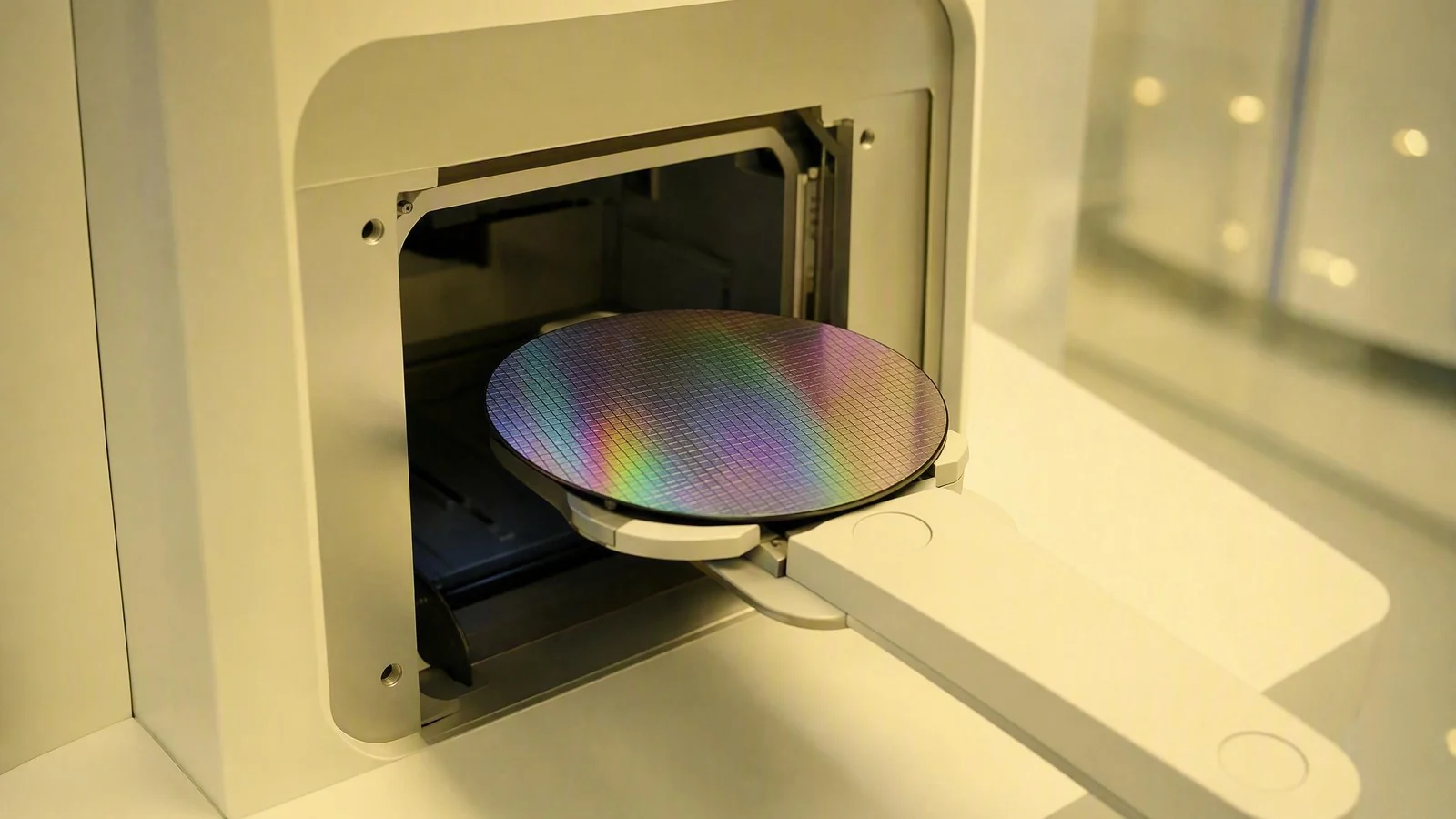
In the semiconductor chip manufacturing process, the inspection of lithography pattern defects is crucial. WeLinkirt (DaoAI) provides an efficient and accurate inspection solution for semiconductor manufacturers with advanced AI vision technology.
User Scenario: In the lithography process of a leading semiconductor chip manufacturer, it is necessary to detect defects in the lithography patterns on the chips. The products are high-precision semiconductor chips, and the inspection objects are various subtle defects in the lithography patterns, such as line breaks, short-circuits, and foreign object attachments. These defects can seriously affect the performance and yield of the chips, so strict inspection is required.
Pain Points: Traditional inspection methods face many quantitative dilemmas. Firstly, the false alarm rate is relatively high, about 30%. A large number of false defects are misjudged as real defects, resulting in a significant increase in the subsequent re-inspection workload and wasting a lot of manpower and time. Secondly, the missed detection problem is also prominent, with a missed detection rate of 1.5%. Some tiny defects may be missed, affecting the final quality of the chips. In addition, the model change time is long. It takes about 30 minutes to change the product model each time, seriously affecting the production efficiency of the production line. Meanwhile, due to the lack of effective semantic understanding, it is difficult to accurately filter false defects, further aggravating the problems of false alarms and missed detections.
Technical Principles
WeLinkirt (DaoAI) uses advanced visual foundation models and semantic understanding technology to solve the above problems. The visual foundation model has a powerful feature recognition ability and can deeply learn and analyze various features of lithography patterns. By learning from a large number of positive samples, the model can accurately identify the normal features of lithography patterns, providing an accurate reference for defect detection. Semantic understanding technology can perform semantic analysis on the detected defects to determine whether they are real defects. For example, for some false defects caused by factors such as illumination and noise, semantic understanding technology can filter them out by analyzing the features and context information of the defects, thereby reducing the false alarm rate. In addition, WeLinkirt (DaoAI) also uses self-developed 3D cameras and three-dimensional topography reconstruction technology to obtain the three-dimensional information of lithography patterns, detect hidden defects, and improve the accuracy of detection.
- The feature recognition ability of the visual foundation model enables the model to quickly learn the features of lithography patterns and improve the detection efficiency.
- Semantic understanding technology accurately filters false defects through semantic analysis of defects and reduces the false alarm rate.
- The self-developed 3D cameras and three-dimensional topography reconstruction technology provide more comprehensive graphic information, which helps to detect hidden defects.
WeLinkirt (DaoAI) Solution and Product Introduction
WeLinkirt (DaoAI) provides the DaoAI ACI (AI-AOI) software system and the DaoAI 2D / 3D ACI equipment to solve the problem of lithography pattern defect detection. The DaoAI ACI OS has a powerful feature recognition ability and can achieve zero-code automatic programming within 5 minutes for a good product. Through APDT positive sample / few-shot learning (only 1 - 20 good products are needed), it can quickly establish an accurate detection model. At the same time, the system also has a semantic false alarm filtering function, which can effectively reduce the false alarm rate. The DaoAI 2D / 3D ACI equipment uses self-developed 3D cameras and three-dimensional topography reconstruction technology, which can detect hidden solder joints, coplanarity, and micron-level topography, improving the accuracy and comprehensiveness of detection. In the implementation process, WeLinkirt (DaoAI) can provide various deployment methods such as SDK / API / Docker according to the specific needs of customers, supporting 100% local privatization to ensure that the data does not leave the factory.
WeLinkirt (DaoAI)'s solution provides efficient and accurate guarantee for semiconductor lithography pattern defect detection.
Quantitative Results: By adopting WeLinkirt (DaoAI)'s solution, the semiconductor manufacturer has achieved remarkable results in the detection of lithography pattern defects. The detection rate has increased from the original 98.5% to 99.2%, and the missed detection rate has decreased from 1.5% to 0.8%. The false alarm rate has been reduced by 65%, from 30% to 10.5%. The model change time has been shortened from the original 30 minutes to 5 minutes, greatly improving the production efficiency of the production line.
FAQ
What pain points can Microchain DaoAI's semiconductor lithography pattern defect detection solution solve?
Microchain DaoAI's solution can solve problems such as high false-alarm rate, prominent missed detection, long model-changing time and difficulty in filtering false defects in traditional detection methods, reducing false alarms and missed detections, shortening model-changing time, and improving production line efficiency and chip quality.
What technologies does Microchain DaoAI use for lithography pattern defect detection?
Microchain DaoAI uses advanced visual foundation models, semantic understanding technology, self-developed 3D cameras and 3D morphology reconstruction technology. It can deeply analyze features, filter false defects, obtain 3D information, and improve detection accuracy.
What products does Microchain DaoAI provide to solve the problem of lithography pattern defect detection?
Microchain DaoAI provides the DaoAI ACI OS and DaoAI 2D / 3D ACI equipment. The software can quickly build models and reduce false alarms, the equipment is more accurate and comprehensive in detection, and it also supports multiple deployment methods.
This article was generated by AI. Customer cases are simulated scenarios based on real product capabilities and figures are illustrative; see product pages for official benchmarks.