
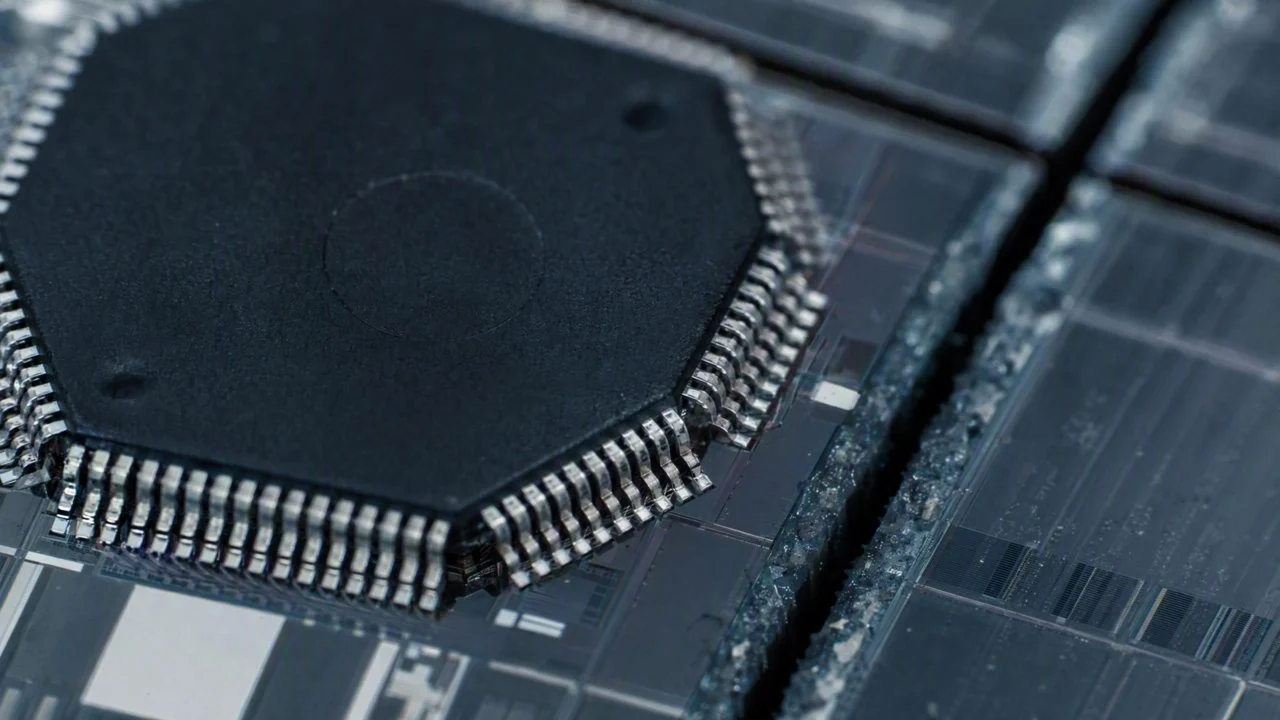
As the core component of modern technology, the quality of semiconductor chips directly affects the performance of various electronic devices. WeLinkirt has achieved remarkable results in the field of semiconductor chip pin and dicing defect inspection with its advanced AI vision technology.
Scenario: In the production process of semiconductor chips, the quality control of chips is of utmost importance. The packaging production line of a leading semiconductor chip manufacturer is mainly dedicated to the production of various high-performance chips. In the packaging process, the inspection of the coplanarity of chip pins and the chipping situation after dicing are key steps. The coplanarity of chip pins directly affects the connection stability between the chip and the circuit board. If the coplanarity is poor, it may lead to loose connections and affect the normal operation of the chip. And dicing chipping may cause cracks on the chip edge, which in turn affects the electrical performance and service life of the chip. Therefore, accurately detecting these defects is crucial for ensuring chip quality.
Pain points: Why is it difficult?
Traditional inspection methods mainly rely on manual visual inspection and simple mechanical measurement, which have many quantitative difficulties. In terms of efficiency, manual visual inspection is extremely inefficient. A skilled inspector can only inspect a limited number of chips in a day, which is far from meeting the needs of large-scale production. Moreover, the labor cost is high. As the labor cost continues to rise, the inspection cost of the enterprise is also increasing. In terms of accuracy, manual visual inspection is prone to missed detections and false alarms. The missed detection rate is about 3%, which means that a certain proportion of defective chips may flow into subsequent processes, posing a hidden danger to product quality. The false alarm rate is as high as 15%, which will lead to a large number of normal chips being misjudged as defective chips, increasing the production cost of the enterprise.
At the same time, the manufacturer produces a wide variety of chips, and small-batch production is relatively common. When changing the product type, the traditional method requires re-programming and debugging, and the downtime is as long as 30 minutes. This is because the pins and dicing conditions of different chips are different, and the inspection equipment needs to be set specifically. The long-time downtime seriously affects the production capacity, greatly reducing the production efficiency of the enterprise. The root cause is that the traditional method lacks flexibility and intelligence and cannot quickly adapt to the inspection needs of different chips.
Technical principle
To solve these problems, WeLinkirt adopts advanced AI algorithms and self-developed 3D camera technology. In terms of imaging, the self-developed 3D camera plays a key role. It can capture the three-dimensional topography information of the chip pins and dicing areas. Compared with traditional 2D imaging, 3D imaging provides more abundant and accurate information. These high-precision data provide a solid foundation for subsequent inspections, enabling the algorithm to have a more comprehensive understanding of the chip's status.
In terms of algorithms, WeLinkirt uses the feature recognition ability of the visual basic model to conduct in-depth learning and analysis of the normal and defective features of the chips. Through APDT positive sample/few-sample learning, only 10 good samples are needed for effective model training. This technological breakthrough greatly reduces the sample requirements and shortens the training time. Traditional methods often require a large number of samples for training, and the training time is long and inefficient. At the same time, the semantic false-alarm filtering algorithm can screen the detection results and remove false alarms caused by factors such as background interference. The combination of these technologies makes the detection more accurate and efficient, and improves the generalization ability and practicality of the model.
Typical application scenarios
- Pin coplanarity inspection: The coplanarity of chip pins directly affects the connection stability between the chip and the circuit board. During inspection, the self-developed 3D camera captures the three-dimensional topography information of the pins, and the visual basic model analyzes features such as the height and angle of the pins to determine whether they meet the coplanarity requirements. The difficulty lies in the tiny size of the pins, which requires extremely high precision of the camera and accuracy of the algorithm.
- Dicing chipping inspection: Chipping may occur during the dicing process, affecting the electrical performance of the chip. The 3D camera is used to obtain the three-dimensional data of the dicing area, and the algorithm identifies the location and size of the chipping. The difficulty lies in the different shapes and degrees of chipping, which requires the algorithm to have strong adaptability.
- Hidden solder joint inspection: The quality of hidden solder joints inside the chip is difficult to detect. The self-developed 3D camera of the DaoAI 2D/3D ACI (AI-AOI) device can perform three-dimensional topography reconstruction to accurately detect the connection status of hidden solder joints. The difficulty lies in the concealed position of the hidden solder joints, which requires the camera to be able to penetrate a certain thickness of material for imaging.
- Coplanarity inspection: In addition to the coplanarity of the pins, the coplanarity of other parts of the chip also needs to be inspected. The 3D camera provides comprehensive three-dimensional information, and the algorithm accurately evaluates the coplanarity. The difficulty lies in that the coplanarity requirements of different parts may be different, and the algorithm needs to be able to judge according to specific requirements.
- Micron-scale topography inspection: Micron-scale topography defects on the chip surface may affect its performance. The high-precision imaging of the 3D camera can capture these tiny defects, and the algorithm identifies and classifies them. The difficulty lies in the extremely subtle micron-scale defects, which requires the camera to have extremely high resolution and the algorithm to have strong feature extraction ability.
Implementation case
A leading semiconductor chip manufacturer, with a large scale and multiple advanced packaging production lines. Before introducing the WeLinkirt solution, the manufacturer had been using traditional inspection methods and faced problems such as low efficiency, high false-alarm rate, and long product-change time. In order to improve the inspection quality and production efficiency, the manufacturer decided to cooperate with WeLinkirt. The WeLinkirt team first conducted in-depth research and analysis on the manufacturer's production process to determine the specific inspection requirements. Then, the DaoAI ACI OS and the DaoAI 2D/3D ACI device were installed on the packaging production line, and model training and parameter settings were carried out. After a period of debugging and optimization, the system was officially put into operation.
WeLinkirt's AI vision solution enables semiconductor chip inspection to bid farewell to complexity and inefficiency and ushers in a new experience of high efficiency and accuracy.
WeLinkirt solutions and products
WeLinkirt provides the DaoAI ACI OS and the DaoAI 2D/3D ACI device. The DaoAI ACI OS has the feature recognition ability of the visual basic model and can achieve 0-code automatic programming of a good sample in 5 minutes. Through APDT positive sample/few-sample learning, an accurate detection model can be quickly established. At the same time, the semantic false-alarm filtering function can effectively reduce the false-alarm rate and improve the accuracy of detection. The DaoAI 2D/3D ACI device uses a self-developed 3D camera, which can perform three-dimensional topography reconstruction and accurately detect hidden solder joints, coplanarity, and micron-scale topography. In practical applications, the device is installed on the packaging production line, and the software system is used for model training and parameter settings to realize real-time inspection of the coplanarity of chip pins and dicing chipping.
Quantitative results: By using WeLinkirt's solution, the inspection effect of the manufacturer has been significantly improved. The detection rate has increased to 98%, the missed detection rate has decreased to <2%, and the false-alarm rate has decreased by 70%. At the same time, the product-change time has been shortened from the original 30 minutes to 5 minutes, greatly improving the production capacity, reducing the production cost, and bringing significant economic benefits to the enterprise.
FAQ
How does WeLinkirt solve the problem of semiconductor chip pin and dicing defect inspection?
WeLinkirt adopts advanced AI algorithms and self-developed 3D camera technology. The 3D camera obtains three-dimensional topography information, the visual basic model learns chip features, APDT few-sample learning reduces sample requirements, and the semantic false-alarm filtering algorithm reduces the false-alarm rate, thus achieving accurate and efficient inspection.
What quantitative results can WeLinkirt's solution bring?
After using WeLinkirt's solution, the inspection results of the manufacturer have been significantly improved. The detection rate reaches 98%, the missed detection rate drops to <2%, the false-alarm rate is reduced by 70%, and the product-change time is greatly shortened from 30 minutes to 5 minutes, improving production capacity and economic benefits.
What products does WeLinkirt provide for semiconductor chip inspection?
WeLinkirt provides the DaoAI ACI OS and the DaoAI 2D/3D ACI device. The software can perform automatic programming, quickly build models, and reduce false alarms. The device uses a self-developed camera and can accurately detect hidden solder joints, coplanarity, and micron-scale topography.
Full solution for this scenario: the full inspection solution for Semiconductor / chips
This article was generated by AI. Customer cases are simulated scenarios based on real product capabilities and figures are illustrative; see product pages for official benchmarks.