
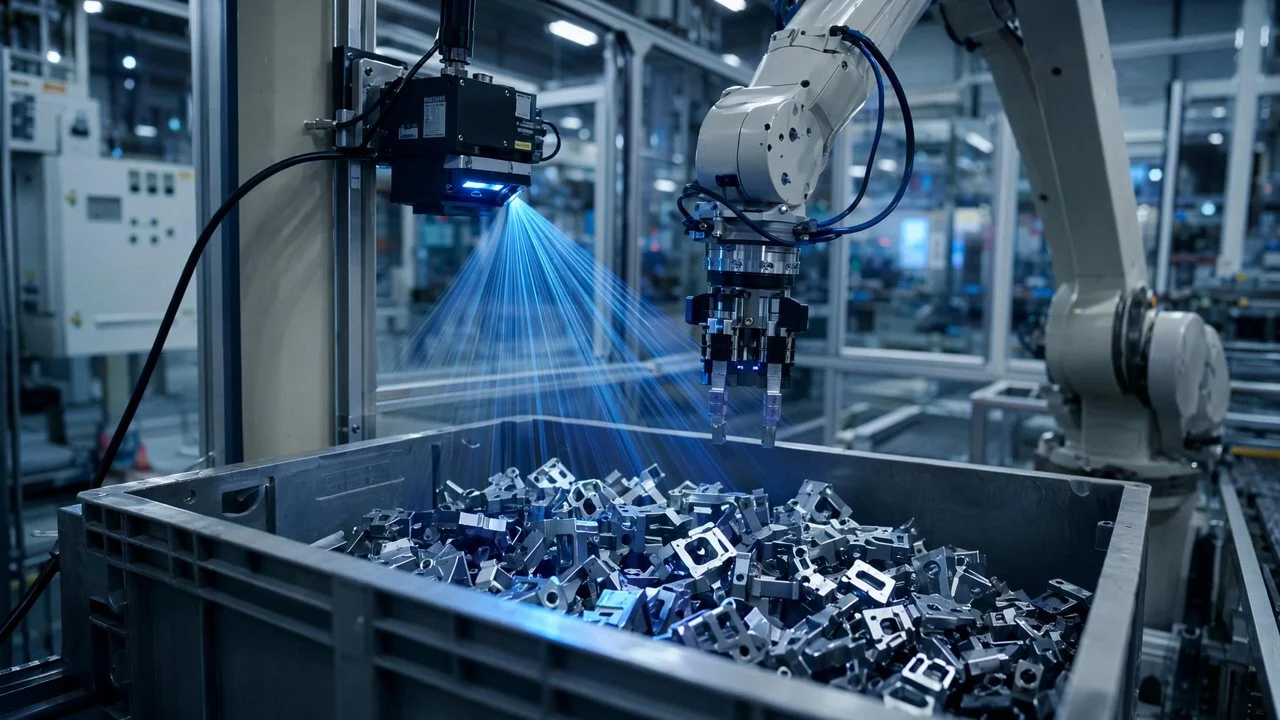
In the field of auto parts production, the requirements for automation and precision are becoming increasingly stringent. WeLinkirt provides an effective solution to the problem of 6D pose recognition for randomly placed parts in bins with its cutting-edge AI vision technology and innovative products.
Against the background of the booming automotive manufacturing industry today, the production scale and complexity of auto parts are constantly increasing. In the production process of auto parts, accurately grabbing specific parts from bins with randomly placed parts for subsequent assembly is a common operation on the assembly lines of many auto parts manufacturers. The assembly line of a leading auto parts manufacturer faces such a demand. Its products cover various auto parts with complex shapes, and the detection object is the 6D pose of these parts in the bins, including position and orientation information. Accurately identifying this information is crucial for achieving automated grabbing and efficient assembly.
Pain Points: Why Is It Difficult?
Traditional grabbing methods have many quantitative difficulties. Firstly, the miss-detection rate is relatively high, about 6%. This is because traditional methods struggle to handle parts with complex shapes and their random placement in bins. When parts are occluded by each other, traditional detection means may not accurately capture the features of the occluded parts, resulting in some parts not being accurately identified and grabbed, which seriously affects production efficiency. Secondly, the false-alarm rate reaches 8%. In the recognition process of traditional technologies, due to the lack of in-depth learning and understanding of part features, it is easy to misjudge some similar objects or background interference as target parts, causing the robotic arm to perform invalid grabbing actions frequently. This not only increases energy consumption but also accelerates equipment wear and raises maintenance costs.
Moreover, the labor cost remains high. Due to the low reliability of traditional grabbing methods, manual intervention is required when grabbing fails. Manual intervention not only increases labor costs but also reduces the degree of automation and efficiency of production. In addition, the long changeover time is also a prominent problem. Every time the part type is changed, traditional methods need about 30 minutes for re-adjustment. This is because traditional adjustment methods require manual parameter setting and calibration according to the new part features, which is a cumbersome and error-prone process.
Technical Principle
WeLinkirt uses advanced AI algorithms and 3D imaging technology to solve this difficult problem. In terms of algorithms, deep learning algorithms are used to train a large amount of part image data. Deep learning algorithms enable the model to learn the features of parts and their performance in different poses. The convolutional neural network (CNN) is used to extract the feature information of images. CNN has a powerful feature extraction ability and can extract various detailed and texture features from images. At the same time, the recurrent neural network (RNN) is combined to process sequential data. RNN can handle data with temporal relationships and better understand the spatial structure and pose relationship of parts. This combination enables the model to more accurately identify the 6D pose of parts, even in complex environments.
In terms of imaging, WeLinkirt's self-developed 3D camera can quickly and accurately obtain the three-dimensional morphology information of parts. The principle is to project a specific pattern onto the part surface through the structured light projection technology, and the camera captures the deformation of the reflected pattern. Using the triangulation principle, based on the pattern deformation and the camera position information, the three-dimensional coordinates of each point on the object surface are calculated, thereby reconstructing the three-dimensional model of the part. This 3D imaging method can clearly present the details and spatial position of parts, providing an accurate data basis for subsequent 6D pose recognition. Compared with traditional 2D imaging technology, 3D imaging can provide more spatial information and is more suitable for handling randomly placed and occluded parts.
Typical Application Scenarios
- Grabbing parts with complex shapes: For some auto parts with complex shapes, such as engine blocks and gearbox housings, it is difficult for traditional methods to accurately identify their poses. WeLinkirt can clearly capture the detailed features of these parts through 3D imaging and AI algorithms, accurately calculate their 6D poses, and guide the robotic arm to perform precise grabbing. The difficulty lies in the large difficulty of feature extraction and recognition of complex-shaped parts, which requires the algorithm to have strong learning and adaptation abilities.
- Grabbing occluded parts: In the bins, parts are often occluded by each other. WeLinkirt uses 3D imaging technology to obtain the three-dimensional information of parts. Even if part of the part is occluded, it can infer the position and pose of the occluded part through the analysis of the un-occluded part and the learning of the model, realizing precise grabbing. The difficulty lies in how to accurately analyze and infer the information of the occluded part and avoid misjudgment.
- Guiding the gluing process: In the gluing process of auto parts, it is necessary to precisely control the gluing position and path. Through 6D pose recognition, WeLinkirt can determine the accurate position and pose of parts, providing precise guidance for the gluing equipment and ensuring the gluing quality. The difficulty lies in that there may be interference factors such as glue splashing and reflection during the gluing process, which affect the accuracy of recognition.
- Guiding the assembly process: In the assembly process of parts, different parts need to be accurately installed in the specified positions. WeLinkirt can real-time identify the 6D pose of parts, guide the robotic arm to accurately assemble the parts to the target position, and improve the assembly efficiency and quality. The difficulty lies in that there may be slight position deviations and pose changes during the assembly process, which requires the algorithm to be able to adjust and correct in real-time.
Implementation Case
A large-scale auto parts manufacturing enterprise faced the problem of randomly placed parts in bins on its multiple assembly lines. The enterprise produces a wide variety of auto parts with complex shapes, and the traditional grabbing method led to low production efficiency and high costs. WeLinkirt provided it with a solution using the DaoAI robotic vision product. During the implementation process, the technical team of WeLinkirt first conducted a detailed investigation and analysis of the enterprise's production environment and parts, and customized the product configuration according to the actual situation. Then, the system was installed and debugged, and the operators were trained to ensure the smooth operation of the system.
The application of WeLinkirt's technology effectively solves the problem of randomly placed parts in bins in auto parts production, significantly improving production efficiency and quality.
Before the implementation, the enterprise's miss-detection rate was about 6%, the false-alarm rate reached 8%, and the changeover time was 30 minutes each time. After the implementation, the miss-detection rate was reduced to <0.6%, greatly improving the part-grabbing success rate; the false-alarm rate was reduced by 63%, reducing the invalid actions of the robotic arm, energy consumption, and equipment wear; the changeover time was shortened from 30 minutes to 5 minutes, improving production flexibility and efficiency.
WeLinkirt's Solution and Product
WeLinkirt uses the DaoAI robotic vision product to solve this scenario problem. This product has the capabilities of 6D pose recognition, bin picking, gluing/assembly guidance, and brain-eye-body closed-loop. In terms of implementation, first, the self-developed 3D camera scans the parts in the bin to obtain their three-dimensional morphology data. Then, the data is transmitted to the DaoAI ACI (AI-AOI) software system. Based on the feature recognition of the visual basic model, this system can quickly and accurately identify the 6D pose of parts. Even with only 1-20 good samples, it can perform efficient learning and recognition through the APDT positive sample/few-shot learning technology. At the same time, the semantic false-alarm filtering function is used to reduce false-alarm situations. Finally, the recognition result is fed back to the robot to guide it to perform precise grabbing.
Quantitative results: Through the application of WeLinkirt's solution, significant results have been achieved. The miss-detection rate has been reduced from 6% to <0.6%, greatly improving the part-grabbing success rate; the false-alarm rate has been reduced by 63%, reducing the invalid actions of the robotic arm, energy consumption, and equipment wear; the changeover time has been shortened from 30 minutes to 5 minutes, improving production flexibility and efficiency.
FAQ
How does WeLinkirt solve the 6D pose recognition problem for randomly placed auto parts in bins?
WeLinkirt uses advanced AI algorithms and 3D imaging technology. It applies deep-learning algorithms to train a large amount of part image data, and combines CNN and RNN to understand the spatial structure and pose relationship of parts. The self-developed 3D camera obtains three-dimensional morphology information through structured light projection and triangulation principle, and high-precision 6D pose recognition is achieved through AI algorithm analysis.
What capabilities does the WeLinkirt DaoAI robotic vision product have?
This product has capabilities such as 6D pose recognition, bin picking, gluing/assembly guidance, and brain-eye-body closed-loop. It can scan parts in the bin to obtain data, identify the pose through the software system, and guide the robot to perform precise grabbing, providing a precise solution for randomly placed auto parts in bins.
What results can be achieved by applying WeLinkirt's solution?
The results are remarkable. The miss-detection rate is reduced from 6% to <0.6%, improving the part-grabbing success rate; the false-alarm rate is reduced by 63%, reducing the invalid actions of the robotic arm, energy consumption, and equipment wear; the changeover time is shortened from 30 minutes to 5 minutes, enhancing production flexibility and efficiency.
Full solution for this scenario: Automotive / parts industry solutions · Random Bin Picking: 6D Pose-Guided Grasping for Featureless Parts
This article was generated by AI. Customer cases are simulated scenarios based on real product capabilities and figures are illustrative; see product pages for official benchmarks.